What is the right order of relative activity in an electrophilic substitution reaction? Briefly explain your answer
A.
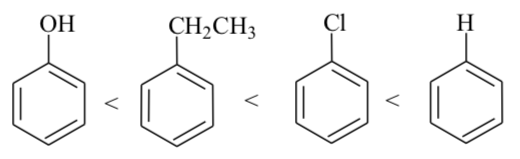
B.
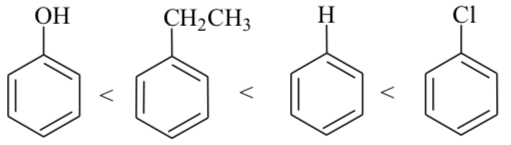
C.
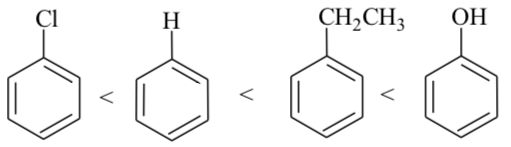
D.
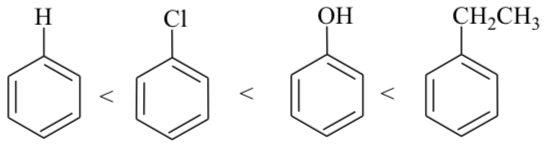
Homework Answers
The order of electrophilic substitution reaction depends upon the ease by which an electrophile attacks and this depends completely on the substituent attached to the benzene ring.
Thus, the substituents that activates the ring (by giving electrons) are the one with fastest electrophilic substitution reaction while those substituents that deactivates the ring (by pulling the electron density towards themselves) show slowest electrophilic substitution reaction.
Out of the given four orders, the correct order of relative activity in electrophilic substitution reaction is that of OPTION- 'C'
This is because:
- OH group in phenol is an activating group as it gives electron by resonance (+R) effect.
- Ethyl group in ethyl benzene is also activating as it gives electron by hyperconjugation or inductive effect (+I)
- Halogens are deactivating groups as they deactivates the ring by (-I) effect, unlike benzene which has no substituent attached to it therefore, benzene comes before chlorobenzene in the reactivity order.
Add Answer to:
What is the right order of relative activity in an electrophilic
substitution reaction? Briefly explain your...
where would the electrophile end up if the following molecule underwent an electrophilic aromatic substitution reaction....
 where would the electrophile end up if the following molecule
underwent an electrophilic aromatic substitution reaction.
QUESTION 9a: Where would the electrophile end up if the following molecule underwent an electrophilic aromatic substitution reaction? Briefly explain your reasoning
where would the electrophile end up if the following molecule
underwent an electrophilic aromatic substitution reaction.
QUESTION 9a: Where would the electrophile end up if the following molecule underwent an electrophilic aromatic substitution reaction? Briefly explain your reasoning
Rank the following compounds in order of increasing reactivity for electrophilic aromatic substitution. Explain your reasoning.
 Rank the following compounds in order of increasing reactivity
for electrophilic aromatic substitution. Explain your
reasoning.
Rank the following compounds in order of increasing reactivity
for electrophilic aromatic substitution. Explain your
reasoning.
organic chemistry 353 2. (4 pts.) Arrange the following in order of increasing electrophilic aromatic substitution...
 organic chemistry 353
2. (4 pts.) Arrange the following in order of increasing electrophilic aromatic substitution reactivity (4 = most reactive): SO3H OH e 3. (4 pts.) Briefly describe why alkenes undergo addition and aromatic compounds undergo substitution. n Briefly describe w 4. (5 pts. Provide an example of an EAS reaction creates an arene that is less reactive than benzene (be specific, include reagents, you do not need to show the mechanism)
organic chemistry 353
2. (4 pts.) Arrange the following in order of increasing electrophilic aromatic substitution reactivity (4 = most reactive): SO3H OH e 3. (4 pts.) Briefly describe why alkenes undergo addition and aromatic compounds undergo substitution. n Briefly describe w 4. (5 pts. Provide an example of an EAS reaction creates an arene that is less reactive than benzene (be specific, include reagents, you do not need to show the mechanism)
h both series below the three aromatic compounds ilhestrated undergo the electrophilic substitution reaction show NHCCHE...
 h both series below the three aromatic compounds ilhestrated undergo the electrophilic substitution reaction show NHCCHE A B Reaction: Bromination Which compound (A, B, C) reacts the fastest? Which compound (A, B, or C) reacts the slowest? O OCH COH A B C Reaction: Chlorination Which compound (A, B, or C) reacts the fastest? Which compound (A, B, or C) reacts the slowest? h both series below the three stomatic compounds ilhestrated undergo the electrophilic substitution reaction shown -C-CH2CH3 OH...
Which compound is the least reactive in the aromatic electrophilic substitution reaction? What product would you...
 Which compound is the least reactive in the aromatic
electrophilic substitution reaction?
What product would you expect from the following reaction?
Answer both, please.
1. Which compound is the least reactive in the aromatic electrophilic substitution reaction? NH . B NH С. SOH Logo D. NO2 E 2. What product would you expect from the following reaction? CO.CH ÇO.CH А ÇOCH B OCH, D CO.CH E
Which compound is the least reactive in the aromatic
electrophilic substitution reaction?
What product would you expect from the following reaction?
Answer both, please.
1. Which compound is the least reactive in the aromatic electrophilic substitution reaction? NH . B NH С. SOH Logo D. NO2 E 2. What product would you expect from the following reaction? CO.CH ÇO.CH А ÇOCH B OCH, D CO.CH E
4. Answer the following questions based on the electrophilic aromatic substitution reaction shown below. door a....
 4. Answer the following questions based on the electrophilic aromatic substitution reaction shown below. door a. (2.5pts) Based on the identity of the substituent on the starting material and its interaction with the aromatic ring, is this substituent an activator or deactivator? Briefly explain your answer and support your answer with structures b. (5.5pts) Draw all of the resonance contributors of the o-complexes that lead to each of the three possible products. c. (0.5p) Based on the structures drawn in...
250 ChemActivity 29 Electrophilic Aromatic Substitution no ChemActivity 29 Part A: Electrophilic Aromatic Substitution (What products...
 250 ChemActivity 29 Electrophilic Aromatic Substitution no ChemActivity 29 Part A: Electrophilic Aromatic Substitution (What products are formed when a strong electrophile is added to benzene?) Model 1: (review) Electrophilic Addition of HCI Rani o g cyclohexene carbocation intermediate Run 2 U X benzene This product carbocation intermediate DOES NOT Critical Thinking Questions 1 For Rxn I (above) draw curved arrows showing the mechanism of electrophilic addition of HCl. Include an appropriate carbocation intermediate in the box above. Figure 1:...
Draw the least stable resonance form for the intermediate in the following electrophilic substitution reaction. NO2...
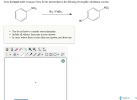 Draw the least stable resonance form for the intermediate in the following electrophilic substitution reaction. NO2 NO2 Brz/ FeBrz Br . You do not have to consider stereochemistry. Include all valence lone pairs in your answer. • In cases where there is more than one answer, just draw one. . с ору P aste [] Previous NE Draw the most stable resonance form for the intermediate in the following electrophilic substitution reaction. OH OH CH3 CH3 CH2 H3PO4 CH3 H3C...
Provide a complete mechanism for the above Electrophilic Aromatic Substitution Reaction. Pay close attention to details,...
 Provide a complete mechanism for the above Electrophilic Aromatic Substitution Reaction. Pay close attention to details, including lone pairs, formal charges and the use of curved arrows. B) Why is toluene an ortho/para director? Explain, using drawings to support your answer.
Which benzene derivative would be the most reactive in an electrophilic aromatic substitution reaction? )A OB...
 Which benzene derivative would be the most reactive in an electrophilic aromatic substitution reaction? )A OB ON BT D Which is the most stable radical? O A. B. C. D.
 where would the electrophile end up if the following molecule
underwent an electrophilic aromatic substitution reaction.
QUESTION 9a: Where would the electrophile end up if the following molecule underwent an electrophilic aromatic substitution reaction? Briefly explain your reasoning
where would the electrophile end up if the following molecule
underwent an electrophilic aromatic substitution reaction.
QUESTION 9a: Where would the electrophile end up if the following molecule underwent an electrophilic aromatic substitution reaction? Briefly explain your reasoning
 Rank the following compounds in order of increasing reactivity
for electrophilic aromatic substitution. Explain your
reasoning.
Rank the following compounds in order of increasing reactivity
for electrophilic aromatic substitution. Explain your
reasoning.
 organic chemistry 353
2. (4 pts.) Arrange the following in order of increasing electrophilic aromatic substitution reactivity (4 = most reactive): SO3H OH e 3. (4 pts.) Briefly describe why alkenes undergo addition and aromatic compounds undergo substitution. n Briefly describe w 4. (5 pts. Provide an example of an EAS reaction creates an arene that is less reactive than benzene (be specific, include reagents, you do not need to show the mechanism)
organic chemistry 353
2. (4 pts.) Arrange the following in order of increasing electrophilic aromatic substitution reactivity (4 = most reactive): SO3H OH e 3. (4 pts.) Briefly describe why alkenes undergo addition and aromatic compounds undergo substitution. n Briefly describe w 4. (5 pts. Provide an example of an EAS reaction creates an arene that is less reactive than benzene (be specific, include reagents, you do not need to show the mechanism)
 h both series below the three aromatic compounds ilhestrated undergo the electrophilic substitution reaction show NHCCHE A B Reaction: Bromination Which compound (A, B, C) reacts the fastest? Which compound (A, B, or C) reacts the slowest? O OCH COH A B C Reaction: Chlorination Which compound (A, B, or C) reacts the fastest? Which compound (A, B, or C) reacts the slowest? h both series below the three stomatic compounds ilhestrated undergo the electrophilic substitution reaction shown -C-CH2CH3 OH...
 Which compound is the least reactive in the aromatic
electrophilic substitution reaction?
What product would you expect from the following reaction?
Answer both, please.
1. Which compound is the least reactive in the aromatic electrophilic substitution reaction? NH . B NH С. SOH Logo D. NO2 E 2. What product would you expect from the following reaction? CO.CH ÇO.CH А ÇOCH B OCH, D CO.CH E
Which compound is the least reactive in the aromatic
electrophilic substitution reaction?
What product would you expect from the following reaction?
Answer both, please.
1. Which compound is the least reactive in the aromatic electrophilic substitution reaction? NH . B NH С. SOH Logo D. NO2 E 2. What product would you expect from the following reaction? CO.CH ÇO.CH А ÇOCH B OCH, D CO.CH E
 4. Answer the following questions based on the electrophilic aromatic substitution reaction shown below. door a. (2.5pts) Based on the identity of the substituent on the starting material and its interaction with the aromatic ring, is this substituent an activator or deactivator? Briefly explain your answer and support your answer with structures b. (5.5pts) Draw all of the resonance contributors of the o-complexes that lead to each of the three possible products. c. (0.5p) Based on the structures drawn in...
 250 ChemActivity 29 Electrophilic Aromatic Substitution no ChemActivity 29 Part A: Electrophilic Aromatic Substitution (What products are formed when a strong electrophile is added to benzene?) Model 1: (review) Electrophilic Addition of HCI Rani o g cyclohexene carbocation intermediate Run 2 U X benzene This product carbocation intermediate DOES NOT Critical Thinking Questions 1 For Rxn I (above) draw curved arrows showing the mechanism of electrophilic addition of HCl. Include an appropriate carbocation intermediate in the box above. Figure 1:...
 Draw the least stable resonance form for the intermediate in the following electrophilic substitution reaction. NO2 NO2 Brz/ FeBrz Br . You do not have to consider stereochemistry. Include all valence lone pairs in your answer. • In cases where there is more than one answer, just draw one. . с ору P aste [] Previous NE Draw the most stable resonance form for the intermediate in the following electrophilic substitution reaction. OH OH CH3 CH3 CH2 H3PO4 CH3 H3C...
 Provide a complete mechanism for the above Electrophilic Aromatic Substitution Reaction. Pay close attention to details, including lone pairs, formal charges and the use of curved arrows. B) Why is toluene an ortho/para director? Explain, using drawings to support your answer.
 Which benzene derivative would be the most reactive in an electrophilic aromatic substitution reaction? )A OB ON BT D Which is the most stable radical? O A. B. C. D.
Most questions answered within 3 hours.
-
Where is the error in this code sequence?
String s1 = "Hello";
String s2 = "ello";...
asked 11 months ago -
Financial data for Joel de Paris, Inc., for last year
follow:
Joel de Paris, Inc.
Balance...
asked 11 months ago -
Consider this reaction:
Al2(SO4)3 (aq)+ BaCl3
(aq) Al2Cl6 (aq)- +
3BaSO4(s) . What is the...
asked 11 months ago -
Suppose that Savneet is considering increasing her
recent random sample from 20 car rentals to 40...
asked 11 months ago -
Trucks arrive at an unloading terminal at an average rate of 120
per hour.
Trucks arrive...
asked 11 months ago -
Why are methanol and ethanol completely soluble in water while
octanol is not very little soluble....
asked 11 months ago -
A facilities manager at a university reads in a research report
that the mean amount of...
asked 11 months ago -
When the CuSO4 is rehydrated by adding water to the anhydrous
compound, is this an endothermic...
asked 11 months ago -
A ray of sunlight is passing from diamond into crown glass; the
angle of incidence is...
asked 11 months ago -
A block of mass 0.249 kg is placed on top of a light, vertical
spring of...
asked 11 months ago -
how do the kidneys compensate in the presences of acidosis
a) trigger hyperventilate
b) reserve acid...
asked 11 months ago -
Question 501 pts
The rental rate of capital to the firm increases. Which of the
following...
asked 11 months ago