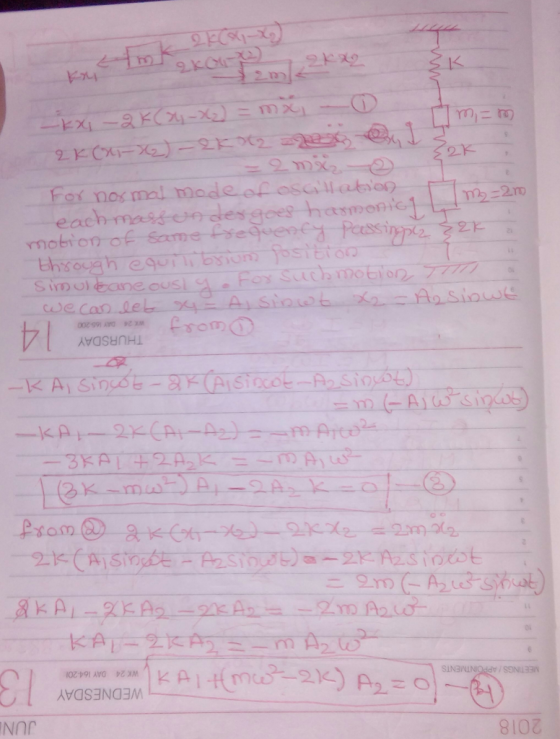
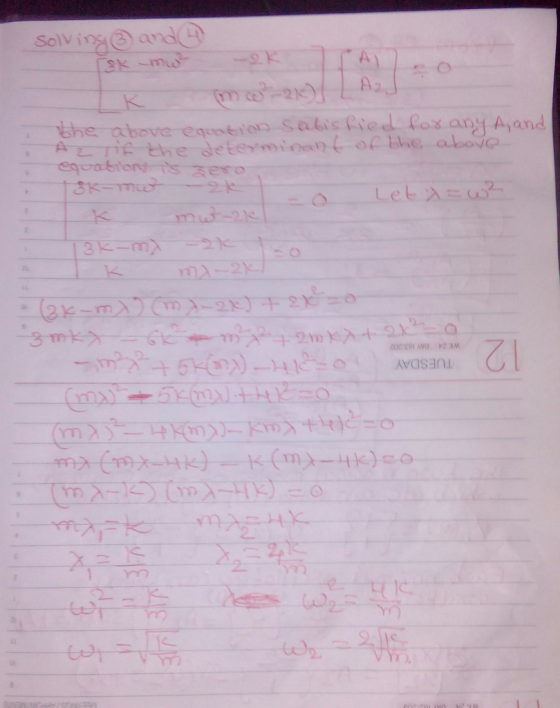
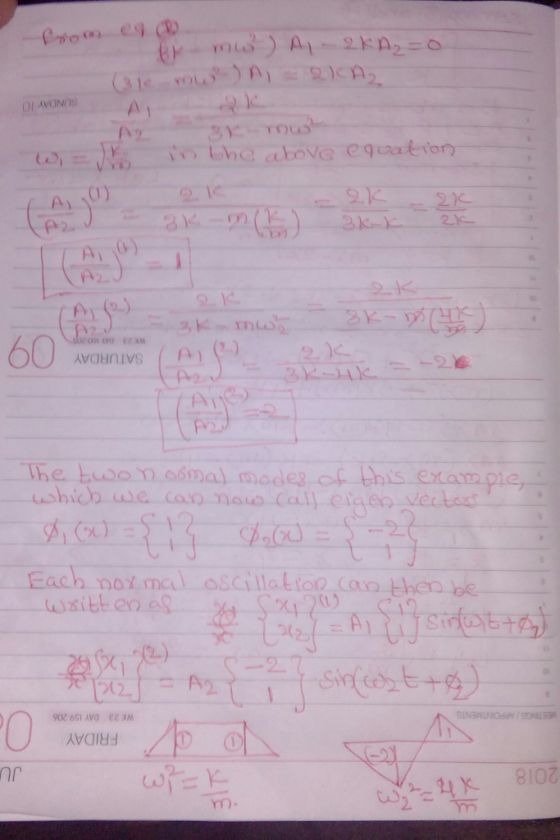
 how to solve this problem?(not
use energy methods)
how to solve this problem?(not
use energy methods)
Homework Answers
Add Answer to:
how to solve this problem?(not
use energy methods)
1. Determine the two natural frequencies and mode...
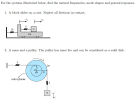
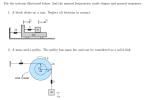
PLEASE SOLVE JUST QUESTION 1. THANKS For the systems illustrated below, find the natural frequencies, mode...
 PLEASE SOLVE JUST QUESTION 1. THANKS
For the systems illustrated below, find the natural frequencies, mode shapes and general responses. 1. A block slides on a cart. Neglect all frictions in contact. X2 2k 2m 2. A mass and a pulley. The pulley has mass 2m and can be considered as a solid disk. 2m 2r solid cylinder
PLEASE SOLVE JUST QUESTION 1. THANKS
For the systems illustrated below, find the natural frequencies, mode shapes and general responses. 1. A block slides on a cart. Neglect all frictions in contact. X2 2k 2m 2. A mass and a pulley. The pulley has mass 2m and can be considered as a solid disk. 2m 2r solid cylinder
1. Consider the two degree of freedom system shown. (a) Find the natural frequencies for the system (b) Determine the modal fraction for each mode. (c) Draw the mode shapes for each mode and iden...
 1. Consider the two degree of freedom system shown. (a) Find the natural frequencies for the system (b) Determine the modal fraction for each mode. (c) Draw the mode shapes for each mode and identify any nodes for each mode. (d) Demonstrate mode shape orthogonality. (e) If F- and the motion is initiated by giving the mass whose displacement is a velocity of 0.2 m/s when in equilibrium, determine 0) and ,0 (f) Determine the steady-state solution for both *)...
Problem: Find the natural frequencies of the system shown in Figure. Take m 2 kg ma 2.5 kg ms 3.0...
 Problem: Find the natural frequencies of the system shown in Figure. Take m 2 kg ma 2.5 kg ms 3.0 kg me = 1.5 kg 914 Given: Four degree of freedom spring-mass system with given masses an stiffnesses. Find: Natural frequencies and mode shapes. Approach: Find the eigenvalues and eigenvectors of the dynamical matrix. 1. Determine [m] and [k] matrices of the vibrating system with all details 2. Determine [DI matrix. 3. Determine Natural frequencies and mode shapes analytically 3....
2. For the system shown, calculate the undamped natural frequencies and mode shapes. Assume m 4...
 2. For the system shown, calculate the undamped natural frequencies and mode shapes. Assume m 4 kg, m5 kg, ki-200 N/m, and k:-500 N/m. Note that c, c, and (o) are not used in this problem. 0o m2
only need part 2 For the systems llustrated below, find the natural frequencies, mode shapes and...
 only need part 2
For the systems llustrated below, find the natural frequencies, mode shapes and general responses 1. A block slides on a cart. Neglect all frictions in contact 2R 1 2m 2. A mass and a pulley. The pulley has mass 2m and can be considered as a solid disk 27m solid cylinder 2
only need part 2
For the systems llustrated below, find the natural frequencies, mode shapes and general responses 1. A block slides on a cart. Neglect all frictions in contact 2R 1 2m 2. A mass and a pulley. The pulley has mass 2m and can be considered as a solid disk 27m solid cylinder 2
ww Ww Assignment Problem 1 Determine the natural frequencies and relative amplitudes of the following spring-mass...
 ww Ww Assignment Problem 1 Determine the natural frequencies and relative amplitudes of the following spring-mass systems with two degrees of freedom. (To be submited in the next class session) Show all the work- should include the following: ki FBD's of the two masses Equation of motion of each mass using equation of dynamic equilibrium Derivation of amplitude ratios (Modes of vibration) Derivation of frequency equation ili. iv. ki XPII
ww Ww Assignment Problem 1 Determine the natural frequencies and...
ww Ww Assignment Problem 1 Determine the natural frequencies and relative amplitudes of the following spring-mass systems with two degrees of freedom. (To be submited in the next class session) Show all the work- should include the following: ki FBD's of the two masses Equation of motion of each mass using equation of dynamic equilibrium Derivation of amplitude ratios (Modes of vibration) Derivation of frequency equation ili. iv. ki XPII
ww Ww Assignment Problem 1 Determine the natural frequencies and...
Q4. For the systern shown in Figure 4 where m=10 kg, k = 100 kN/m, the governing equations has been derived as (1) Find...
 Q4. For the systern shown in Figure 4 where m=10 kg, k = 100 kN/m, the governing equations has been derived as (1) Find the natural frequencies of the system; (2) Determine the associated mode shapes; and (3) Obtain the vibration response if the initial conditions are given as x (0) 0, x, (0) 0.001 m 2k E 2m Figure 4
Q4. For the systern shown in Figure 4 where m=10 kg, k = 100 kN/m, the governing equations has...
Q4. For the systern shown in Figure 4 where m=10 kg, k = 100 kN/m, the governing equations has been derived as (1) Find the natural frequencies of the system; (2) Determine the associated mode shapes; and (3) Obtain the vibration response if the initial conditions are given as x (0) 0, x, (0) 0.001 m 2k E 2m Figure 4
Q4. For the systern shown in Figure 4 where m=10 kg, k = 100 kN/m, the governing equations has...
Problem 5 (20%) For the system shown in Figure 5, a. How many degrees of freedom is this system and why? (5) b. If x3 0...
 Problem 5 (20%) For the system shown in Figure 5, a. How many degrees of freedom is this system and why? (5) b. If x3 0 (the upper end is fixed and K1 and K2=K Write the equations of motion. Set the necessary matrix to find the natural frequencies and mode shapes (5) (5) (5) 1. 2. 3. Determine and explain how to get the natural frequencies. m2 Figure 5 www
Problem 5 (20%) For the system shown in Figure...
Problem 5 (20%) For the system shown in Figure 5, a. How many degrees of freedom is this system and why? (5) b. If x3 0 (the upper end is fixed and K1 and K2=K Write the equations of motion. Set the necessary matrix to find the natural frequencies and mode shapes (5) (5) (5) 1. 2. 3. Determine and explain how to get the natural frequencies. m2 Figure 5 www
Problem 5 (20%) For the system shown in Figure...
For the given part, use ANSYS Work Bench to determine the fundamental frequencies and the associated...
 For the given part, use ANSYS Work Bench to determine the fundamental frequencies and the associated mode shapes if one of the two edges is fixed: 8000 125 4250 8.000 500 5000 0.125 Note: All dimensions are in inches.
For the given part, use ANSYS Work Bench to determine the fundamental frequencies and the associated mode shapes if one of the two edges is fixed: 8000 125 4250 8.000 500 5000 0.125 Note: All dimensions are in inches.
For the given part, use ANSYS Work Bench to determine the fundamental frequencies and the associated mode shapes if one of the two edges is fixed: 8000 125 4250 8.000 500 5000 0.125 Note: All dimensions are in inches.
Problem 2. Eigenvalue and Eigenvector Consider the mass-spring system in Fig. P13.5. The frequencies for the...
 Problem 2. Eigenvalue and Eigenvector Consider the mass-spring system in Fig. P13.5. The frequencies for the mass vibrations can be determined by solving for the eigenvalues and by applying Mi + kx = 0, which yields m 0 07/31 (2k -k -k X1 (0 0 m2 0 {2}+{-k 2k -kX{X2} = {0} LO 0 m3] 1 iz) 1-k -k 2kJ (x3) lo Applying the guess x = xoeiat as a solution, we get the fol- lowing matrix: 52k - m102...
 PLEASE SOLVE JUST QUESTION 1. THANKS
For the systems illustrated below, find the natural frequencies, mode shapes and general responses. 1. A block slides on a cart. Neglect all frictions in contact. X2 2k 2m 2. A mass and a pulley. The pulley has mass 2m and can be considered as a solid disk. 2m 2r solid cylinder
PLEASE SOLVE JUST QUESTION 1. THANKS
For the systems illustrated below, find the natural frequencies, mode shapes and general responses. 1. A block slides on a cart. Neglect all frictions in contact. X2 2k 2m 2. A mass and a pulley. The pulley has mass 2m and can be considered as a solid disk. 2m 2r solid cylinder
 1. Consider the two degree of freedom system shown. (a) Find the natural frequencies for the system (b) Determine the modal fraction for each mode. (c) Draw the mode shapes for each mode and identify any nodes for each mode. (d) Demonstrate mode shape orthogonality. (e) If F- and the motion is initiated by giving the mass whose displacement is a velocity of 0.2 m/s when in equilibrium, determine 0) and ,0 (f) Determine the steady-state solution for both *)...
 Problem: Find the natural frequencies of the system shown in Figure. Take m 2 kg ma 2.5 kg ms 3.0 kg me = 1.5 kg 914 Given: Four degree of freedom spring-mass system with given masses an stiffnesses. Find: Natural frequencies and mode shapes. Approach: Find the eigenvalues and eigenvectors of the dynamical matrix. 1. Determine [m] and [k] matrices of the vibrating system with all details 2. Determine [DI matrix. 3. Determine Natural frequencies and mode shapes analytically 3....
 2. For the system shown, calculate the undamped natural frequencies and mode shapes. Assume m 4 kg, m5 kg, ki-200 N/m, and k:-500 N/m. Note that c, c, and (o) are not used in this problem. 0o m2
 only need part 2
For the systems llustrated below, find the natural frequencies, mode shapes and general responses 1. A block slides on a cart. Neglect all frictions in contact 2R 1 2m 2. A mass and a pulley. The pulley has mass 2m and can be considered as a solid disk 27m solid cylinder 2
only need part 2
For the systems llustrated below, find the natural frequencies, mode shapes and general responses 1. A block slides on a cart. Neglect all frictions in contact 2R 1 2m 2. A mass and a pulley. The pulley has mass 2m and can be considered as a solid disk 27m solid cylinder 2
 ww Ww Assignment Problem 1 Determine the natural frequencies and relative amplitudes of the following spring-mass systems with two degrees of freedom. (To be submited in the next class session) Show all the work- should include the following: ki FBD's of the two masses Equation of motion of each mass using equation of dynamic equilibrium Derivation of amplitude ratios (Modes of vibration) Derivation of frequency equation ili. iv. ki XPII
ww Ww Assignment Problem 1 Determine the natural frequencies and...
ww Ww Assignment Problem 1 Determine the natural frequencies and relative amplitudes of the following spring-mass systems with two degrees of freedom. (To be submited in the next class session) Show all the work- should include the following: ki FBD's of the two masses Equation of motion of each mass using equation of dynamic equilibrium Derivation of amplitude ratios (Modes of vibration) Derivation of frequency equation ili. iv. ki XPII
ww Ww Assignment Problem 1 Determine the natural frequencies and...
 Q4. For the systern shown in Figure 4 where m=10 kg, k = 100 kN/m, the governing equations has been derived as (1) Find the natural frequencies of the system; (2) Determine the associated mode shapes; and (3) Obtain the vibration response if the initial conditions are given as x (0) 0, x, (0) 0.001 m 2k E 2m Figure 4
Q4. For the systern shown in Figure 4 where m=10 kg, k = 100 kN/m, the governing equations has...
Q4. For the systern shown in Figure 4 where m=10 kg, k = 100 kN/m, the governing equations has been derived as (1) Find the natural frequencies of the system; (2) Determine the associated mode shapes; and (3) Obtain the vibration response if the initial conditions are given as x (0) 0, x, (0) 0.001 m 2k E 2m Figure 4
Q4. For the systern shown in Figure 4 where m=10 kg, k = 100 kN/m, the governing equations has...
 Problem 5 (20%) For the system shown in Figure 5, a. How many degrees of freedom is this system and why? (5) b. If x3 0 (the upper end is fixed and K1 and K2=K Write the equations of motion. Set the necessary matrix to find the natural frequencies and mode shapes (5) (5) (5) 1. 2. 3. Determine and explain how to get the natural frequencies. m2 Figure 5 www
Problem 5 (20%) For the system shown in Figure...
Problem 5 (20%) For the system shown in Figure 5, a. How many degrees of freedom is this system and why? (5) b. If x3 0 (the upper end is fixed and K1 and K2=K Write the equations of motion. Set the necessary matrix to find the natural frequencies and mode shapes (5) (5) (5) 1. 2. 3. Determine and explain how to get the natural frequencies. m2 Figure 5 www
Problem 5 (20%) For the system shown in Figure...
 For the given part, use ANSYS Work Bench to determine the fundamental frequencies and the associated mode shapes if one of the two edges is fixed: 8000 125 4250 8.000 500 5000 0.125 Note: All dimensions are in inches.
For the given part, use ANSYS Work Bench to determine the fundamental frequencies and the associated mode shapes if one of the two edges is fixed: 8000 125 4250 8.000 500 5000 0.125 Note: All dimensions are in inches.
For the given part, use ANSYS Work Bench to determine the fundamental frequencies and the associated mode shapes if one of the two edges is fixed: 8000 125 4250 8.000 500 5000 0.125 Note: All dimensions are in inches.
 Problem 2. Eigenvalue and Eigenvector Consider the mass-spring system in Fig. P13.5. The frequencies for the mass vibrations can be determined by solving for the eigenvalues and by applying Mi + kx = 0, which yields m 0 07/31 (2k -k -k X1 (0 0 m2 0 {2}+{-k 2k -kX{X2} = {0} LO 0 m3] 1 iz) 1-k -k 2kJ (x3) lo Applying the guess x = xoeiat as a solution, we get the fol- lowing matrix: 52k - m102...
Most questions answered within 3 hours.
-
Where is the error in this code sequence?
String s1 = "Hello";
String s2 = "ello";...
asked 10 months ago -
Financial data for Joel de Paris, Inc., for last year
follow:
Joel de Paris, Inc.
Balance...
asked 10 months ago -
Consider this reaction:
Al2(SO4)3 (aq)+ BaCl3
(aq) Al2Cl6 (aq)- +
3BaSO4(s) . What is the...
asked 10 months ago -
Suppose that Savneet is considering increasing her
recent random sample from 20 car rentals to 40...
asked 10 months ago -
Trucks arrive at an unloading terminal at an average rate of 120
per hour.
Trucks arrive...
asked 10 months ago -
Why are methanol and ethanol completely soluble in water while
octanol is not very little soluble....
asked 10 months ago -
A facilities manager at a university reads in a research report
that the mean amount of...
asked 10 months ago -
When the CuSO4 is rehydrated by adding water to the anhydrous
compound, is this an endothermic...
asked 10 months ago -
A ray of sunlight is passing from diamond into crown glass; the
angle of incidence is...
asked 10 months ago -
A block of mass 0.249 kg is placed on top of a light, vertical
spring of...
asked 10 months ago -
how do the kidneys compensate in the presences of acidosis
a) trigger hyperventilate
b) reserve acid...
asked 10 months ago -
Question 501 pts
The rental rate of capital to the firm increases. Which of the
following...
asked 10 months ago