Disease occurrence can be measured as prevalence or incidence. Which measure is better suited for the...
Disease occurrence can be measured as prevalence or incidence. Which measure is better suited for the evaluation of preventive programs? A) cumulative incidence B) prevalence C) A and C D) incidence rate E) A and B
Homework Answers
Answer
D) Incidence rate
Explanation :Incidence rate is more useful in measuring effect of preventive programs.
prevalence is a composite measure of the incidence rate and the mean disease duration. Prevention should decrease new occurrence of disease, which should result in decrease in the incidence rate. This does not necessarily result in prevalence as soon as incidence, as a large pool of people who already have the disease of interest can keep existing.
Add Answer to:
Disease occurrence can be measured as prevalence or incidence.
Which measure is better suited for the...
Which of the following statements regarding disease measures is not true? A. Incidence density is a...
Which of the following statements regarding disease measures is not true? A. Incidence density is a proportion, not a rate B. Prevalence is a proportion C. Prevalence equals duration times incidence D. Cumulative incidence is a proportion, not a rate
Which factors can decrease an observed prevalence of a disease? [Choose the ONE best answer): A....
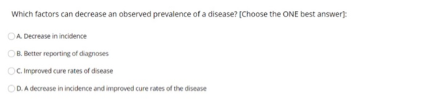 Which factors can decrease an observed prevalence of a disease? [Choose the ONE best answer): A. Decrease in incidence B. Better reporting of diagnoses C. Improved cure rates of disease D. A decrease in incidence and improved cure rates of the disease
One of the following is an example of a relative measure of disease frequency in epidemiological...
One of the following is an example of a relative measure of disease frequency in epidemiological studies: A. Cumulative incidence B. Incidence rate ratio C. Prevalence difference D. Population attributable risk
Define incidence and prevalence of disease. Name a microbial disease for which the numerical values of...
Define incidence and prevalence of disease. Name a microbial disease for which the numerical values of annual incidence and annual prevalence are likely similar and name another microbial disease for which the numerical values of annual incidence and annual prevalence are likely quite different; explain why this is the case for both diseases.
1. Cross-sectional study can not measure Incidence risk Prevalence Seroprevalence 2. Which study yo...
1. Cross-sectional study can not measure Incidence risk Prevalence Seroprevalence 2. Which study you generally conduct if you are interested in studying the risk factors of diabetes in a population in an ethically and scientifically convincing way? Case-Control Cross-sectional study Experimental study Cohort study 3. Prevalence of disease in exposed is not different than the prevalence of exposure among diseased False True 4. Sero-prevalence study is also called Cross-sectional study Cohort study Experimental study Case reports 5. Which one of...
9. The following table describes trends in prevalence and incidence of chronic invariably fatal disease from...
 9. The following table describes trends in prevalence and incidence of chronic invariably fatal disease from 2093 to 2013, Which of the following describes the above trends? a. The case fatality rate from Disease Z is increasing b. The duration of Disease Z is becoming shorter c. The duration of Disease Z is becoming longer d. Both A and B may be correct e. None of the above Prevalence and Incidence of Rates of Disease Z Among U.S. Adults 25-44...
Prevalence-incidence bias occurs: a The exposure is associated with a decrease in both the incidence and...
Prevalence-incidence bias occurs: a The exposure is associated with a decrease in both the incidence and prevalence of disease b Most commonly in cross-sectional studies c The outcome has an influence on the duration of disease d The disease has long duration (this is wrong, dont choose it)
Incidence and prevalence rates can also be used to compare the rates of disease across different...
Incidence and prevalence rates can also be used to compare the rates of disease across different settings (places), people, or time. We therefore need measures of comparison. The ratio of two measures of disease frequency is called the relative risk. The difference between two measures of disease frequency is called the risk difference, or rate difference. In some cases, it involves a measure in an exposed group (or groups) and a measure in an unexposed or comparison group. In other...
1. Disease X has a steady incidence rate over five years but all of a sudden...
 1. Disease X has a steady incidence rate over five years but all of a sudden has a sharp decrease in mortality rate. What would be the impact on the prevalence rate? A. Increase B. Decrease C. Stay the same 2. A public health researcher is interested in the number of new strep throat cases diagnosed in Lexington in the last three months. Which of the following terms best describes the number she will report? A. Population at Risk B....
Match the following examples to their corresponding type of measure - A....
Match the following examples to their corresponding type of measure - A. B. C. D. E. F. Number of persons ill per total number in the group at a time point - A. B. C. D. E. F. Number of persons ill per average population during a time period ...
 Which factors can decrease an observed prevalence of a disease? [Choose the ONE best answer): A. Decrease in incidence B. Better reporting of diagnoses C. Improved cure rates of disease D. A decrease in incidence and improved cure rates of the disease
 9. The following table describes trends in prevalence and incidence of chronic invariably fatal disease from 2093 to 2013, Which of the following describes the above trends? a. The case fatality rate from Disease Z is increasing b. The duration of Disease Z is becoming shorter c. The duration of Disease Z is becoming longer d. Both A and B may be correct e. None of the above Prevalence and Incidence of Rates of Disease Z Among U.S. Adults 25-44...
 1. Disease X has a steady incidence rate over five years but all of a sudden has a sharp decrease in mortality rate. What would be the impact on the prevalence rate? A. Increase B. Decrease C. Stay the same 2. A public health researcher is interested in the number of new strep throat cases diagnosed in Lexington in the last three months. Which of the following terms best describes the number she will report? A. Population at Risk B....
Most questions answered within 3 hours.
-
Where is the error in this code sequence?
String s1 = "Hello";
String s2 = "ello";...
asked 10 months ago -
Financial data for Joel de Paris, Inc., for last year
follow:
Joel de Paris, Inc.
Balance...
asked 10 months ago -
Consider this reaction:
Al2(SO4)3 (aq)+ BaCl3
(aq) Al2Cl6 (aq)- +
3BaSO4(s) . What is the...
asked 10 months ago -
Suppose that Savneet is considering increasing her
recent random sample from 20 car rentals to 40...
asked 10 months ago -
Trucks arrive at an unloading terminal at an average rate of 120
per hour.
Trucks arrive...
asked 10 months ago -
Why are methanol and ethanol completely soluble in water while
octanol is not very little soluble....
asked 10 months ago -
A facilities manager at a university reads in a research report
that the mean amount of...
asked 10 months ago -
When the CuSO4 is rehydrated by adding water to the anhydrous
compound, is this an endothermic...
asked 10 months ago -
A ray of sunlight is passing from diamond into crown glass; the
angle of incidence is...
asked 10 months ago -
A block of mass 0.249 kg is placed on top of a light, vertical
spring of...
asked 10 months ago -
how do the kidneys compensate in the presences of acidosis
a) trigger hyperventilate
b) reserve acid...
asked 10 months ago -
Question 501 pts
The rental rate of capital to the firm increases. Which of the
following...
asked 10 months ago