
Homework Answers
![fts Maxwells equations in Jvee spare ave give b @ ▽XE=-20-1Faradys lan] 0 (Gauss lau) . E-o Ot deesnt ezist) 米For Electric](http://img.homeworklib.com/questions/94d1f5b0-bad9-11ea-9958-dbf597b56540.png?x-oss-process=image/resize,w_560)
Add Answer to:
9. (a)Using the Maxwell's equations prove that the wave equations for the electric and magnetic fields...
Use Maxwell's Equations to derive a decoupled set of wave equations for electric and magnetic fields...
Use Maxwell's Equations to derive a decoupled set of wave equations for electric and magnetic fields in a linear, homogeneous, isotropic media characterized by (µ, ε, σ) in the absence of sources. Then modify these equations to describe waves propagating in free space. Show all work, please
Consider an electromagnetic wave traveling through empty space described by the electric and magnetic fields given....
 Consider an electromagnetic wave traveling through empty space
described by the electric and magnetic fields given. In which
direction is this wave traveling? Find the magnitude (in terms of
alpha) and the direction of the constant vector G. What is the
wavelength and frequency of this wave?
Consider an electromagnetic wave travelling through empty space described by the electric and magnetic fields where ? and L are positive constants and G is a constant vector. (a) [1 pt] In which...
Consider an electromagnetic wave traveling through empty space
described by the electric and magnetic fields given. In which
direction is this wave traveling? Find the magnitude (in terms of
alpha) and the direction of the constant vector G. What is the
wavelength and frequency of this wave?
Consider an electromagnetic wave travelling through empty space described by the electric and magnetic fields where ? and L are positive constants and G is a constant vector. (a) [1 pt] In which...
For an electromagnetic wave, A. the electric and magnetic fields are perpendicular to each other and...
 For an electromagnetic wave, A. the electric and magnetic fields are perpendicular to each other and to the direction of propagation B. the ratio of the electric and magnetic fields strengths is proportional to the speed of propagation C. the ratio of the electric and magnetic fields strengths is always less than the speed of propagation. D. the electric and magnetic fields are parallel to each other and to the direction of propagation. E. A & B F. C&D 10....
Given the electric field phasor E-E) ρ-le-jkza, in cylindrical coordinates, where 1.4 , show that it represents an electromagnetic wave propagating in free space by using (a) Maxwell's equati...
 Given the electric field phasor E-E) ρ-le-jkza, in cylindrical coordinates, where 1.4 , show that it represents an electromagnetic wave propagating in free space by using (a) Maxwell's equations, and (b) Helmholtz equation. (c) Find the magnetic field phasor H. 88 8-9 Given the electric field phasor E -(E.a, +jE a)e n free space, determine (a) propagation direction, (b) H, (c) & and (d) polarization state. 1th yeaeo circularly polarized waves.
Given the electric field phasor E-E) ρ-le-jkza, in cylindrical...
Given the electric field phasor E-E) ρ-le-jkza, in cylindrical coordinates, where 1.4 , show that it represents an electromagnetic wave propagating in free space by using (a) Maxwell's equations, and (b) Helmholtz equation. (c) Find the magnetic field phasor H. 88 8-9 Given the electric field phasor E -(E.a, +jE a)e n free space, determine (a) propagation direction, (b) H, (c) & and (d) polarization state. 1th yeaeo circularly polarized waves.
Given the electric field phasor E-E) ρ-le-jkza, in cylindrical...
5. What are the equations for magnetic and electric fields for an electromagnetic wave having a...
5. What are the equations for magnetic and electric fields for an electromagnetic wave having a frequency of 2 X 10^11 hz if the wave is in a vaccum and E max is 30V/m?
2. [8-pts] Once you've rewritten Maxwell's equations for a vacuum, recall that those equations lead directly...
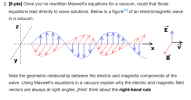 2. [8-pts] Once you've rewritten Maxwell's equations for a vacuum, recall that those equations lead directly to wave solutions. Below is a figurel1 of an electromagnetic wave in a vacuum. Note the geometric relationship between the electric and magnetic components of the wave. Using Maxwell's equations in a vacuum explain why the electric and magnetic field vectors are always at right angles. [Hint: think about the right-hand rule
We use the last two Maxwell's Equations to derive the following two partial differential equations Use...
 We use the last two Maxwell's Equations to derive the following two partial differential equations Use the above equations and the traveling wave equations for electric and magnetic field (E-Em Sin (Kx-ut) and B = B-Sin (Kx-ut) To prove speed of light formula C-1???.
Write equations for both the electric and magnetic fields for an electromagnetic wave in the red...
Write equations for both the electric and magnetic fields for an electromagnetic wave in the red part of the visible spectrum that has a wavelength of 718 nm and a peak electric field magnitude of 3.6 V/m. (Use the following as necessary: t and x. Assume that E is in volts per meter, B is in teslas, t is in seconds, and x is in meters. Do not include units in your answer. Assume that E = 0 and B...
Write equations for both the electric and magnetic fields for an electromagnetic wave in the red...
 Write equations for both the electric and magnetic fields for an electromagnetic wave in the red part of the visible spectrum that has a wavelength of 697 nm and a peak electric field magnitude of 2.4 V/m. (Use the following as necessary: t and X. Assume that E is in volts per meter, B is in teslas, t is in seconds, and x is in meters. Do not include units in your answer. Assume that E = and B =...
Problem 3 Consider a possible solution to Maxwell's equations in vacuum given by A(x, t) =...
 Problem 3 Consider a possible solution to Maxwell's equations in vacuum given by A(x, t) = Ao exp(i(kx - wt)), V(x, t) = 0 where A is the vector potential and V is the scalar potential. Suppose Ao, k and w are constants in space and time. a) Compute the time-dependent electric and magnetic fields from the given potentials. Show your work. b) Give the contraints, if any, on Ao, k and w imposed by the following two Maxwell's equations...
 Consider an electromagnetic wave traveling through empty space
described by the electric and magnetic fields given. In which
direction is this wave traveling? Find the magnitude (in terms of
alpha) and the direction of the constant vector G. What is the
wavelength and frequency of this wave?
Consider an electromagnetic wave travelling through empty space described by the electric and magnetic fields where ? and L are positive constants and G is a constant vector. (a) [1 pt] In which...
Consider an electromagnetic wave traveling through empty space
described by the electric and magnetic fields given. In which
direction is this wave traveling? Find the magnitude (in terms of
alpha) and the direction of the constant vector G. What is the
wavelength and frequency of this wave?
Consider an electromagnetic wave travelling through empty space described by the electric and magnetic fields where ? and L are positive constants and G is a constant vector. (a) [1 pt] In which...
 For an electromagnetic wave, A. the electric and magnetic fields are perpendicular to each other and to the direction of propagation B. the ratio of the electric and magnetic fields strengths is proportional to the speed of propagation C. the ratio of the electric and magnetic fields strengths is always less than the speed of propagation. D. the electric and magnetic fields are parallel to each other and to the direction of propagation. E. A & B F. C&D 10....
 Given the electric field phasor E-E) ρ-le-jkza, in cylindrical coordinates, where 1.4 , show that it represents an electromagnetic wave propagating in free space by using (a) Maxwell's equations, and (b) Helmholtz equation. (c) Find the magnetic field phasor H. 88 8-9 Given the electric field phasor E -(E.a, +jE a)e n free space, determine (a) propagation direction, (b) H, (c) & and (d) polarization state. 1th yeaeo circularly polarized waves.
Given the electric field phasor E-E) ρ-le-jkza, in cylindrical...
Given the electric field phasor E-E) ρ-le-jkza, in cylindrical coordinates, where 1.4 , show that it represents an electromagnetic wave propagating in free space by using (a) Maxwell's equations, and (b) Helmholtz equation. (c) Find the magnetic field phasor H. 88 8-9 Given the electric field phasor E -(E.a, +jE a)e n free space, determine (a) propagation direction, (b) H, (c) & and (d) polarization state. 1th yeaeo circularly polarized waves.
Given the electric field phasor E-E) ρ-le-jkza, in cylindrical...
 2. [8-pts] Once you've rewritten Maxwell's equations for a vacuum, recall that those equations lead directly to wave solutions. Below is a figurel1 of an electromagnetic wave in a vacuum. Note the geometric relationship between the electric and magnetic components of the wave. Using Maxwell's equations in a vacuum explain why the electric and magnetic field vectors are always at right angles. [Hint: think about the right-hand rule
 We use the last two Maxwell's Equations to derive the following two partial differential equations Use the above equations and the traveling wave equations for electric and magnetic field (E-Em Sin (Kx-ut) and B = B-Sin (Kx-ut) To prove speed of light formula C-1???.
 Write equations for both the electric and magnetic fields for an electromagnetic wave in the red part of the visible spectrum that has a wavelength of 697 nm and a peak electric field magnitude of 2.4 V/m. (Use the following as necessary: t and X. Assume that E is in volts per meter, B is in teslas, t is in seconds, and x is in meters. Do not include units in your answer. Assume that E = and B =...
 Problem 3 Consider a possible solution to Maxwell's equations in vacuum given by A(x, t) = Ao exp(i(kx - wt)), V(x, t) = 0 where A is the vector potential and V is the scalar potential. Suppose Ao, k and w are constants in space and time. a) Compute the time-dependent electric and magnetic fields from the given potentials. Show your work. b) Give the contraints, if any, on Ao, k and w imposed by the following two Maxwell's equations...
Most questions answered within 3 hours.
-
Where is the error in this code sequence?
String s1 = "Hello";
String s2 = "ello";...
asked 11 months ago -
Financial data for Joel de Paris, Inc., for last year
follow:
Joel de Paris, Inc.
Balance...
asked 11 months ago -
Consider this reaction:
Al2(SO4)3 (aq)+ BaCl3
(aq) Al2Cl6 (aq)- +
3BaSO4(s) . What is the...
asked 11 months ago -
Suppose that Savneet is considering increasing her
recent random sample from 20 car rentals to 40...
asked 11 months ago -
Trucks arrive at an unloading terminal at an average rate of 120
per hour.
Trucks arrive...
asked 11 months ago -
Why are methanol and ethanol completely soluble in water while
octanol is not very little soluble....
asked 11 months ago -
A facilities manager at a university reads in a research report
that the mean amount of...
asked 11 months ago -
When the CuSO4 is rehydrated by adding water to the anhydrous
compound, is this an endothermic...
asked 11 months ago -
A ray of sunlight is passing from diamond into crown glass; the
angle of incidence is...
asked 11 months ago -
A block of mass 0.249 kg is placed on top of a light, vertical
spring of...
asked 11 months ago -
how do the kidneys compensate in the presences of acidosis
a) trigger hyperventilate
b) reserve acid...
asked 11 months ago -
Question 501 pts
The rental rate of capital to the firm increases. Which of the
following...
asked 11 months ago