
Homework Answers


Add Answer to:
Derive Eq. 14. (Hint: In the valence band, the probability of occupancy of a state by...
(A) Comment on the energy needed to excite an electron from the valence band edge to...
 (A) Comment on the energy needed to excite an electron from the valence band edge to conduction band edge of InP if the temperature is reduced from 300K to 77K. Justify your answer (B) If the semiconductor is undoped, how does the probability of occupancy of a state at the conduction band edge change as the temperature of the semiconductor is increased? Justify your answer.
Derive Eq.2-69 by applying Eq.2-68 to combined events (Hint: you will need to use the distributive...
 Derive Eq.2-69 by applying Eq.2-68 to combined events (Hint: you
will need to use the distributive law. )
44. 2.44* Derive Eq. (2-69) by applying Eq. (2-68) to combined events. ( Hint: You will need to use the distributive law in Table 2.1..) We treat image intensities as random quantities in numerous places in the book. For example, let zal = 0,1,2, , L-1, denote the values of all possible intensities in an M × N digital image. The probability,...
Derive Eq.2-69 by applying Eq.2-68 to combined events (Hint: you
will need to use the distributive law. )
44. 2.44* Derive Eq. (2-69) by applying Eq. (2-68) to combined events. ( Hint: You will need to use the distributive law in Table 2.1..) We treat image intensities as random quantities in numerous places in the book. For example, let zal = 0,1,2, , L-1, denote the values of all possible intensities in an M × N digital image. The probability,...
1. Derived Eq. 12 by using Eq. 1la, Eq. 9, and the last equation of Appendix...
 1. Derived Eq. 12 by using Eq. 1la, Eq. 9, and the last equation of Appendix H. (25pts) Eq. 12: Eq. 1a F(E) e-E-E for (E Ep)>3kT, Eq. 9: Appx H: 2. Draw flat energy band diagrams for silicon doped with 101s arsenic atoms/cm3 and 80 K, 280 K, and 550 K. Show the Fermi level and use the intrinsic Femi level as the energy reference. (25pts) A silicon sample is doped with 1015 arsenic atoms/cm. What is the hole...
Sodium is a body centered cubic crystal with a single 3s valence electron and a lattice...
Sodium is a body centered cubic crystal with a single 3s valence electron and a lattice parameter a = 0.4225 nm. Assuming the electron effective mass in sodium to be m∗ = 1.26 me where me is the mass of a free electron in vacuum, use Eq.(2) to estimate the value of γ for the 3s electron band in sodium. State your answer in eV. Hint: Taylor expand Eq. (2) to second order in kx, ky, and kz. Ek =...
or a Silicon sample energy band diagram shown below, assume room temperature and the band gap Eg 1.1 eV 6) F calculate the probability of a state with energy Ec to be filled; calculate the probabilit...
 or a Silicon sample energy band diagram shown below, assume room temperature and the band gap Eg 1.1 eV 6) F calculate the probability of a state with energy Ec to be filled; calculate the probability ofa state with energy Ev to be empty. a. b. 0.2 eV Ее Ef Ev enn l+
or a Silicon sample energy band diagram shown below, assume room temperature and the band gap Eg 1.1 eV 6) F calculate the probability of a state...
or a Silicon sample energy band diagram shown below, assume room temperature and the band gap Eg 1.1 eV 6) F calculate the probability of a state with energy Ec to be filled; calculate the probability ofa state with energy Ev to be empty. a. b. 0.2 eV Ее Ef Ev enn l+
or a Silicon sample energy band diagram shown below, assume room temperature and the band gap Eg 1.1 eV 6) F calculate the probability of a state...
Band structure Consider a one-dimensional semiconductor crystal consisting of 11 atoms with nearest- neighbor atoms separated...
 Band structure Consider a one-dimensional semiconductor crystal consisting of 11 atoms with nearest- neighbor atoms separated by a 5 . The band structure for electrons in the conduction band is given by Ec(k) = 101(k-0.2n)2-A(k-02n)"] + 2.25 [eV] and the band structure for holes in the valence band is given by where the wavevector k s in units ofA-1. The allowed wavevectors are--< k 즈 al (a) Is this a direct or indirect gap semiconductor? What is the energy gap...
a) (10 points) Calculate the occupation probability f(E), that is the probability that a state will...
 a) (10 points) Calculate the occupation probability f(E), that is the probability that a state will be occupied, at 293 K for a state at the bottom of the conduction band in germanium. The energy of the gap is Eg= 0.67 eV and assume that the Fermi energy lies in the middle of the gap.
( 10 points) Calculate the occupation probability f(E), that is the probability that a state will...
 ( 10 points) Calculate the occupation probability f(E), that is the probability that a state will be occupied, at 293 K for a state at the bottom of the conduction band in germanium. The energy of the gap is Eg= 0.67 eV and assume that the Fermi energy lies in the middle of the gap.
1.12 Figs. 1、12 and 1.13 are plots of data used to derive the Hum- ble (Eq....
 1.12 Figs. 1、12 and 1.13 are plots of data used to derive the Hum- ble (Eq. 1.16) and the Phillips (Eq. 1.18) equations. Can each data set be represented by a relationship of the form F-m If yes, determine the values of m 100 F .629" 2.15 LITHOLOGYs Sandstoss A11 FORMATION: AREA Al1 "Date Poist (793 sunples) O 20 S 10 intercept @ ф 0.62 POROSITY. % Flg. 1.13-F data collected by Carothers (from Ret. 12) 2 3 4 .5
1. Derive the wavefunction for Hydrogen in Ground State For Q1, find the probability distribution for...
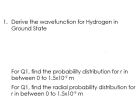 1. Derive the wavefunction for Hydrogen in Ground State For Q1, find the probability distribution for r in between 0 to 1.5x10⁻⁹ m For Q, find the radial probability distribution for r in between 0 to 1.5x10⁻⁹ m
 (A) Comment on the energy needed to excite an electron from the valence band edge to conduction band edge of InP if the temperature is reduced from 300K to 77K. Justify your answer (B) If the semiconductor is undoped, how does the probability of occupancy of a state at the conduction band edge change as the temperature of the semiconductor is increased? Justify your answer.
 Derive Eq.2-69 by applying Eq.2-68 to combined events (Hint: you
will need to use the distributive law. )
44. 2.44* Derive Eq. (2-69) by applying Eq. (2-68) to combined events. ( Hint: You will need to use the distributive law in Table 2.1..) We treat image intensities as random quantities in numerous places in the book. For example, let zal = 0,1,2, , L-1, denote the values of all possible intensities in an M × N digital image. The probability,...
Derive Eq.2-69 by applying Eq.2-68 to combined events (Hint: you
will need to use the distributive law. )
44. 2.44* Derive Eq. (2-69) by applying Eq. (2-68) to combined events. ( Hint: You will need to use the distributive law in Table 2.1..) We treat image intensities as random quantities in numerous places in the book. For example, let zal = 0,1,2, , L-1, denote the values of all possible intensities in an M × N digital image. The probability,...
 1. Derived Eq. 12 by using Eq. 1la, Eq. 9, and the last equation of Appendix H. (25pts) Eq. 12: Eq. 1a F(E) e-E-E for (E Ep)>3kT, Eq. 9: Appx H: 2. Draw flat energy band diagrams for silicon doped with 101s arsenic atoms/cm3 and 80 K, 280 K, and 550 K. Show the Fermi level and use the intrinsic Femi level as the energy reference. (25pts) A silicon sample is doped with 1015 arsenic atoms/cm. What is the hole...
 or a Silicon sample energy band diagram shown below, assume room temperature and the band gap Eg 1.1 eV 6) F calculate the probability of a state with energy Ec to be filled; calculate the probability ofa state with energy Ev to be empty. a. b. 0.2 eV Ее Ef Ev enn l+
or a Silicon sample energy band diagram shown below, assume room temperature and the band gap Eg 1.1 eV 6) F calculate the probability of a state...
or a Silicon sample energy band diagram shown below, assume room temperature and the band gap Eg 1.1 eV 6) F calculate the probability of a state with energy Ec to be filled; calculate the probability ofa state with energy Ev to be empty. a. b. 0.2 eV Ее Ef Ev enn l+
or a Silicon sample energy band diagram shown below, assume room temperature and the band gap Eg 1.1 eV 6) F calculate the probability of a state...
 Band structure Consider a one-dimensional semiconductor crystal consisting of 11 atoms with nearest- neighbor atoms separated by a 5 . The band structure for electrons in the conduction band is given by Ec(k) = 101(k-0.2n)2-A(k-02n)"] + 2.25 [eV] and the band structure for holes in the valence band is given by where the wavevector k s in units ofA-1. The allowed wavevectors are--< k 즈 al (a) Is this a direct or indirect gap semiconductor? What is the energy gap...
 a) (10 points) Calculate the occupation probability f(E), that is the probability that a state will be occupied, at 293 K for a state at the bottom of the conduction band in germanium. The energy of the gap is Eg= 0.67 eV and assume that the Fermi energy lies in the middle of the gap.
 ( 10 points) Calculate the occupation probability f(E), that is the probability that a state will be occupied, at 293 K for a state at the bottom of the conduction band in germanium. The energy of the gap is Eg= 0.67 eV and assume that the Fermi energy lies in the middle of the gap.
 1.12 Figs. 1、12 and 1.13 are plots of data used to derive the Hum- ble (Eq. 1.16) and the Phillips (Eq. 1.18) equations. Can each data set be represented by a relationship of the form F-m If yes, determine the values of m 100 F .629" 2.15 LITHOLOGYs Sandstoss A11 FORMATION: AREA Al1 "Date Poist (793 sunples) O 20 S 10 intercept @ ф 0.62 POROSITY. % Flg. 1.13-F data collected by Carothers (from Ret. 12) 2 3 4 .5
 1. Derive the wavefunction for Hydrogen in Ground State For Q1, find the probability distribution for r in between 0 to 1.5x10⁻⁹ m For Q, find the radial probability distribution for r in between 0 to 1.5x10⁻⁹ m
Most questions answered within 3 hours.
-
Where is the error in this code sequence?
String s1 = "Hello";
String s2 = "ello";...
asked 11 months ago -
Financial data for Joel de Paris, Inc., for last year
follow:
Joel de Paris, Inc.
Balance...
asked 11 months ago -
Consider this reaction:
Al2(SO4)3 (aq)+ BaCl3
(aq) Al2Cl6 (aq)- +
3BaSO4(s) . What is the...
asked 11 months ago -
Suppose that Savneet is considering increasing her
recent random sample from 20 car rentals to 40...
asked 11 months ago -
Trucks arrive at an unloading terminal at an average rate of 120
per hour.
Trucks arrive...
asked 11 months ago -
Why are methanol and ethanol completely soluble in water while
octanol is not very little soluble....
asked 11 months ago -
A facilities manager at a university reads in a research report
that the mean amount of...
asked 11 months ago -
When the CuSO4 is rehydrated by adding water to the anhydrous
compound, is this an endothermic...
asked 11 months ago -
A ray of sunlight is passing from diamond into crown glass; the
angle of incidence is...
asked 11 months ago -
A block of mass 0.249 kg is placed on top of a light, vertical
spring of...
asked 11 months ago -
how do the kidneys compensate in the presences of acidosis
a) trigger hyperventilate
b) reserve acid...
asked 11 months ago -
Question 501 pts
The rental rate of capital to the firm increases. Which of the
following...
asked 11 months ago