
Homework Answers
Add Answer to:
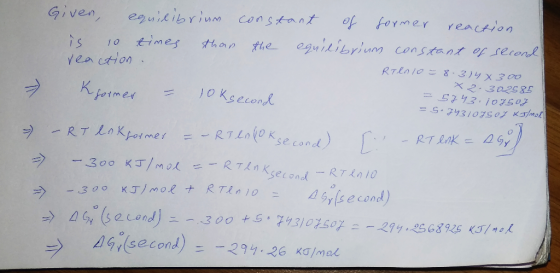
4. An enzyme reaction in a biochemical cycle has an equilibrium constant that is 10 times...
If the reaction A + B → C has an equilibrium constant of 10-6. Which of...
If the reaction A + B → C has an equilibrium constant of 10-6. Which of the following statements are necessarily true? Make sure to select all of the correct responses At equilibrium there will be more products than reactants At equilibrium there will be more reactants than products the reaction is spontaneous the reaction is not spontaneous The reaction is fast The reaction is slow The chemical potential energy of the products is greater than that of the reactants...
Suppose that, in the absence of a catalyst, a certain biochemical reaction occurs x times per...
 Suppose that, in the absence of a catalyst, a certain biochemical reaction occurs x times per second at normal body temperature (37 °C). In order to be physiologically useful, the reaction needs to occur 2000 times faster than when it is uncatalyzed. Part A By how many kJ/mol must an enzyme lower the activation energy of the reaction to make it useful? Express your answer using two significant figures. PO AQ * o o ? Ea – Eac = kJ/mol
A certain reaction has an enthalpy value of -56.4 kJ moll. Assume this value remains constant...
 A certain reaction has an enthalpy value of -56.4 kJ moll. Assume this value remains constant in the temperature range being studied. The standard Gibbs free energy for the reaction is -241 kJ mol-'at 25.0 °C. What is the standard Gibbs free energy for the reaction at 50.0 °C?
From the information in the Data section of the textbook, calculate the equilibrium constant at 3...
 step by step pls
can
you only do uestion 2 and 3 for me
step by step
From the information in the Data section of the textbook, calculate the equilibrium constant at 338 K for the reaction: assuming that the reaction enthalpy is independent of temperature. Answer: 0.0835 The degree of dissociation, a, for the following reaction is 0.655 at 298 K and 1.00 bar total pressure. Find K Answer: 300 Given K 9.18E-8 for the reaction: laqi and the...
step by step pls
can
you only do uestion 2 and 3 for me
step by step
From the information in the Data section of the textbook, calculate the equilibrium constant at 338 K for the reaction: assuming that the reaction enthalpy is independent of temperature. Answer: 0.0835 The degree of dissociation, a, for the following reaction is 0.655 at 298 K and 1.00 bar total pressure. Find K Answer: 300 Given K 9.18E-8 for the reaction: laqi and the...
Calculate the standard change in Gibbs free energy, AGixn , for the given reaction at 25.0...
 Calculate the standard change in Gibbs free energy, AGixn , for the given reaction at 25.0 °C. Consult the table of thermodynamic properties for standard Gibbs free energy of formation values. NH,CI() = NH(aq) + Cl(aq) AGxn = -7.7 kJ/mol Determine the concentration of NH(aq) if the change in Gibbs free energy, AGrxn , for the reaction is –9.53 kJ/mol. [NH] = 0.72 Consider a general reaction enzyme A(aq) = B(aq) The AG® of the reaction is -4.880 kJ mol-....
Question B1. The binding of a substrate (S) to an enzyme (E) can be described by...
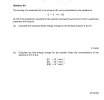 Question B1. The binding of a substrate (S) to an enzyme (E) can be described by the equilibrium E + S 4 ES At 273 K the equilibrium constant for this reaction has been found to be 0.134 for a particular substrate and enzyme. (a) Calculate the standard Gibbs energy change for the binding reaction at 273 K. [1 mark] (b) Calculate the free energy change for the reaction when the concentrations of the species at 273 K are: [E]...
Explain IN WORDS the biochemical relationship between Gibbs free energy, equilibrium constant and reduction potential?
Explain IN WORDS the biochemical relationship between Gibbs free energy, equilibrium constant and reduction potential?
What is the standard Gibbs free energy of the reaction, H(aq) - H(aq)+F(aq), if its equilibrium...
 What is the standard Gibbs free energy of the reaction, H(aq) - H(aq)+F(aq), if its equilibrium constant at 298 Kis 7.2 10 A 177 kJfmol O B 17.9 kJ/mol O C -17.9 kJ/mol O D 584 l/mol
3. + 2.5/10 points Previous Answers McM8 6.P.012. The standard Gibbs-free energy of a system is related to its equilibr...
 3. + 2.5/10 points Previous Answers McM8 6.P.012. The standard Gibbs-free energy of a system is related to its equilibrium constant through the following equation. AG° = -R·T· In(K) In this equation R is the gas constant, T is the temperature, and the ° next to AG defines the conditions as standard ambient temperature and pressure, i.e. "SATP". (Answer the following questions to three significant figures.) (a) Given an equilibrium constant of 4.53 x 10⁻⁶, what is its standard Gibbs-free...
a.) Calculate the equilibrium constant for the following reaction at 298.15 K from cell potential data....
a.) Calculate the equilibrium constant for the following reaction at 298.15 K from cell potential data. Express the answer as lnK. Sn4+ + 2Fe2+ ----> Sn2+ + 2Fe3+ b.) Calculate the standard Gibbs free energy change in kJ/mol at 298.15 K for the following reaction from cell potential data: 3Sn4+ + 2Cr ----> 3Sn2+ + 2Cr3+
 Suppose that, in the absence of a catalyst, a certain biochemical reaction occurs x times per second at normal body temperature (37 °C). In order to be physiologically useful, the reaction needs to occur 2000 times faster than when it is uncatalyzed. Part A By how many kJ/mol must an enzyme lower the activation energy of the reaction to make it useful? Express your answer using two significant figures. PO AQ * o o ? Ea – Eac = kJ/mol
 A certain reaction has an enthalpy value of -56.4 kJ moll. Assume this value remains constant in the temperature range being studied. The standard Gibbs free energy for the reaction is -241 kJ mol-'at 25.0 °C. What is the standard Gibbs free energy for the reaction at 50.0 °C?
 step by step pls
can
you only do uestion 2 and 3 for me
step by step
From the information in the Data section of the textbook, calculate the equilibrium constant at 338 K for the reaction: assuming that the reaction enthalpy is independent of temperature. Answer: 0.0835 The degree of dissociation, a, for the following reaction is 0.655 at 298 K and 1.00 bar total pressure. Find K Answer: 300 Given K 9.18E-8 for the reaction: laqi and the...
step by step pls
can
you only do uestion 2 and 3 for me
step by step
From the information in the Data section of the textbook, calculate the equilibrium constant at 338 K for the reaction: assuming that the reaction enthalpy is independent of temperature. Answer: 0.0835 The degree of dissociation, a, for the following reaction is 0.655 at 298 K and 1.00 bar total pressure. Find K Answer: 300 Given K 9.18E-8 for the reaction: laqi and the...
 Calculate the standard change in Gibbs free energy, AGixn , for the given reaction at 25.0 °C. Consult the table of thermodynamic properties for standard Gibbs free energy of formation values. NH,CI() = NH(aq) + Cl(aq) AGxn = -7.7 kJ/mol Determine the concentration of NH(aq) if the change in Gibbs free energy, AGrxn , for the reaction is –9.53 kJ/mol. [NH] = 0.72 Consider a general reaction enzyme A(aq) = B(aq) The AG® of the reaction is -4.880 kJ mol-....
 Question B1. The binding of a substrate (S) to an enzyme (E) can be described by the equilibrium E + S 4 ES At 273 K the equilibrium constant for this reaction has been found to be 0.134 for a particular substrate and enzyme. (a) Calculate the standard Gibbs energy change for the binding reaction at 273 K. [1 mark] (b) Calculate the free energy change for the reaction when the concentrations of the species at 273 K are: [E]...
 What is the standard Gibbs free energy of the reaction, H(aq) - H(aq)+F(aq), if its equilibrium constant at 298 Kis 7.2 10 A 177 kJfmol O B 17.9 kJ/mol O C -17.9 kJ/mol O D 584 l/mol
 3. + 2.5/10 points Previous Answers McM8 6.P.012. The standard Gibbs-free energy of a system is related to its equilibrium constant through the following equation. AG° = -R·T· In(K) In this equation R is the gas constant, T is the temperature, and the ° next to AG defines the conditions as standard ambient temperature and pressure, i.e. "SATP". (Answer the following questions to three significant figures.) (a) Given an equilibrium constant of 4.53 x 10⁻⁶, what is its standard Gibbs-free...
Most questions answered within 3 hours.
-
Where is the error in this code sequence?
String s1 = "Hello";
String s2 = "ello";...
asked 10 months ago -
Financial data for Joel de Paris, Inc., for last year
follow:
Joel de Paris, Inc.
Balance...
asked 10 months ago -
Consider this reaction:
Al2(SO4)3 (aq)+ BaCl3
(aq) Al2Cl6 (aq)- +
3BaSO4(s) . What is the...
asked 10 months ago -
Suppose that Savneet is considering increasing her
recent random sample from 20 car rentals to 40...
asked 10 months ago -
Trucks arrive at an unloading terminal at an average rate of 120
per hour.
Trucks arrive...
asked 10 months ago -
Why are methanol and ethanol completely soluble in water while
octanol is not very little soluble....
asked 10 months ago -
A facilities manager at a university reads in a research report
that the mean amount of...
asked 10 months ago -
When the CuSO4 is rehydrated by adding water to the anhydrous
compound, is this an endothermic...
asked 10 months ago -
A ray of sunlight is passing from diamond into crown glass; the
angle of incidence is...
asked 10 months ago -
A block of mass 0.249 kg is placed on top of a light, vertical
spring of...
asked 10 months ago -
how do the kidneys compensate in the presences of acidosis
a) trigger hyperventilate
b) reserve acid...
asked 10 months ago -
Question 501 pts
The rental rate of capital to the firm increases. Which of the
following...
asked 10 months ago