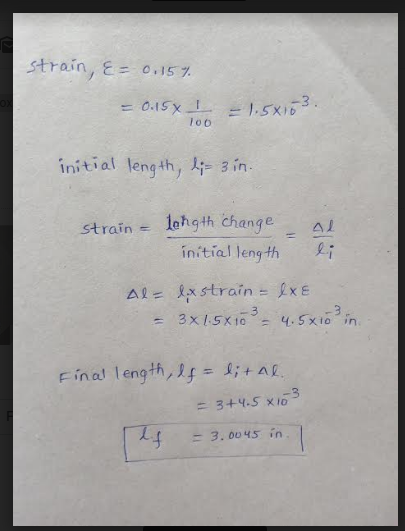
If the strain or offset is specified as 0.15%, the applied stress plastically deform a 3-inch...
If the strain or offset is specified as 0.15%, the applied stress plastically deform a 3-inch length to a final length of: a. 3.0015 b. 3.0030 c. 3.0060 d. 3.0045
Homework Answers
Add Answer to:
If the strain or offset is specified as 0.15%, the applied
stress plastically deform a 3-inch...
Please give a full, detailed, worded explanation. Thank you :))) S. Draw a possible stress strain...
 Please give a full, detailed, worded explanation. Thank you :)))
S. Draw a possible stress strain graph for a material with a yield stress of 300 MPa, an elastic modulus of 200 GPa, a UTS of 450 MPa and a ductility of 20%. Calculate the elastic strain at the point where the material starts to plastically deform. 6. A nylon rope with an elastic modulus of 3 GPa is placed under a force of 17.5 kN. The cross-sectional area of...
Please give a full, detailed, worded explanation. Thank you :)))
S. Draw a possible stress strain graph for a material with a yield stress of 300 MPa, an elastic modulus of 200 GPa, a UTS of 450 MPa and a ductility of 20%. Calculate the elastic strain at the point where the material starts to plastically deform. 6. A nylon rope with an elastic modulus of 3 GPa is placed under a force of 17.5 kN. The cross-sectional area of...
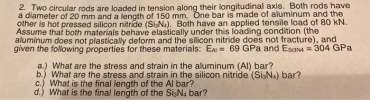
Two circular rods are loaded in tension along their longitudinal axis. Both rods have a diameter...
Two circular rods are loaded in tension along their longitudinal axis. Both rods have a diameter of 20 mm and a length of 150 mm. One bar is made of aluminum and the other is hot pressed silicon nitride (Si3N4). Both have an applied tensile load of 80 kN. Assume that both materials behave elastically under this loading condition (the aluminum does not plastically deform and the silicon nitride does not fracture) and given the following properties for these materials:EAl= 69 GPa...
Give the following as functions of slug temperature: a. The strain in the slug when d 0.25 inch? ...
 Give the following as functions of slug temperature: a. The strain in the slug when d 0.25 inch? (10 pts) b. The strain rate in the slug when d-0.25 inch? (10 pts) c. The flow stress in the slug when d 0.25 inch? (10 pts) d. The pressure in the matrix when d = 0.25 inch? (10 pts) Calculate (algebraically): e. The slug temperature required to keep the force applied by the ram below press capacity? Justify that your force...
PLEASE HELP ON STUDY GUIDE FOR MIDTERM! PLEASE SHOW ALL WORK! 2. Two circular rods are...
 PLEASE HELP ON STUDY GUIDE FOR MIDTERM!
PLEASE SHOW ALL WORK!
2. Two circular rods are loaded in tension along their longitudinal axis. Both rods have a diameter of 20 mm and a length of 150 mm. One bar is made of aluminum and the other is hot pressed silicon nitride (SigN). Both have an applied tensile load of 80 kN. Assume that both materials behave elastically under this loading condition (the aluminum does not plastically deform and the silicon...
PLEASE HELP ON STUDY GUIDE FOR MIDTERM!
PLEASE SHOW ALL WORK!
2. Two circular rods are loaded in tension along their longitudinal axis. Both rods have a diameter of 20 mm and a length of 150 mm. One bar is made of aluminum and the other is hot pressed silicon nitride (SigN). Both have an applied tensile load of 80 kN. Assume that both materials behave elastically under this loading condition (the aluminum does not plastically deform and the silicon...
The stress-strain curve for titanium alloy (Ti-6Al-4V) at 427° C is compared with the stress-strain curves...
 The stress-strain curve for titanium alloy (Ti-6Al-4V) at 427°
C is compared with the stress-strain curves for titanium matrix
composite (TMC) at 25° and 427° C.
a. Determine the value of the elastic modulus for Ti-6Al-4V
at 427° C.
b.Determine the change in length of a for Ti-6Al-4V test
specimen (originally 5 inch long) that is subjected to a tensile
stress of 40,000 lb/in2 at 427° C.
c. Determine the 0.2% YS for TMC at 25° C and 427° C....
The stress-strain curve for titanium alloy (Ti-6Al-4V) at 427°
C is compared with the stress-strain curves for titanium matrix
composite (TMC) at 25° and 427° C.
a. Determine the value of the elastic modulus for Ti-6Al-4V
at 427° C.
b.Determine the change in length of a for Ti-6Al-4V test
specimen (originally 5 inch long) that is subjected to a tensile
stress of 40,000 lb/in2 at 427° C.
c. Determine the 0.2% YS for TMC at 25° C and 427° C....
Tensile strain is: A) the stress per unit area B) the same as force C) the...
Tensile strain is: A) the stress per unit area B) the same as force C) the ratio of stress to elastic modulus D) the applied force per cross-sectional area E) the ratio of the change in length to the original length
Refer to the following figure, stress-strain diagram, for samples of three different materials: A, B, and...
 Refer to the following figure, stress-strain diagram,
for samples of three different materials: A, B, and C. The end of
each curve indicates the fracture point.
e) After the conclusion of the tests, if the broken halves of each
sample were fitted back together, which sample would be the
shortest? Assume that all three samples had the same initial
length. f) A circular rod is to be produced, 15 cm long with a
diameter of 5.0 mm. This rod must...
Refer to the following figure, stress-strain diagram,
for samples of three different materials: A, B, and C. The end of
each curve indicates the fracture point.
e) After the conclusion of the tests, if the broken halves of each
sample were fitted back together, which sample would be the
shortest? Assume that all three samples had the same initial
length. f) A circular rod is to be produced, 15 cm long with a
diameter of 5.0 mm. This rod must...
A tensile test was conducted on a specimen that had an original diameter of 0.5 in. It fractured with an applied load of 71100lb. Determine the true stress and true strain at fracture if measured diam...
A tensile test was conducted on a specimen that had an original diameter of 0.5 in. It fractured with an applied load of 71100lb. Determine the true stress and true strain at fracture if measured diameter of the fracture part was 0.3in. I believe for fracture, true stress and strain are: True strain = ln(original area/final area) True stress = applied load/final area However, Im not quite sure
Problem 6-9 thank you 6. What four factors govern a rock's response to applied stress? a Rate of strain, Temperature, Azimuth, Gradation b. Confinement, Rate of strain, Rock strength, Temperat...
 Problem 6-9
thank you
6. What four factors govern a rock's response to applied stress? a Rate of strain, Temperature, Azimuth, Gradation b. Confinement, Rate of strain, Rock strength, Temperature C. Confinement, Rock strength, Gradation, Weathering d. Temperature, Rate of strain, Dimensions, Faulting 7. The drawing below is a strike-slip fault with offset segments. Identify (1), the lateral motion (right or left lateral), and (2), the step-over direction. Would you expect to see a small normal or reverse fault in...
Problem 6-9
thank you
6. What four factors govern a rock's response to applied stress? a Rate of strain, Temperature, Azimuth, Gradation b. Confinement, Rate of strain, Rock strength, Temperature C. Confinement, Rock strength, Gradation, Weathering d. Temperature, Rate of strain, Dimensions, Faulting 7. The drawing below is a strike-slip fault with offset segments. Identify (1), the lateral motion (right or left lateral), and (2), the step-over direction. Would you expect to see a small normal or reverse fault in...
(30 points) From the stress-strain chart for a unknown material determine thoe following 400 a) The...
 (30 points) From the stress-strain chart for a unknown material determine thoe following 400 a) The modulus of elasticity b) The yield strength at a strain offset of 0.002 c) Tensile strength d) The Ductility (percentage of 300 200 elongation, %EL) e) The Modulus of resilience f) Strain at 350 Mpa stress g) Strain at 150 Mpa stress 200 100 100 0.005 0.30 0.40 0.10 trein 0.20
 Please give a full, detailed, worded explanation. Thank you :)))
S. Draw a possible stress strain graph for a material with a yield stress of 300 MPa, an elastic modulus of 200 GPa, a UTS of 450 MPa and a ductility of 20%. Calculate the elastic strain at the point where the material starts to plastically deform. 6. A nylon rope with an elastic modulus of 3 GPa is placed under a force of 17.5 kN. The cross-sectional area of...
Please give a full, detailed, worded explanation. Thank you :)))
S. Draw a possible stress strain graph for a material with a yield stress of 300 MPa, an elastic modulus of 200 GPa, a UTS of 450 MPa and a ductility of 20%. Calculate the elastic strain at the point where the material starts to plastically deform. 6. A nylon rope with an elastic modulus of 3 GPa is placed under a force of 17.5 kN. The cross-sectional area of...
 Give the following as functions of slug temperature: a. The strain in the slug when d 0.25 inch? (10 pts) b. The strain rate in the slug when d-0.25 inch? (10 pts) c. The flow stress in the slug when d 0.25 inch? (10 pts) d. The pressure in the matrix when d = 0.25 inch? (10 pts) Calculate (algebraically): e. The slug temperature required to keep the force applied by the ram below press capacity? Justify that your force...
 PLEASE HELP ON STUDY GUIDE FOR MIDTERM!
PLEASE SHOW ALL WORK!
2. Two circular rods are loaded in tension along their longitudinal axis. Both rods have a diameter of 20 mm and a length of 150 mm. One bar is made of aluminum and the other is hot pressed silicon nitride (SigN). Both have an applied tensile load of 80 kN. Assume that both materials behave elastically under this loading condition (the aluminum does not plastically deform and the silicon...
PLEASE HELP ON STUDY GUIDE FOR MIDTERM!
PLEASE SHOW ALL WORK!
2. Two circular rods are loaded in tension along their longitudinal axis. Both rods have a diameter of 20 mm and a length of 150 mm. One bar is made of aluminum and the other is hot pressed silicon nitride (SigN). Both have an applied tensile load of 80 kN. Assume that both materials behave elastically under this loading condition (the aluminum does not plastically deform and the silicon...
 The stress-strain curve for titanium alloy (Ti-6Al-4V) at 427°
C is compared with the stress-strain curves for titanium matrix
composite (TMC) at 25° and 427° C.
a. Determine the value of the elastic modulus for Ti-6Al-4V
at 427° C.
b.Determine the change in length of a for Ti-6Al-4V test
specimen (originally 5 inch long) that is subjected to a tensile
stress of 40,000 lb/in2 at 427° C.
c. Determine the 0.2% YS for TMC at 25° C and 427° C....
The stress-strain curve for titanium alloy (Ti-6Al-4V) at 427°
C is compared with the stress-strain curves for titanium matrix
composite (TMC) at 25° and 427° C.
a. Determine the value of the elastic modulus for Ti-6Al-4V
at 427° C.
b.Determine the change in length of a for Ti-6Al-4V test
specimen (originally 5 inch long) that is subjected to a tensile
stress of 40,000 lb/in2 at 427° C.
c. Determine the 0.2% YS for TMC at 25° C and 427° C....
 Refer to the following figure, stress-strain diagram,
for samples of three different materials: A, B, and C. The end of
each curve indicates the fracture point.
e) After the conclusion of the tests, if the broken halves of each
sample were fitted back together, which sample would be the
shortest? Assume that all three samples had the same initial
length. f) A circular rod is to be produced, 15 cm long with a
diameter of 5.0 mm. This rod must...
Refer to the following figure, stress-strain diagram,
for samples of three different materials: A, B, and C. The end of
each curve indicates the fracture point.
e) After the conclusion of the tests, if the broken halves of each
sample were fitted back together, which sample would be the
shortest? Assume that all three samples had the same initial
length. f) A circular rod is to be produced, 15 cm long with a
diameter of 5.0 mm. This rod must...
 Problem 6-9
thank you
6. What four factors govern a rock's response to applied stress? a Rate of strain, Temperature, Azimuth, Gradation b. Confinement, Rate of strain, Rock strength, Temperature C. Confinement, Rock strength, Gradation, Weathering d. Temperature, Rate of strain, Dimensions, Faulting 7. The drawing below is a strike-slip fault with offset segments. Identify (1), the lateral motion (right or left lateral), and (2), the step-over direction. Would you expect to see a small normal or reverse fault in...
Problem 6-9
thank you
6. What four factors govern a rock's response to applied stress? a Rate of strain, Temperature, Azimuth, Gradation b. Confinement, Rate of strain, Rock strength, Temperature C. Confinement, Rock strength, Gradation, Weathering d. Temperature, Rate of strain, Dimensions, Faulting 7. The drawing below is a strike-slip fault with offset segments. Identify (1), the lateral motion (right or left lateral), and (2), the step-over direction. Would you expect to see a small normal or reverse fault in...
 (30 points) From the stress-strain chart for a unknown material determine thoe following 400 a) The modulus of elasticity b) The yield strength at a strain offset of 0.002 c) Tensile strength d) The Ductility (percentage of 300 200 elongation, %EL) e) The Modulus of resilience f) Strain at 350 Mpa stress g) Strain at 150 Mpa stress 200 100 100 0.005 0.30 0.40 0.10 trein 0.20
Most questions answered within 3 hours.
-
Where is the error in this code sequence?
String s1 = "Hello";
String s2 = "ello";...
asked 10 months ago -
Financial data for Joel de Paris, Inc., for last year
follow:
Joel de Paris, Inc.
Balance...
asked 10 months ago -
Consider this reaction:
Al2(SO4)3 (aq)+ BaCl3
(aq) Al2Cl6 (aq)- +
3BaSO4(s) . What is the...
asked 10 months ago -
Suppose that Savneet is considering increasing her
recent random sample from 20 car rentals to 40...
asked 10 months ago -
Trucks arrive at an unloading terminal at an average rate of 120
per hour.
Trucks arrive...
asked 10 months ago -
Why are methanol and ethanol completely soluble in water while
octanol is not very little soluble....
asked 10 months ago -
A facilities manager at a university reads in a research report
that the mean amount of...
asked 10 months ago -
When the CuSO4 is rehydrated by adding water to the anhydrous
compound, is this an endothermic...
asked 10 months ago -
A ray of sunlight is passing from diamond into crown glass; the
angle of incidence is...
asked 10 months ago -
A block of mass 0.249 kg is placed on top of a light, vertical
spring of...
asked 10 months ago -
how do the kidneys compensate in the presences of acidosis
a) trigger hyperventilate
b) reserve acid...
asked 10 months ago -
Question 501 pts
The rental rate of capital to the firm increases. Which of the
following...
asked 10 months ago