Particles A through D have the following rest energies and total energies: Particle Rest Energy Total...
Particles A through D have the following rest energies and total energies:
| Particle | Rest Energy | Total Energy |
| A | 6E | 6E |
| B | 2E | 4E |
| C | 4E | 6E |
| D | 3E | 4E |
A. Rank these particles in order of decreasing rest mass.
B.Rank these particles in order of decreasing kinetic energy.
C. Rank these particles in order of decreasing speed.
Homework Answers
Add Answer to:
Particles A through
D have the following rest energies and total energies:
Particle
Rest
Energy
Total...
Two particles each have a rest mass energy of 30 MeV and are traveling with a...
Two particles each have a rest mass energy of 30 MeV and are traveling with a total of 10 MeV of kinetic energy. When they collide, they fuse into a new particle with a rest mass energy of 50 MeV. How much kinetic energy does the final particle possess?
Problem 1. Consider a system of three identical particles. Each particle has 5 quantum states with...
 Problem 1. Consider a system of three identical particles. Each particle has 5 quantum states with energies 0, ε, 2E, 3E, 4E. For distinguishable particles, calculate the number of quantum states where (1) three particles are in the same single-particle state, (2) only two particles are in the same single-particle state, and (3) no two particles are in the same single-particle state. Problem 2. For fermions, (1) calculate the total number of quantum states, and (2) the number of states...
4. Two particles A and B collide and stick together to form a new particle. Particle...
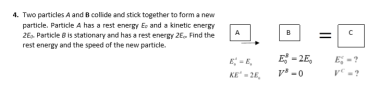 4. Two particles A and B collide and stick together to form a new particle. Particle A has a rest energy Eo and a kinetic energy 2E0. Particle B is stationary and has a rest energy 2E Find the rest energy and the speed of the new particle. E = E, KE' = 2E EⓇ = 2E, vp = 0 E = ? V° = ?
3. (10 pts) High energy particle accelerators convert part of the energy of colliding particles into...
 3. (10 pts) High energy particle accelerators convert part of the energy of colliding particles into the masses of particles produced in the collisions. Consider a collision of two protons that produces two charged kaons. The mass of the proton is mp- 938.3 MeV/c2, and the mass of each kaon is mK 493.7 MeV/c2. The reaction is a) The total energy (kinetic energy and rest energy) and total momentum is conserved. Suppose one of the protons is at rest in...
16 , Eo Problem 1 (8 pts): An experimentalist is examining a kind of non-interacting identical...
 16 , Eo Problem 1 (8 pts): An experimentalist is examining a kind of non-interacting identical particles that could be either spinless bosons or spin-half fermions by putting a number of them inside a potential and measuring the energy levels of the system, but without being able to resolve the degeneracy of each level. Energy levels do not depend on the particles' spin. The following values of the energy are observed: No particles: 0 -5€ 1 particle: E, 2E, 5E...
In the figure a particle is to be released at rest at point A and then...
 In the figure a particle is to
be released at rest at point A and then is to be accelerated
directly through point B by an electric field. The potential
difference between points A and B is 100 V. Which point should be
at higher electric potential if the particle is (a) an electron,
(b) a proton, and (c) an alpha particle (a nucleus of two protons
and two neutrons, 4He)? (d) Compute the kinetic energies of these
particles at...
In the figure a particle is to
be released at rest at point A and then is to be accelerated
directly through point B by an electric field. The potential
difference between points A and B is 100 V. Which point should be
at higher electric potential if the particle is (a) an electron,
(b) a proton, and (c) an alpha particle (a nucleus of two protons
and two neutrons, 4He)? (d) Compute the kinetic energies of these
particles at...
-31 1 Electrons have a rest mass of 9.1095x10³"kg(0.511 MeV/c2) and an energy of 0.511 MeV million electron volts)...
 -31 1 Electrons have a rest mass of 9.1095x10³"kg(0.511 MeV/c2) and an energy of 0.511 MeV million electron volts) when at rest. In a colliding beam experiment, a beam of electrons accelerated to a high speed is sent toward a beam of antielectrons (same mass as electrons) moving in the opposite direction at the same speed. a.) Experimenters hope to create the J/y particle that has a rest mass energy of 3097 MeV through one of these collisions. The J/y...
Why do scientists need particle accelerators to discover new particles and to study the properties of known particles? charge greater than less Particle accelerators allow scientists to accelerate su...
 Why do scientists need particle accelerators to discover new particles and to study the properties of known particles? charge greater than less Particle accelerators allow scientists to accelerate subatomic particles to very high speeds( the speed of light). At these speeds, collisions between the accelerated particles and particles in a stationary target have sufficient energy to produce new particles and/or known particles via energy conversion greater near For example, the mediators of the weak nuclear interaction have very large rest...
Four different charged particles are accelerated through a potential difference. This results in either a high...
Four different charged particles are accelerated through a potential difference. This results in either a high or low energy and a high or low momentum for each particle. The high energies and momenta are twice the low energies and momenta. All particles have the same charge. The results are as follows: A: high energy and high momentum B: high energy and low momentum C: low energy and high momentum D: low energy and low momentum QUESTION: Rank the wavelength of...
Please answer question (b) part (iii) (a) Particle A decays at rest into particles B and...
 Please answer question (b) part (iii)
(a) Particle A decays at rest into particles B and C, i.e., A + B +C. Find the (i) energies, (ii) the magnitudes of the 3-momenta, and (iii) the speeds of the outgoing particles in terms of the rest masses of the three particles. (b) Suppose now particle A moves in the x-direction with a momentum pa, and particle B is emitted at an angle a relative to the x-axis. -a (i) Use conservation...
Please answer question (b) part (iii)
(a) Particle A decays at rest into particles B and C, i.e., A + B +C. Find the (i) energies, (ii) the magnitudes of the 3-momenta, and (iii) the speeds of the outgoing particles in terms of the rest masses of the three particles. (b) Suppose now particle A moves in the x-direction with a momentum pa, and particle B is emitted at an angle a relative to the x-axis. -a (i) Use conservation...
 Problem 1. Consider a system of three identical particles. Each particle has 5 quantum states with energies 0, ε, 2E, 3E, 4E. For distinguishable particles, calculate the number of quantum states where (1) three particles are in the same single-particle state, (2) only two particles are in the same single-particle state, and (3) no two particles are in the same single-particle state. Problem 2. For fermions, (1) calculate the total number of quantum states, and (2) the number of states...
 4. Two particles A and B collide and stick together to form a new particle. Particle A has a rest energy Eo and a kinetic energy 2E0. Particle B is stationary and has a rest energy 2E Find the rest energy and the speed of the new particle. E = E, KE' = 2E EⓇ = 2E, vp = 0 E = ? V° = ?
 3. (10 pts) High energy particle accelerators convert part of the energy of colliding particles into the masses of particles produced in the collisions. Consider a collision of two protons that produces two charged kaons. The mass of the proton is mp- 938.3 MeV/c2, and the mass of each kaon is mK 493.7 MeV/c2. The reaction is a) The total energy (kinetic energy and rest energy) and total momentum is conserved. Suppose one of the protons is at rest in...
 16 , Eo Problem 1 (8 pts): An experimentalist is examining a kind of non-interacting identical particles that could be either spinless bosons or spin-half fermions by putting a number of them inside a potential and measuring the energy levels of the system, but without being able to resolve the degeneracy of each level. Energy levels do not depend on the particles' spin. The following values of the energy are observed: No particles: 0 -5€ 1 particle: E, 2E, 5E...
 In the figure a particle is to
be released at rest at point A and then is to be accelerated
directly through point B by an electric field. The potential
difference between points A and B is 100 V. Which point should be
at higher electric potential if the particle is (a) an electron,
(b) a proton, and (c) an alpha particle (a nucleus of two protons
and two neutrons, 4He)? (d) Compute the kinetic energies of these
particles at...
In the figure a particle is to
be released at rest at point A and then is to be accelerated
directly through point B by an electric field. The potential
difference between points A and B is 100 V. Which point should be
at higher electric potential if the particle is (a) an electron,
(b) a proton, and (c) an alpha particle (a nucleus of two protons
and two neutrons, 4He)? (d) Compute the kinetic energies of these
particles at...
 -31 1 Electrons have a rest mass of 9.1095x10³"kg(0.511 MeV/c2) and an energy of 0.511 MeV million electron volts) when at rest. In a colliding beam experiment, a beam of electrons accelerated to a high speed is sent toward a beam of antielectrons (same mass as electrons) moving in the opposite direction at the same speed. a.) Experimenters hope to create the J/y particle that has a rest mass energy of 3097 MeV through one of these collisions. The J/y...
 Why do scientists need particle accelerators to discover new particles and to study the properties of known particles? charge greater than less Particle accelerators allow scientists to accelerate subatomic particles to very high speeds( the speed of light). At these speeds, collisions between the accelerated particles and particles in a stationary target have sufficient energy to produce new particles and/or known particles via energy conversion greater near For example, the mediators of the weak nuclear interaction have very large rest...
 Please answer question (b) part (iii)
(a) Particle A decays at rest into particles B and C, i.e., A + B +C. Find the (i) energies, (ii) the magnitudes of the 3-momenta, and (iii) the speeds of the outgoing particles in terms of the rest masses of the three particles. (b) Suppose now particle A moves in the x-direction with a momentum pa, and particle B is emitted at an angle a relative to the x-axis. -a (i) Use conservation...
Please answer question (b) part (iii)
(a) Particle A decays at rest into particles B and C, i.e., A + B +C. Find the (i) energies, (ii) the magnitudes of the 3-momenta, and (iii) the speeds of the outgoing particles in terms of the rest masses of the three particles. (b) Suppose now particle A moves in the x-direction with a momentum pa, and particle B is emitted at an angle a relative to the x-axis. -a (i) Use conservation...
Most questions answered within 3 hours.
-
Where is the error in this code sequence?
String s1 = "Hello";
String s2 = "ello";...
asked 10 months ago -
Financial data for Joel de Paris, Inc., for last year
follow:
Joel de Paris, Inc.
Balance...
asked 10 months ago -
Consider this reaction:
Al2(SO4)3 (aq)+ BaCl3
(aq) Al2Cl6 (aq)- +
3BaSO4(s) . What is the...
asked 10 months ago -
Suppose that Savneet is considering increasing her
recent random sample from 20 car rentals to 40...
asked 10 months ago -
Trucks arrive at an unloading terminal at an average rate of 120
per hour.
Trucks arrive...
asked 10 months ago -
Why are methanol and ethanol completely soluble in water while
octanol is not very little soluble....
asked 10 months ago -
A facilities manager at a university reads in a research report
that the mean amount of...
asked 10 months ago -
When the CuSO4 is rehydrated by adding water to the anhydrous
compound, is this an endothermic...
asked 10 months ago -
A ray of sunlight is passing from diamond into crown glass; the
angle of incidence is...
asked 10 months ago -
A block of mass 0.249 kg is placed on top of a light, vertical
spring of...
asked 10 months ago -
how do the kidneys compensate in the presences of acidosis
a) trigger hyperventilate
b) reserve acid...
asked 10 months ago -
Question 501 pts
The rental rate of capital to the firm increases. Which of the
following...
asked 10 months ago