c = a + b d = a * b – c e = d/c *...
c = a + b
d = a * b – c
e = d/c * (a/c + b)
Write out the assembly code to do the high level operations. You do not need to use addressing modes, you can use letters in the statements
- stack
- accumulator
- (0,2) GPR
- (0,3) GPR
- (3,3) GPR
Homework Answers
mov ax, a
mov bx,b
add ax,bx
mov c, ax
mov ax,a
mov bx,b
mul ax,bx
mov bx,c
sub ax,bx
mov ax, a
mov bx,c
div ax,bx
mov bx,b
add ax,bx
mov p,ax
mov ax,d
mov bx,c
div ax,bx
mov bx,p
mul ax,bx
This question is from Computer architecture. Please show steps and add comments so its easy to...
This question is from Computer architecture. Please show steps and add comments so its easy to understand. Translate the high-level language code below into assembly instructions. The variables A, B, C, D, E and F are located in the memory and can be accessed by their label (e.g., LOAD R1, A will load A from the memory into R1). Minimize the number of instructions in the assembly code that you write. F = (A-B)*(C+D)/(E-D) a) Write the code for an...
1. Consider the code sequence: C= A + B D= A-E F= C+ D Assume the...
1. Consider the code sequence: C= A + B D= A-E F= C+ D Assume the values A, B, C, D, E, and F reside in memory. For each Architecture I. Accumulator Architecture II. Memory- Register Architecture III. Register-Register Architecture write the code assuming the instruction codes (opcode) are 8 bits, memory addresses are 32 bits, and register addresses are 6 bits and CPU has 64 Registers; and create a table which specifies: – The execution sequence – The variables...
In the following code I give, everytime it will output ")". Input : ((A+B)*((C-D)/(E^F))) Expected output...
In the following code I give, everytime it will output ")". Input : ((A+B)*((C-D)/(E^F))) Expected output : ((A+B)*((C-D)/(E^F))) A+B*C-D/E^F my output : ) My code : class Et: def __init__(self , value): self.value = value self.left = None self.right = None def isOperator(c): if (c == '+' or c == '-' or c == '*' or c == '/' or c == '^' ): return True else: return False def inorder(t): if t is not None: inorder(t.left) print (t.value) inorder(t.right)...
(c.) What is an assembler language and what are the advantages of using one in comparison...
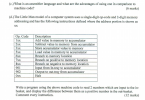 (c.) What is an assembler language and what are the advantages of using one in comparison to machine code? (6 marks) (d.)The Little Man model of a computer system uses a single-digit op-code and 2-digit memory addressing and has the following instructions defined where the address portion is shown as Op. Code Description 1xx 2xx Add value in memory to accumulator Subtract value in memo Store accumulator value to memo Load value in memory to accumulator Branch to memory location...
For (a, b), (c, d) E R2, define if b d This defines a metric on R2. (You need not check this now....
 For (a, b), (c, d) E R2, define if b d This defines a metric on R2. (You need not check this now.) (a) Plot a few points in the plane, and find the distances between them, as mea- sured by de. Choose cases that you think will be illuminating b) Explain why this metric could be called the "lift" metric. (Think about trav- elling between floors in a hotel.) (c) i. Draw the open ball, centre (3, 0), radius...
Name B. (7 pts) MIPS short answer 1. (3pt) For the following MIPS assembly language program:...
 Name B. (7 pts) MIPS short answer 1. (3pt) For the following MIPS assembly language program: loop: addi Sto, $to,-1 bne $to, $zero, loop Translate the second instruction into MIPS machine language and write it in hex. 2. (2 pt) Which best describes the reason that we maintain the stack pointer in a register? (circle one) i. The hardware forces use of a stack pointer. ii. We need a local pointer because we are often limited to relative addressing. ili....
2. You randomly choose a letter from (A, B, C, D, E and a friend randomly...
 2. You randomly choose a letter from (A, B, C, D, E and a friend randomly chooses a letter from fa, b, c, d, e to create a pair of 2 letters with 1 upper case letter followed by 1 lower case letter. (Note: in the English alphabet, the vowels are A, E, I, O, U.) a) Write out the sample space for this experiment. (For example one outcome in the sample space is: Ac; another is Bb.) For parts...
The functional decomposition flowchart shows a. how variables are used from procedures b. how procedures are...
 The functional decomposition flowchart shows a. how variables are used from procedures b. how procedures are called c. the addressing modes used in the code d. all the above 2. The pipeline a. transfers the data from the memory to the CPU b. offers processor-level parallelism C. transfers the data for memory to 1/0 d. offers instruction-level parallelism 2 The three last steps in the instruction execution cycle are a. IF, EX, WB b. EX, OF, WB C. OF, EX,...
(f) and (g) please f and g please letters Question 2 Indirect addressing mode in assembly language is sanilar to pointers in C. Answer the following questions: (1 point) a) How many 8-bit reg...
 (f) and (g) please
f and g please
letters Question 2 Indirect addressing mode in assembly language is sanilar to pointers in C. Answer the following questions: (1 point) a) How many 8-bit registers can a FSR access in the PICI8F452 MCU? b) Write the assembly language command to load the address of the variable with name: PVal into one of the FSR? (2 points) (2 points) (2 points) c) What is the meaning of: movf PREINC2, F? d) What...
(f) and (g) please
f and g please
letters Question 2 Indirect addressing mode in assembly language is sanilar to pointers in C. Answer the following questions: (1 point) a) How many 8-bit registers can a FSR access in the PICI8F452 MCU? b) Write the assembly language command to load the address of the variable with name: PVal into one of the FSR? (2 points) (2 points) (2 points) c) What is the meaning of: movf PREINC2, F? d) What...
I need PARTS (e), (f), and (g) please NOT (a), (b), (c), and (d) again, PARTS...
 I need PARTS (e), (f), and (g) please NOT (a), (b), (c), and
(d)
again, PARTS (e), (f), and (g) please
The intensity of the sun on earth is 1300 W/m2. If this intensity falls on a black surface the size of a football field (what is it's size) (a) what is the radiation pressure on it? (b) what is the force on the football field? (c) Is this force sufficient to levitate a tennis ball (50g) against the earth's...
I need PARTS (e), (f), and (g) please NOT (a), (b), (c), and
(d)
again, PARTS (e), (f), and (g) please
The intensity of the sun on earth is 1300 W/m2. If this intensity falls on a black surface the size of a football field (what is it's size) (a) what is the radiation pressure on it? (b) what is the force on the football field? (c) Is this force sufficient to levitate a tennis ball (50g) against the earth's...
 (c.) What is an assembler language and what are the advantages of using one in comparison to machine code? (6 marks) (d.)The Little Man model of a computer system uses a single-digit op-code and 2-digit memory addressing and has the following instructions defined where the address portion is shown as Op. Code Description 1xx 2xx Add value in memory to accumulator Subtract value in memo Store accumulator value to memo Load value in memory to accumulator Branch to memory location...
 For (a, b), (c, d) E R2, define if b d This defines a metric on R2. (You need not check this now.) (a) Plot a few points in the plane, and find the distances between them, as mea- sured by de. Choose cases that you think will be illuminating b) Explain why this metric could be called the "lift" metric. (Think about trav- elling between floors in a hotel.) (c) i. Draw the open ball, centre (3, 0), radius...
 Name B. (7 pts) MIPS short answer 1. (3pt) For the following MIPS assembly language program: loop: addi Sto, $to,-1 bne $to, $zero, loop Translate the second instruction into MIPS machine language and write it in hex. 2. (2 pt) Which best describes the reason that we maintain the stack pointer in a register? (circle one) i. The hardware forces use of a stack pointer. ii. We need a local pointer because we are often limited to relative addressing. ili....
 2. You randomly choose a letter from (A, B, C, D, E and a friend randomly chooses a letter from fa, b, c, d, e to create a pair of 2 letters with 1 upper case letter followed by 1 lower case letter. (Note: in the English alphabet, the vowels are A, E, I, O, U.) a) Write out the sample space for this experiment. (For example one outcome in the sample space is: Ac; another is Bb.) For parts...
 The functional decomposition flowchart shows a. how variables are used from procedures b. how procedures are called c. the addressing modes used in the code d. all the above 2. The pipeline a. transfers the data from the memory to the CPU b. offers processor-level parallelism C. transfers the data for memory to 1/0 d. offers instruction-level parallelism 2 The three last steps in the instruction execution cycle are a. IF, EX, WB b. EX, OF, WB C. OF, EX,...
 (f) and (g) please
f and g please
letters Question 2 Indirect addressing mode in assembly language is sanilar to pointers in C. Answer the following questions: (1 point) a) How many 8-bit registers can a FSR access in the PICI8F452 MCU? b) Write the assembly language command to load the address of the variable with name: PVal into one of the FSR? (2 points) (2 points) (2 points) c) What is the meaning of: movf PREINC2, F? d) What...
(f) and (g) please
f and g please
letters Question 2 Indirect addressing mode in assembly language is sanilar to pointers in C. Answer the following questions: (1 point) a) How many 8-bit registers can a FSR access in the PICI8F452 MCU? b) Write the assembly language command to load the address of the variable with name: PVal into one of the FSR? (2 points) (2 points) (2 points) c) What is the meaning of: movf PREINC2, F? d) What...
 I need PARTS (e), (f), and (g) please NOT (a), (b), (c), and
(d)
again, PARTS (e), (f), and (g) please
The intensity of the sun on earth is 1300 W/m2. If this intensity falls on a black surface the size of a football field (what is it's size) (a) what is the radiation pressure on it? (b) what is the force on the football field? (c) Is this force sufficient to levitate a tennis ball (50g) against the earth's...
I need PARTS (e), (f), and (g) please NOT (a), (b), (c), and
(d)
again, PARTS (e), (f), and (g) please
The intensity of the sun on earth is 1300 W/m2. If this intensity falls on a black surface the size of a football field (what is it's size) (a) what is the radiation pressure on it? (b) what is the force on the football field? (c) Is this force sufficient to levitate a tennis ball (50g) against the earth's...
Most questions answered within 3 hours.
-
Where is the error in this code sequence?
String s1 = "Hello";
String s2 = "ello";...
asked 10 months ago -
Financial data for Joel de Paris, Inc., for last year
follow:
Joel de Paris, Inc.
Balance...
asked 10 months ago -
Consider this reaction:
Al2(SO4)3 (aq)+ BaCl3
(aq) Al2Cl6 (aq)- +
3BaSO4(s) . What is the...
asked 10 months ago -
Suppose that Savneet is considering increasing her
recent random sample from 20 car rentals to 40...
asked 10 months ago -
Trucks arrive at an unloading terminal at an average rate of 120
per hour.
Trucks arrive...
asked 10 months ago -
Why are methanol and ethanol completely soluble in water while
octanol is not very little soluble....
asked 10 months ago -
A facilities manager at a university reads in a research report
that the mean amount of...
asked 10 months ago -
When the CuSO4 is rehydrated by adding water to the anhydrous
compound, is this an endothermic...
asked 10 months ago -
A ray of sunlight is passing from diamond into crown glass; the
angle of incidence is...
asked 10 months ago -
A block of mass 0.249 kg is placed on top of a light, vertical
spring of...
asked 10 months ago -
how do the kidneys compensate in the presences of acidosis
a) trigger hyperventilate
b) reserve acid...
asked 10 months ago -
Question 501 pts
The rental rate of capital to the firm increases. Which of the
following...
asked 10 months ago