1. Consider the code sequence: C= A + B D= A-E F= C+ D Assume the...
1. Consider the code sequence: C= A + B D= A-E F= C+ D Assume the values A, B, C, D, E, and F reside in memory. For each Architecture I. Accumulator Architecture II. Memory- Register Architecture III. Register-Register Architecture write the code assuming the instruction codes (opcode) are 8 bits, memory addresses are 32 bits, and register addresses are 6 bits and CPU has 64 Registers; and create a table which specifies: – The execution sequence – The variables that were destroyed in the course of execution – The overhead instruction just to overcome the loss of data – Total code size – The number of bytes of instruction and data moved to or from memory – The number of overhead data bytes.
Homework Answers
Request Answer!
We need at least 10 more requests to produce the answer.
0 / 10 have requested this problem solution
The more requests, the faster the answer.
Add Answer to:
1. Consider the code sequence: C= A + B D= A-E F= C+ D Assume
the...
Question 3: ARM Processor a) What is the number of bits in a general-purpose register (e.g., R1) of the ARM Cortex-M4 processor (CPU)? b) What is the number of bits in a memory address for the ARM pr...
 Question 3: ARM Processor a) What is the number of bits in a general-purpose register (e.g., R1) of the ARM Cortex-M4 processor (CPU)? b) What is the number of bits in a memory address for the ARM processor architecture? c) What is the number of bits in an assembly instruction for the ARM Thumb-2 instruction set? d) Consider the memory map used with the TM4C123 microcontroller shown below. If the stack is in data memory, what is the initial address...
Consider a hypothetical computer with an instruction set of only two n-but instructions. The firs...
 Consider a hypothetical computer with an instruction set of only two n-but instructions. The first bit specifies the opcode, and the remaining bits specify one of the 2-1 n-bit words of main memory. The two instructions are as follows: SUBS X: Subtract the contents of location X from the accumulator, and store the result in location X and the accumulator JUMP X: Place address X in Program Counter A word in memory may contain either an instruction or a binary...
Consider a hypothetical computer with an instruction set of only two n-bit instruc- tions.The first bit...
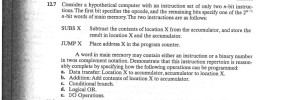 Consider a hypothetical computer with an instruction set of only two n-bit instruc- tions.The first bit specifies the opcode, and the remaining bits specify one of the 2-1 n-bit words of main memory. The two instructions are as follows: 12.7 SUBS X Subtract the contents of location X from the accumulator, and store the result in location X and the accumulator. Place address X in the program counter JUMPX A word in main memory may contain either an instruction or...
The Fibonacci sequence F is defined as F(1) = F(2) = 1 and for n>= 2,...
The Fibonacci sequence F is defined as F(1) = F(2) = 1 and for n>= 2, F(n + 1) = F(n) + F(n − 1) i.e., the (n + 1)th value is given by the sum of the nth value and the (n − 1)th value. 1. Write an assembly program typical of RISC machines for computing the kth value F(k), where k is a natural number greater than 2 loaded from a memory location M, and storing the result...
[20 pts] 5- Consider the following hypothetical 1-address assembly instruction called "Store Accumulator Indirect with Post-increment"...
 [20 pts] 5- Consider the following hypothetical 1-address assembly instruction called "Store Accumulator Indirect with Post-increment" of the form STA (x)- : M(M(x)) ← AC, M(x) ← M(x)+1 Suppose we want to implement this instruction on the pseudo-CPU discussed in class augmented with a temporary register TEMP. An instruction consists of 16 bits: A 4-bit opcode and a 12-bit address. All operands are 16 bits. PC and MAR each contain 12 bits. AC, MDR, and TEMP each contain 16 bits,...
The classic five-stage pipeline MIPS architecture is used to execute the code fragments in this problem....
 The classic five-stage pipeline MIPS architecture is used to execute the code fragments in this problem. Assume the followings: • The architecture fully supports forwarding, • Register write is done in the first half of the clock cycle; register read is performed in the second half of the clock cycle, • Branches are resolved in the third stage of the pipeline and the architecture does not utilize any branch prediction mechanism, • Register R4 is initially 100. L1: lw add...
he classic five-stage pipeline MIPS architecture is used to execute the code fragments in this problem....
 he classic five-stage pipeline MIPS architecture is used to execute the code fragments in this problem. Assume the followings: The architecture fully supports forwarding, • Register write is done in the first half of the clock cycle; register read is performed in the second half of the clock cycle, • Branches are resolved in the third stage of the pipeline and the architecture does not utilize any branch prediction mechanism, • Register R4 is initially 100. Ll: lw add SW...
4. Translate 10*2to exactly 8-digit hexadecimal number. Answers: If the cost for all RAM chips to...
 4. Translate 10*2to exactly 8-digit hexadecimal number. Answers: If the cost for all RAM chips to utilize the maximum memory space of the MIPS architecture is SI dolloars, how much will it cost, approximately, to implement the maximum memory space of the a 64-bit computer architecture Answer: Approximately 6 billions Filli an integer. No fraction.) 6. Fill in the missing pieces of the MIPS assembly codes that translate the following C codes int A[1001. BI 1001; B12] = h +...
The classic five-stage pipeline MIPS architecture is used to execute the code fragments in this problem....
 The classic five-stage pipeline MIPS architecture is used to
execute the code fragments in this problem. Assume the
followings:
The architecture fully supports forwarding,
Register write is done in the first half of the clock cycle;
register read is performed in the second half of the clock
cycle,
Branches are resolved in the third stage of the pipeline and
the architecture does not utilize any branch prediction
mechanism,
Register R4 is initially 100.
L1: lw R1,
0(R4)
add R3, R1, R2
sw ...
The classic five-stage pipeline MIPS architecture is used to
execute the code fragments in this problem. Assume the
followings:
The architecture fully supports forwarding,
Register write is done in the first half of the clock cycle;
register read is performed in the second half of the clock
cycle,
Branches are resolved in the third stage of the pipeline and
the architecture does not utilize any branch prediction
mechanism,
Register R4 is initially 100.
L1: lw R1,
0(R4)
add R3, R1, R2
sw ...
The classic five-stage pipeline MIPS architecture is used to execute the code fragments in this problem....
 The classic five-stage pipeline MIPS architecture is used to execute the code fragments in this problem. Assume the followings: • The architecture fully supports forwarding, • Register write is done in the first half of the clock cycle; register read is performed in the second half of the clock cycle, • Branches are resolved in the third stage of the pipeline and the architecture does not utilize any branch prediction mechanism, • Register R4 is initially 200. L1: lw lw...
 Question 3: ARM Processor a) What is the number of bits in a general-purpose register (e.g., R1) of the ARM Cortex-M4 processor (CPU)? b) What is the number of bits in a memory address for the ARM processor architecture? c) What is the number of bits in an assembly instruction for the ARM Thumb-2 instruction set? d) Consider the memory map used with the TM4C123 microcontroller shown below. If the stack is in data memory, what is the initial address...
 Consider a hypothetical computer with an instruction set of only two n-but instructions. The first bit specifies the opcode, and the remaining bits specify one of the 2-1 n-bit words of main memory. The two instructions are as follows: SUBS X: Subtract the contents of location X from the accumulator, and store the result in location X and the accumulator JUMP X: Place address X in Program Counter A word in memory may contain either an instruction or a binary...
 Consider a hypothetical computer with an instruction set of only two n-bit instruc- tions.The first bit specifies the opcode, and the remaining bits specify one of the 2-1 n-bit words of main memory. The two instructions are as follows: 12.7 SUBS X Subtract the contents of location X from the accumulator, and store the result in location X and the accumulator. Place address X in the program counter JUMPX A word in main memory may contain either an instruction or...
 [20 pts] 5- Consider the following hypothetical 1-address assembly instruction called "Store Accumulator Indirect with Post-increment" of the form STA (x)- : M(M(x)) ← AC, M(x) ← M(x)+1 Suppose we want to implement this instruction on the pseudo-CPU discussed in class augmented with a temporary register TEMP. An instruction consists of 16 bits: A 4-bit opcode and a 12-bit address. All operands are 16 bits. PC and MAR each contain 12 bits. AC, MDR, and TEMP each contain 16 bits,...
 The classic five-stage pipeline MIPS architecture is used to execute the code fragments in this problem. Assume the followings: • The architecture fully supports forwarding, • Register write is done in the first half of the clock cycle; register read is performed in the second half of the clock cycle, • Branches are resolved in the third stage of the pipeline and the architecture does not utilize any branch prediction mechanism, • Register R4 is initially 100. L1: lw add...
 he classic five-stage pipeline MIPS architecture is used to execute the code fragments in this problem. Assume the followings: The architecture fully supports forwarding, • Register write is done in the first half of the clock cycle; register read is performed in the second half of the clock cycle, • Branches are resolved in the third stage of the pipeline and the architecture does not utilize any branch prediction mechanism, • Register R4 is initially 100. Ll: lw add SW...
 4. Translate 10*2to exactly 8-digit hexadecimal number. Answers: If the cost for all RAM chips to utilize the maximum memory space of the MIPS architecture is SI dolloars, how much will it cost, approximately, to implement the maximum memory space of the a 64-bit computer architecture Answer: Approximately 6 billions Filli an integer. No fraction.) 6. Fill in the missing pieces of the MIPS assembly codes that translate the following C codes int A[1001. BI 1001; B12] = h +...
 The classic five-stage pipeline MIPS architecture is used to
execute the code fragments in this problem. Assume the
followings:
The architecture fully supports forwarding,
Register write is done in the first half of the clock cycle;
register read is performed in the second half of the clock
cycle,
Branches are resolved in the third stage of the pipeline and
the architecture does not utilize any branch prediction
mechanism,
Register R4 is initially 100.
L1: lw R1,
0(R4)
add R3, R1, R2
sw ...
The classic five-stage pipeline MIPS architecture is used to
execute the code fragments in this problem. Assume the
followings:
The architecture fully supports forwarding,
Register write is done in the first half of the clock cycle;
register read is performed in the second half of the clock
cycle,
Branches are resolved in the third stage of the pipeline and
the architecture does not utilize any branch prediction
mechanism,
Register R4 is initially 100.
L1: lw R1,
0(R4)
add R3, R1, R2
sw ...
 The classic five-stage pipeline MIPS architecture is used to execute the code fragments in this problem. Assume the followings: • The architecture fully supports forwarding, • Register write is done in the first half of the clock cycle; register read is performed in the second half of the clock cycle, • Branches are resolved in the third stage of the pipeline and the architecture does not utilize any branch prediction mechanism, • Register R4 is initially 200. L1: lw lw...
Most questions answered within 3 hours.
-
Where is the error in this code sequence?
String s1 = "Hello";
String s2 = "ello";...
asked 11 months ago -
Financial data for Joel de Paris, Inc., for last year
follow:
Joel de Paris, Inc.
Balance...
asked 11 months ago -
Consider this reaction:
Al2(SO4)3 (aq)+ BaCl3
(aq) Al2Cl6 (aq)- +
3BaSO4(s) . What is the...
asked 11 months ago -
Suppose that Savneet is considering increasing her
recent random sample from 20 car rentals to 40...
asked 11 months ago -
Trucks arrive at an unloading terminal at an average rate of 120
per hour.
Trucks arrive...
asked 11 months ago -
Why are methanol and ethanol completely soluble in water while
octanol is not very little soluble....
asked 11 months ago -
A facilities manager at a university reads in a research report
that the mean amount of...
asked 11 months ago -
When the CuSO4 is rehydrated by adding water to the anhydrous
compound, is this an endothermic...
asked 11 months ago -
A ray of sunlight is passing from diamond into crown glass; the
angle of incidence is...
asked 11 months ago -
A block of mass 0.249 kg is placed on top of a light, vertical
spring of...
asked 11 months ago -
how do the kidneys compensate in the presences of acidosis
a) trigger hyperventilate
b) reserve acid...
asked 11 months ago -
Question 501 pts
The rental rate of capital to the firm increases. Which of the
following...
asked 11 months ago