A cylindrical container with a cross-sectional area of 60.2cm2 holds a fluid of density 786kg/m3 ....
A cylindrical container with a cross-sectional area of 60.2cm2 holds a fluid of density 786kg/m3 . At the bottom of the container the pressure is 119kPa . Assume Pat = 101 kPa. What is the depth of the fluid? Find the pressure at the bottom of the container after an additional 2.35
Homework Answers
Pressure = density x gravitational acceleration g x
height.
P=786 x 9.81 x h = 119000 Pa
h=119000/(786 x 9.81) m
=> 15.4 m
Add Answer to:
A cylindrical container with a cross-sectional area of 60.2cm2
holds a fluid of density 786kg/m3 ....
A cylindrical container with a cross-sectional area of 61.2 cm2 holds a fluid of density 816...
A cylindrical container with a cross-sectional area of 61.2 cm2 holds a fluid of density 816 kg/m3. At the bottom of the container the pressure is 120 kPa. Assume Pat = 101 kPa. Depth of the fluid = h=2.37m Find the pressure at the bottom of the container after an additional 2.05×10⁻³ m3 of this fluid is added to the container. Assume that no fluid spills out of the container.
A cylindrical container with a cross sectional area of 61.2 cm^2 holds a fluid of density...
A cylindrical container with a cross sectional area of 61.2 cm^2 holds a fluid of density 846 kg/m^3. At the bottom of the container the pressure is 126 kPa. (a) What is the depth of the fluid? (b) Find the pressure at the bottom of the container after an additional 2.05 X 10^-3 m^3 of this fluid is added to the container. Assume that no fluid spills out of the container.
Part (a) The fluid has a density of 920 kg/m, and the tube has a cross-sectional...
 Part (a)
The fluid has a density of 920 kg/m,
and the tube has a cross-sectional area that is much smaller than
the cross-sectional area of the higher container.
Calculate the speed at which the fluid flows out of the tube at
point Z.
_______ m/s
The fluid has a density of 920 kg/m,
and the tube has a cross-sectional area that is much smaller than
the cross-sectional area of the higher container.
Calculate the speed at which the fluid...
Part (a)
The fluid has a density of 920 kg/m,
and the tube has a cross-sectional area that is much smaller than
the cross-sectional area of the higher container.
Calculate the speed at which the fluid flows out of the tube at
point Z.
_______ m/s
The fluid has a density of 920 kg/m,
and the tube has a cross-sectional area that is much smaller than
the cross-sectional area of the higher container.
Calculate the speed at which the fluid...
A liquid of density 890 kg/m3 flows through a horizontal pipe that has a cross-sectional area...
A liquid of density 890 kg/m3 flows through a horizontal pipe that has a cross-sectional area of 2.50 x 10⁻² m2 in region A and a cross-sectional area of 8.50 x 10⁻²m2 in region B. The pressure difference between the two regions is 7.90 x 10³ Pa. What are (a) the volume flow rate and (b) the mass flow rate?
A liquid of density 830 kg/m3 flows through a horizontal pipe that has a cross-sectional area...
A liquid of density 830 kg/m3 flows through a horizontal pipe that has a cross-sectional area of 2.50 x 10⁻² m2 in region A and a cross-sectional area of 9.20 x 10⁻² m2 in region B. The pressure difference between the two regions is 6.80 x 10³ Pa. What are (a) the volume flow rate and (b) the mass flow rate?
A liquid of density 930 kg/m3 flows through a horizontal pipe that has a cross-sectional area...
A liquid of density 930 kg/m3 flows through a horizontal pipe that has a cross-sectional area of 2.90 x 10⁻² m2 in region A and a cross-sectional area of 9.90 x 10⁻² m2 in region B. The pressure difference between the two regions is 7.40 x 10³ Pa. What are (a) the volume flow rate and (b) the mass flow rate?
Problem 2 A concrete dam has a curved surface and restrain water (p=1000kg/m3) at a depth...
 Problem 2 A concrete dam has a curved surface and restrain water (p=1000kg/m3) at a depth H=2 m. The trace of the surface is a parabola described by the equation: z= 0.2x2 . dam 1- Determine the gage pressure distribution in the water 2- Determine the magnitude of the pressure force F acting on the curved dam surface per unit width (dimension normal to the page) of the gate. [Solution: F=45,780 N] 3-Determine the angle of that force relative to...
The oil of density p in a storage tank with cross-sectional area A, is at a...
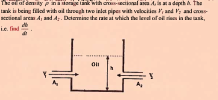 The oil of density p in a storage tank with cross-sectional area A, is at a depth h. The tank is being filled with oil through two inlet pipes with velocities V, and V, and cross- sectional areas A, and A2 . Determine the rate at which the level of oil rises in the tank, dh i.e. find di
An aluminum wire has a mobile charge density is 8.0e28 electrons/m3, and a cross-sectional area of...
An aluminum wire has a mobile charge density is 8.0e28 electrons/m3, and a cross-sectional area of 2.3e-6 m2. When a current flows through the wire, the average drift speed of the electrons is 1.7e-4 m/s. What is the current in the wire?
A container of cross-sectional area 112 cm2 contains liquid of density 1.85 g/cm3 to a height...
A container of cross-sectional area 112 cm2 contains liquid of density 1.85 g/cm3 to a height of 6.60 cm above a small hole of area 1.00 cm2 in the side=2
 Part (a)
The fluid has a density of 920 kg/m,
and the tube has a cross-sectional area that is much smaller than
the cross-sectional area of the higher container.
Calculate the speed at which the fluid flows out of the tube at
point Z.
_______ m/s
The fluid has a density of 920 kg/m,
and the tube has a cross-sectional area that is much smaller than
the cross-sectional area of the higher container.
Calculate the speed at which the fluid...
Part (a)
The fluid has a density of 920 kg/m,
and the tube has a cross-sectional area that is much smaller than
the cross-sectional area of the higher container.
Calculate the speed at which the fluid flows out of the tube at
point Z.
_______ m/s
The fluid has a density of 920 kg/m,
and the tube has a cross-sectional area that is much smaller than
the cross-sectional area of the higher container.
Calculate the speed at which the fluid...
 Problem 2 A concrete dam has a curved surface and restrain water (p=1000kg/m3) at a depth H=2 m. The trace of the surface is a parabola described by the equation: z= 0.2x2 . dam 1- Determine the gage pressure distribution in the water 2- Determine the magnitude of the pressure force F acting on the curved dam surface per unit width (dimension normal to the page) of the gate. [Solution: F=45,780 N] 3-Determine the angle of that force relative to...
 The oil of density p in a storage tank with cross-sectional area A, is at a depth h. The tank is being filled with oil through two inlet pipes with velocities V, and V, and cross- sectional areas A, and A2 . Determine the rate at which the level of oil rises in the tank, dh i.e. find di
Most questions answered within 3 hours.
-
Where is the error in this code sequence?
String s1 = "Hello";
String s2 = "ello";...
asked 10 months ago -
Financial data for Joel de Paris, Inc., for last year
follow:
Joel de Paris, Inc.
Balance...
asked 10 months ago -
Consider this reaction:
Al2(SO4)3 (aq)+ BaCl3
(aq) Al2Cl6 (aq)- +
3BaSO4(s) . What is the...
asked 10 months ago -
Suppose that Savneet is considering increasing her
recent random sample from 20 car rentals to 40...
asked 10 months ago -
Trucks arrive at an unloading terminal at an average rate of 120
per hour.
Trucks arrive...
asked 10 months ago -
Why are methanol and ethanol completely soluble in water while
octanol is not very little soluble....
asked 10 months ago -
A facilities manager at a university reads in a research report
that the mean amount of...
asked 10 months ago -
When the CuSO4 is rehydrated by adding water to the anhydrous
compound, is this an endothermic...
asked 10 months ago -
A ray of sunlight is passing from diamond into crown glass; the
angle of incidence is...
asked 10 months ago -
A block of mass 0.249 kg is placed on top of a light, vertical
spring of...
asked 10 months ago -
how do the kidneys compensate in the presences of acidosis
a) trigger hyperventilate
b) reserve acid...
asked 10 months ago -
Question 501 pts
The rental rate of capital to the firm increases. Which of the
following...
asked 10 months ago