
Homework Answers
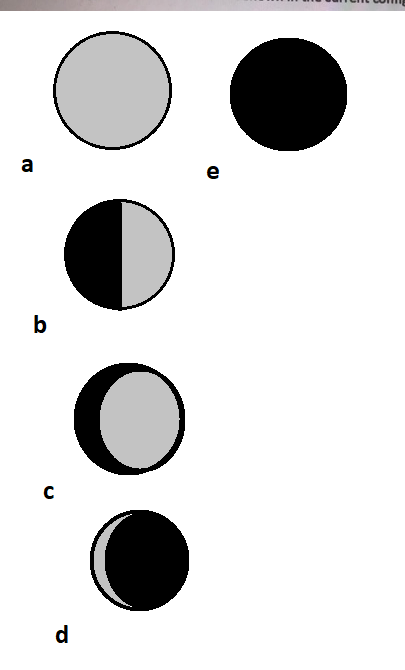
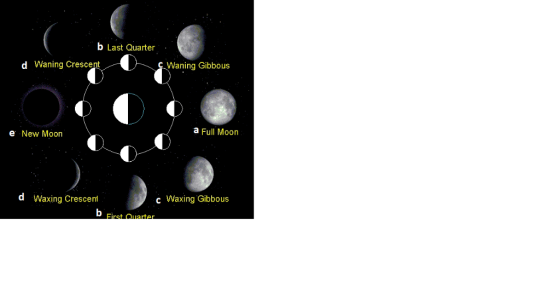
a-Full moon shows Lunar eclipse.
d-New moon solar eclipse
ans 2:
Add Answer to:
2. On the figure above, draw (if not already pictured) and label th following phases (note:...
For this concept sketch I'd like you to sketch, label, and describe the 8 main phases...
For this concept sketch I'd like you to sketch, label, and describe the 8 main phases of the Moon. For each moon phase you must illustrate what the moon looks like from Earth and also its position relative to the Earth and Sun. Also show which Moon phase occurs during a lunar eclipse and during a solar eclipse, and explain why those eclipses occur at those times.
se 4: Phases of the Moon Everyone has seen the Moon, which is a natural satellite...
 se 4: Phases of the Moon Everyone has seen the Moon, which is a natural satellite that orbits the Earth. As the Moon rotates around the Earth it is exposed to various amounts of light from the Sun. The reason for this is simple, the Moon at night because it is reflecting light produced by the Sun and because the Earth is slightly out of the direct line of sight between the Moon and Sun. If it were not, a...
12) Th Dote CPTUAL Physical Science PRASTICE SRECY Chapter 26: The Solar System Earth-Moon-Sun Al...
 12) Th Dote CPTUAL Physical Science PRASTICE SRECY Chapter 26: The Solar System Earth-Moon-Sun Allgnment 4-3-19 Here we see a shadow on a wall cast by an apple. Note how the rays define the darkest part of the shadow, the umbra, and the lghter part of the shadow, the penumbra The shadows that comprise eclipses of planetary bodies are similarty formed. Below lis a diagram of the Sun Earth, and the orbital path of the Moon (dashed cirdle). One position...
2 pts Time Atten 2 Mi Question 1 If the moon only falls partially in the...
 2 pts Time Atten 2 Mi Question 1 If the moon only falls partially in the earth's total shadow what type of eclipse do you get? O partial eclipse total eclipse no eclipse annular eclipse Question 2 2 pts What phase of the moon do you get a solar eclipse? t O new moon full moon O first quarter moon O eclipses are not based on phase U Question 3 2 pts Which phase of moon gives stronger tides, full...
2. In the initial alignment, you cannot see any portion of the illuminated Moon, Which phase...
 2. In the initial alignment, you cannot see any portion of the illuminated Moon, Which phase of the Moon does this initial alignment correspond to? Crescent Moon. Stay in the same spot but turn about 45 degrees, west to east (counterclockwise, as viewed from above). In the circle below, sketch how the Moon looks, by shading in regions that are not lit (for example, the sketch for the initial alignment would have the entire circle shaded in). 3. Is this...
Astronomy ranking task phase of the moon Astronomy Ranking Task: Phases of the Moon Exercise #2 Description: The figure below shows a "top view" of the Sun, Earth and six different positions (...
 Astronomy ranking task phase of the moon
Astronomy Ranking Task: Phases of the Moon Exercise #2 Description: The figure below shows a "top view" of the Sun, Earth and six different positions (A - F) of the Moon during one orbit around Earth. Note that the distances shown for the Sun to Earth and for Earth to the Moon are not drawn to scale Orbit of Moon OD Sunlight SUN NOT TO SCALE Ranking Instructions: Rank (from greatest to least)...
Astronomy ranking task phase of the moon
Astronomy Ranking Task: Phases of the Moon Exercise #2 Description: The figure below shows a "top view" of the Sun, Earth and six different positions (A - F) of the Moon during one orbit around Earth. Note that the distances shown for the Sun to Earth and for Earth to the Moon are not drawn to scale Orbit of Moon OD Sunlight SUN NOT TO SCALE Ranking Instructions: Rank (from greatest to least)...
Question 6 (1 point) Which Moon position (A-E), shown in the diagram at right (where you...
 Question 6 (1 point) Which Moon position (A-E), shown in the diagram at right (where you are looking down on the north pole of Earth), best corresponds with the moon phase shown below? (Note that the drawing is not to scale for the sizes and distances of objects.) Sun Earth C Orbit of the Moon B Match the corresponding moon phase with the correct position of the moon shown in the diagram above in Part B. < 1. A <...
All of the following questions are in relation to the following journal article which is available...
 All of the following questions are in relation to the following journal article which is available on Moodle: Parr CL, Magnus MC, Karlstad O, Holvik K, Lund-Blix NA, Jaugen M, et al. Vitamin A and D intake in pregnancy, infant supplementation and asthma development: the Norwegian Mother and Child Cohort. Am J Clin Nutr 2018:107:789-798 QUESTIONS: 1. State one hypothesis the author's proposed in the manuscript. 2. There is previous research that shows that adequate Vitamin A intake is required...
 se 4: Phases of the Moon Everyone has seen the Moon, which is a natural satellite that orbits the Earth. As the Moon rotates around the Earth it is exposed to various amounts of light from the Sun. The reason for this is simple, the Moon at night because it is reflecting light produced by the Sun and because the Earth is slightly out of the direct line of sight between the Moon and Sun. If it were not, a...
 12) Th Dote CPTUAL Physical Science PRASTICE SRECY Chapter 26: The Solar System Earth-Moon-Sun Allgnment 4-3-19 Here we see a shadow on a wall cast by an apple. Note how the rays define the darkest part of the shadow, the umbra, and the lghter part of the shadow, the penumbra The shadows that comprise eclipses of planetary bodies are similarty formed. Below lis a diagram of the Sun Earth, and the orbital path of the Moon (dashed cirdle). One position...
 2 pts Time Atten 2 Mi Question 1 If the moon only falls partially in the earth's total shadow what type of eclipse do you get? O partial eclipse total eclipse no eclipse annular eclipse Question 2 2 pts What phase of the moon do you get a solar eclipse? t O new moon full moon O first quarter moon O eclipses are not based on phase U Question 3 2 pts Which phase of moon gives stronger tides, full...
 2. In the initial alignment, you cannot see any portion of the illuminated Moon, Which phase of the Moon does this initial alignment correspond to? Crescent Moon. Stay in the same spot but turn about 45 degrees, west to east (counterclockwise, as viewed from above). In the circle below, sketch how the Moon looks, by shading in regions that are not lit (for example, the sketch for the initial alignment would have the entire circle shaded in). 3. Is this...
 Astronomy ranking task phase of the moon
Astronomy Ranking Task: Phases of the Moon Exercise #2 Description: The figure below shows a "top view" of the Sun, Earth and six different positions (A - F) of the Moon during one orbit around Earth. Note that the distances shown for the Sun to Earth and for Earth to the Moon are not drawn to scale Orbit of Moon OD Sunlight SUN NOT TO SCALE Ranking Instructions: Rank (from greatest to least)...
Astronomy ranking task phase of the moon
Astronomy Ranking Task: Phases of the Moon Exercise #2 Description: The figure below shows a "top view" of the Sun, Earth and six different positions (A - F) of the Moon during one orbit around Earth. Note that the distances shown for the Sun to Earth and for Earth to the Moon are not drawn to scale Orbit of Moon OD Sunlight SUN NOT TO SCALE Ranking Instructions: Rank (from greatest to least)...
 Question 6 (1 point) Which Moon position (A-E), shown in the diagram at right (where you are looking down on the north pole of Earth), best corresponds with the moon phase shown below? (Note that the drawing is not to scale for the sizes and distances of objects.) Sun Earth C Orbit of the Moon B Match the corresponding moon phase with the correct position of the moon shown in the diagram above in Part B. < 1. A <...
 All of the following questions are in relation to the following journal article which is available on Moodle: Parr CL, Magnus MC, Karlstad O, Holvik K, Lund-Blix NA, Jaugen M, et al. Vitamin A and D intake in pregnancy, infant supplementation and asthma development: the Norwegian Mother and Child Cohort. Am J Clin Nutr 2018:107:789-798 QUESTIONS: 1. State one hypothesis the author's proposed in the manuscript. 2. There is previous research that shows that adequate Vitamin A intake is required...
Most questions answered within 3 hours.
-
Where is the error in this code sequence?
String s1 = "Hello";
String s2 = "ello";...
asked 10 months ago -
Financial data for Joel de Paris, Inc., for last year
follow:
Joel de Paris, Inc.
Balance...
asked 10 months ago -
Consider this reaction:
Al2(SO4)3 (aq)+ BaCl3
(aq) Al2Cl6 (aq)- +
3BaSO4(s) . What is the...
asked 10 months ago -
Suppose that Savneet is considering increasing her
recent random sample from 20 car rentals to 40...
asked 10 months ago -
Trucks arrive at an unloading terminal at an average rate of 120
per hour.
Trucks arrive...
asked 10 months ago -
Why are methanol and ethanol completely soluble in water while
octanol is not very little soluble....
asked 10 months ago -
A facilities manager at a university reads in a research report
that the mean amount of...
asked 10 months ago -
When the CuSO4 is rehydrated by adding water to the anhydrous
compound, is this an endothermic...
asked 10 months ago -
A ray of sunlight is passing from diamond into crown glass; the
angle of incidence is...
asked 10 months ago -
A block of mass 0.249 kg is placed on top of a light, vertical
spring of...
asked 10 months ago -
how do the kidneys compensate in the presences of acidosis
a) trigger hyperventilate
b) reserve acid...
asked 10 months ago -
Question 501 pts
The rental rate of capital to the firm increases. Which of the
following...
asked 10 months ago