Refer to Interactive Solution 6.59 for a review of the approach taken in problems such as...
Refer to Interactive Solution 6.59 for a review of the approach taken in problems such as this one. A 53.0-kg person jumps from rest off a 4.40-m-high tower straight down into the water. Neglect air resistance during the descent. She comes to rest 1.40 m under the surface of the water. Determine the magnitude of the average force that the water exerts on the diver. This force is non-conservative.
Homework Answers
MGH = MGH + Wnc
(53.0)(9.8)(4.40) = (53.0)(9.8)(-1.40) + Wnc
2285 = -727 + wnc
3012 = Wnc
W=FD
3012= F(1.4)
3012/1.4 = F
2151 = F
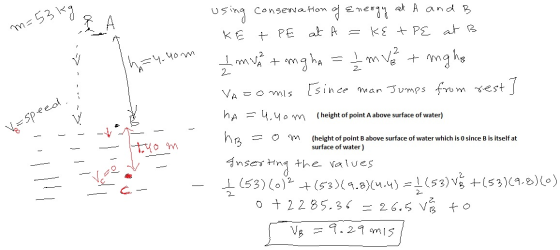
Consider B to C motion inside water ::
Vb = 9.29 m/s
Vc = 0 m/s
d = 1.40 m
Using Kinematics equation ::
Vc^2 + Vb^2 + 2 a d
0^2 = 9.29^2 + 2 a (1.40)
0 = 86.3 + 2.8 a
a = -30.82 m/s2
average force = mass x acceleration
F = (53 kg) (30.82) = 1633.5 N
F = 1633.5 N
Add Answer to:
Refer to Interactive Solution 6.59 for a review of the approach
taken in problems such as...
A 950-kg race car can drive around an unbanked turn at a maximum speed of 44...
A 950-kg race car can drive around an unbanked turn at a maximum speed of 44 m/s without slipping. The turn has a radius of 140 m. Air flowing over the car's wing exerts a downward-pointing force (called the downforce) of 12000 N on the car. (a) What is the coefficient of static friction between the track and the car's tires? (b) What would be the maximum speed if no downforce acted on the car? Refer to Interactive Solution 6.59...
A 64.7 kg person jumps from rest off a 2.83 m-high tower straight down into the...
A 64.7 kg person jumps from rest off a 2.83 m-high tower straight down into the water. Neglect air resistance during the descent. She comes to rest 1.15 m under the surface of the water. Determine the magnitude of the average force that the water exerts on the diver. This force is nonconservative.
A 65.5 kg person jumps from rest off a 2.83 m-high tower straight down into the...
A 65.5 kg person jumps from rest off a 2.83 m-high tower straight down into the water. Neglect air resistance during the descent. She comes to rest 1.15 m under the surface of the water. Determine the magnitude of the average force that the water exerts on the diver. This force is nonconservative.
A 65.3 kg person jumps from rest off a 2.85 m-high tower straight down into the...
A 65.3 kg person jumps from rest off a 2.85 m-high tower straight down into the water. Neglect air resistance during the descent. She comes to rest 1.15 m under the surface of the water. Determine the magnitude of the average force that the water exerts on the diver. This force is nonconservative.
A 67.0 kg person jumps from rest off a 3.00 m high towerstraight down into the...
A 67.0 kg person jumps from rest off a 3.00 m high towerstraight down into the water. Neglect air resistance duringthe descent. She comes to rest 1.10 m under the surface ofthe water. Determine the magnitude of the average force that thewater exerts on the diver. This force isnonconservative.
A 100 kg diver steps off a 10.0 meter tower and dives straight down into the...
A 100 kg diver steps off a 10.0 meter tower and dives straight down into the water. If he comes to rest at 7.50 m beneath the surface of the water, determine the average resistance force that the water exerts on the diver.
A 61.0 kg diver steps off a 14.0 m tower and drops straight down into the water. If he comes...
A 61.0 kg diver steps off a 14.0 m tower and drops straight down into the water. If he comes to rest 7.00 m beneath the surface of the water, determine the average resistance force exerted by the water on the diver.
Interactive Learning Ware 7.1 reviews the approach that is necessary for solving problems such as this...
 Interactive Learning Ware 7.1 reviews the approach that is necessary for solving problems such as this one. A baseball (m = 152 g) approaches a bat horizontally at a speed of 36.8 m/s (82.3 ml/h) and is hit straight back at a speed of 52.8 m/s (118 ml/h). If the ball is in contact with the bat for a time of 1.20 ms, what is the average force exerted on the ball by the bat? Neglect the weight of the...
Interactive LearningWare 7.1 reviews the approach that is necessary for solving problems such as this one....
Interactive LearningWare 7.1 reviews the approach that is necessary for solving problems such as this one. A baseball (m = 150 g) approaches a bat horizontally at a speed of 41.1 m/s (92.0 mi/h) and is hit straight back at a speed of 47.8 m/s (107 mi/h). If the ball is in contact with the bat for a time of 1.19 ms, what is the average force exerted on the ball by the bat? Neglect the weight of the bat,...
Refer to Interactive Solution 19.25 to review one way in which this problem can be solved....
 Refer to Interactive Solution 19.25 to review one way in which this problem can be solved. Two protons are moving directly toward one another. When they are very far apart, their initial speeds are 2.10 x 10² m/s. What is the distance of closest approach? Number Units
 Interactive Learning Ware 7.1 reviews the approach that is necessary for solving problems such as this one. A baseball (m = 152 g) approaches a bat horizontally at a speed of 36.8 m/s (82.3 ml/h) and is hit straight back at a speed of 52.8 m/s (118 ml/h). If the ball is in contact with the bat for a time of 1.20 ms, what is the average force exerted on the ball by the bat? Neglect the weight of the...
 Refer to Interactive Solution 19.25 to review one way in which this problem can be solved. Two protons are moving directly toward one another. When they are very far apart, their initial speeds are 2.10 x 10² m/s. What is the distance of closest approach? Number Units
Most questions answered within 3 hours.
-
Where is the error in this code sequence?
String s1 = "Hello";
String s2 = "ello";...
asked 10 months ago -
Financial data for Joel de Paris, Inc., for last year
follow:
Joel de Paris, Inc.
Balance...
asked 10 months ago -
Consider this reaction:
Al2(SO4)3 (aq)+ BaCl3
(aq) Al2Cl6 (aq)- +
3BaSO4(s) . What is the...
asked 10 months ago -
Suppose that Savneet is considering increasing her
recent random sample from 20 car rentals to 40...
asked 10 months ago -
Trucks arrive at an unloading terminal at an average rate of 120
per hour.
Trucks arrive...
asked 10 months ago -
Why are methanol and ethanol completely soluble in water while
octanol is not very little soluble....
asked 10 months ago -
A facilities manager at a university reads in a research report
that the mean amount of...
asked 10 months ago -
When the CuSO4 is rehydrated by adding water to the anhydrous
compound, is this an endothermic...
asked 10 months ago -
A ray of sunlight is passing from diamond into crown glass; the
angle of incidence is...
asked 10 months ago -
A block of mass 0.249 kg is placed on top of a light, vertical
spring of...
asked 10 months ago -
how do the kidneys compensate in the presences of acidosis
a) trigger hyperventilate
b) reserve acid...
asked 10 months ago -
Question 501 pts
The rental rate of capital to the firm increases. Which of the
following...
asked 10 months ago