
Homework Answers
MATLAB CODE:
%This program calculates the step response of a single degree of freedom system
a=input('Enter coefficient of ddx : ');
b=input('Enter coefficient of dx : ');
c=input('Enter coefficient of x : ');
wn=sqrt(c/a);
zeta=b/(2*a*wn);
tf=10;
npts=1000;
t=linspace(0,tf,npts);
to=input('Enter time instant for step input : ');;
k=(wn)^2;
Fm=input('Enter a force magnitude : ');
Fint=Fm*ones(1,npts);
qtest=t>to;
fmult=[qtest];
Fo=Fint.*fmult; % The force matrix.
wd=wn*sqrt(1-zeta^2);
phi=atan2(zeta,sqrt(1-zeta^2));
A=Fo(1,:)/k;
B=Fo(1,:)/(k*sqrt(1-zeta^2));
x=A-B.*exp(-zeta*wn*t).*cos(wd*t-phi);
plot(t,x)
title(['Response for wn=',num2str(wn),', Fmax=',num2str(Fm(1)),',
and time=', num2str(to)]);
ylabel('Response x')
xlabel('Time, seconds')
grid
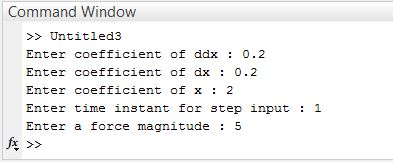
INPUT FOR TEST RUN:
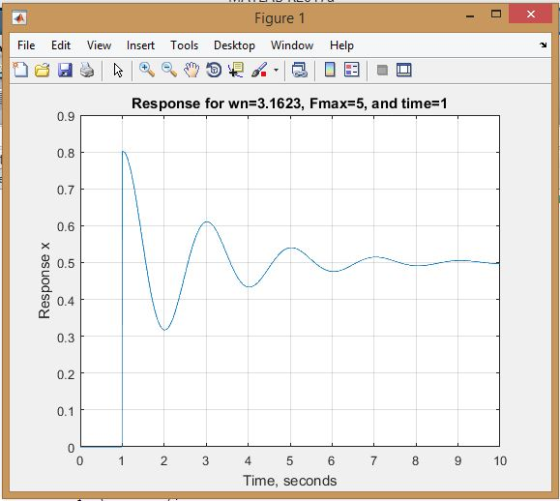
OUTPUT OF ABOVE TEST RUN:
Add Answer to:
Consider the system 0.28 +0.2x + 2x = f(t), where f(t) is a unit step function,...
Problem1 The response of an underdamped second order system to a step input can be expressed as a...
 Problem1 The response of an underdamped second order system to a step input can be expressed as a) Plot the system's response and from this response, explain how you would determine the rise time and settling time of the system (define these terms) b) If the experimentally observed damped period of oscillation of the system is 0.577ms and, from a logarithmic decrement analysis, the damping ratio is found to be is the damped circular frequency of the system? the natural...
Question three The figure below shows a unit step response of a second order system. From...
 Question three The figure below shows a unit step response of a second order system. From the graph of response find: 1- The rise timet, 2- The peak timet, 3- The maximum overshoot Mp 4- The damped natural frequency w 5. The transfer function. Hence find the damping ratio ζ and the natural frequency ah-Find also the transfer function of the system. r 4 02 15 25 35 45 Question Four For the control system shown in the figure below,...
Do only parts C and D 1. A second-order system has the following transfer function that...
 Do only parts C and D
1. A second-order system has the following transfer function that describes its response: F(s)- s2 +as + 9 A. For a -3, calculate the following performance specifications of the system: Natural frequency (on) Damping ratio( Estimated rise time and settling time with ±5% change (tr, ts) Estimated overshoot (MP) . B. Label (a) ±5% range of steady state, (b) tr, (c) ts, and (d) MP on the step response curve below (You may also...
Do only parts C and D
1. A second-order system has the following transfer function that describes its response: F(s)- s2 +as + 9 A. For a -3, calculate the following performance specifications of the system: Natural frequency (on) Damping ratio( Estimated rise time and settling time with ±5% change (tr, ts) Estimated overshoot (MP) . B. Label (a) ±5% range of steady state, (b) tr, (c) ts, and (d) MP on the step response curve below (You may also...
2. then design the LF components Ri. R2,and C to produce and plot with Matlab the following step ...
 2. then design the LF components Ri. R2,and C to produce and plot with Matlab the following step responses by the PLL a. overdamped, b. underdamped, c. critically damped; 3. calculate the phase step response's following parameters: a. b. c. d. rise time T peak time Tp (if applicable) percent overshoot %OS(if applicable) settling time T, c) calculate the steady state phase error lim0e(t) for both PLL types, and draw conclusions whether your PLL can track the: i. incoming signal's...
The system has a steady-state gain of K = 23.8 rad/s/ and a time constant of...
 The system has a steady-state gain of K = 23.8 rad/s/ and a time constant of t = 0.1 seconds. Let us further assume that you are required to design a PD position controller that has an overshoot of less than 5% and a peak time of no more than 0.2 seconds. 1. Using Equations 4 and 5 determine the required natural frequency (wn) and damping ratio (7) that will satisfy the overshoot and rise time requirements of the controller....
only b and c please 1 Consider the system whose transfer function is given by: G(S)...
 only b and c please
1 Consider the system whose transfer function is given by: G(S) == (2s +1)(s+3) unction is given by: G(s) - (a) Use the root-locus design methodology to design a lead compensator that will provide a closed-loop damping 5 =0.4 and a natural frequency on =9 rad/sec. The general transfer function for lead compensation is given by D(5)=K (977), p>z, 2=2 (b) Use MATLAB to plot the root locus of the feed-forward transfer function, D(s)*G(s), and...
only b and c please
1 Consider the system whose transfer function is given by: G(S) == (2s +1)(s+3) unction is given by: G(s) - (a) Use the root-locus design methodology to design a lead compensator that will provide a closed-loop damping 5 =0.4 and a natural frequency on =9 rad/sec. The general transfer function for lead compensation is given by D(5)=K (977), p>z, 2=2 (b) Use MATLAB to plot the root locus of the feed-forward transfer function, D(s)*G(s), and...
Problem1 The response of an underdamped second order system to a step input can be expressed...
 Problem1 The response of an underdamped second order system to a step input can be expressed as a) Plot the system's response and from this response, explain how you would determine the rise time and settling time of the system (define these terms) b) If the experimentally observed damped period of oscillation of the system is 0.577ms and, from a logarithmic decrement analysis, the damping ratio is found to be is the damped circular frequency of the system? the natural...
Problem : Consider the systems A and B whose roots are shown below BI 1. Regarding stability, the systems are a) b) c) d) Both stable Both unstable A is unstable and B is stable A is stable and B is...
 Problem : Consider the systems A and B whose roots are shown below BI 1. Regarding stability, the systems are a) b) c) d) Both stable Both unstable A is unstable and B is stable A is stable and B is unstable 2. The responses of the systems to step input are characterized as follows: a) Both are underdamped b) Both are overdamped c) A is underdamped and B is overdamped d) A is overdamped and B is underdamped 3....
Unit Step Response .A plant has the response, c(), to a unit step, as shown. 3.5 a. From the grap...
 Unit Step Response .A plant has the response, c(), to a unit step, as shown. 3.5 a. From the graph, estimate 3 3 the system's time constant, 5 % overshoot and DC gain. 2 1.5 c. Using the information, find o.5 b. What is the system's damped natural frequency and damping ratio? the second order transfer function C(s)/R(s). 0.2 0.4 0.6 0.8 1.2 Time (sec)
Unit Step Response .A plant has the response, c(), to a unit step, as shown....
Unit Step Response .A plant has the response, c(), to a unit step, as shown. 3.5 a. From the graph, estimate 3 3 the system's time constant, 5 % overshoot and DC gain. 2 1.5 c. Using the information, find o.5 b. What is the system's damped natural frequency and damping ratio? the second order transfer function C(s)/R(s). 0.2 0.4 0.6 0.8 1.2 Time (sec)
Unit Step Response .A plant has the response, c(), to a unit step, as shown....
can help to solve this ? Thank you Consider the second order system when damping ratio...
 can help to solve this ? Thank
you
Consider the second order system when damping ratio = 8.6. and natural angles frequency = 5 rad/sec, find the rise time, Peak time, max. overshoot, and setting time (20/5) when the system is sub-pected to a unit-step input.
can help to solve this ? Thank
you
Consider the second order system when damping ratio = 8.6. and natural angles frequency = 5 rad/sec, find the rise time, Peak time, max. overshoot, and setting time (20/5) when the system is sub-pected to a unit-step input.
 Problem1 The response of an underdamped second order system to a step input can be expressed as a) Plot the system's response and from this response, explain how you would determine the rise time and settling time of the system (define these terms) b) If the experimentally observed damped period of oscillation of the system is 0.577ms and, from a logarithmic decrement analysis, the damping ratio is found to be is the damped circular frequency of the system? the natural...
 Question three The figure below shows a unit step response of a second order system. From the graph of response find: 1- The rise timet, 2- The peak timet, 3- The maximum overshoot Mp 4- The damped natural frequency w 5. The transfer function. Hence find the damping ratio ζ and the natural frequency ah-Find also the transfer function of the system. r 4 02 15 25 35 45 Question Four For the control system shown in the figure below,...
 Do only parts C and D
1. A second-order system has the following transfer function that describes its response: F(s)- s2 +as + 9 A. For a -3, calculate the following performance specifications of the system: Natural frequency (on) Damping ratio( Estimated rise time and settling time with ±5% change (tr, ts) Estimated overshoot (MP) . B. Label (a) ±5% range of steady state, (b) tr, (c) ts, and (d) MP on the step response curve below (You may also...
Do only parts C and D
1. A second-order system has the following transfer function that describes its response: F(s)- s2 +as + 9 A. For a -3, calculate the following performance specifications of the system: Natural frequency (on) Damping ratio( Estimated rise time and settling time with ±5% change (tr, ts) Estimated overshoot (MP) . B. Label (a) ±5% range of steady state, (b) tr, (c) ts, and (d) MP on the step response curve below (You may also...
 2. then design the LF components Ri. R2,and C to produce and plot with Matlab the following step responses by the PLL a. overdamped, b. underdamped, c. critically damped; 3. calculate the phase step response's following parameters: a. b. c. d. rise time T peak time Tp (if applicable) percent overshoot %OS(if applicable) settling time T, c) calculate the steady state phase error lim0e(t) for both PLL types, and draw conclusions whether your PLL can track the: i. incoming signal's...
 The system has a steady-state gain of K = 23.8 rad/s/ and a time constant of t = 0.1 seconds. Let us further assume that you are required to design a PD position controller that has an overshoot of less than 5% and a peak time of no more than 0.2 seconds. 1. Using Equations 4 and 5 determine the required natural frequency (wn) and damping ratio (7) that will satisfy the overshoot and rise time requirements of the controller....
 only b and c please
1 Consider the system whose transfer function is given by: G(S) == (2s +1)(s+3) unction is given by: G(s) - (a) Use the root-locus design methodology to design a lead compensator that will provide a closed-loop damping 5 =0.4 and a natural frequency on =9 rad/sec. The general transfer function for lead compensation is given by D(5)=K (977), p>z, 2=2 (b) Use MATLAB to plot the root locus of the feed-forward transfer function, D(s)*G(s), and...
only b and c please
1 Consider the system whose transfer function is given by: G(S) == (2s +1)(s+3) unction is given by: G(s) - (a) Use the root-locus design methodology to design a lead compensator that will provide a closed-loop damping 5 =0.4 and a natural frequency on =9 rad/sec. The general transfer function for lead compensation is given by D(5)=K (977), p>z, 2=2 (b) Use MATLAB to plot the root locus of the feed-forward transfer function, D(s)*G(s), and...
 Problem1 The response of an underdamped second order system to a step input can be expressed as a) Plot the system's response and from this response, explain how you would determine the rise time and settling time of the system (define these terms) b) If the experimentally observed damped period of oscillation of the system is 0.577ms and, from a logarithmic decrement analysis, the damping ratio is found to be is the damped circular frequency of the system? the natural...
 Problem : Consider the systems A and B whose roots are shown below BI 1. Regarding stability, the systems are a) b) c) d) Both stable Both unstable A is unstable and B is stable A is stable and B is unstable 2. The responses of the systems to step input are characterized as follows: a) Both are underdamped b) Both are overdamped c) A is underdamped and B is overdamped d) A is overdamped and B is underdamped 3....
 Unit Step Response .A plant has the response, c(), to a unit step, as shown. 3.5 a. From the graph, estimate 3 3 the system's time constant, 5 % overshoot and DC gain. 2 1.5 c. Using the information, find o.5 b. What is the system's damped natural frequency and damping ratio? the second order transfer function C(s)/R(s). 0.2 0.4 0.6 0.8 1.2 Time (sec)
Unit Step Response .A plant has the response, c(), to a unit step, as shown....
Unit Step Response .A plant has the response, c(), to a unit step, as shown. 3.5 a. From the graph, estimate 3 3 the system's time constant, 5 % overshoot and DC gain. 2 1.5 c. Using the information, find o.5 b. What is the system's damped natural frequency and damping ratio? the second order transfer function C(s)/R(s). 0.2 0.4 0.6 0.8 1.2 Time (sec)
Unit Step Response .A plant has the response, c(), to a unit step, as shown....
 can help to solve this ? Thank
you
Consider the second order system when damping ratio = 8.6. and natural angles frequency = 5 rad/sec, find the rise time, Peak time, max. overshoot, and setting time (20/5) when the system is sub-pected to a unit-step input.
can help to solve this ? Thank
you
Consider the second order system when damping ratio = 8.6. and natural angles frequency = 5 rad/sec, find the rise time, Peak time, max. overshoot, and setting time (20/5) when the system is sub-pected to a unit-step input.
Most questions answered within 3 hours.
-
Where is the error in this code sequence?
String s1 = "Hello";
String s2 = "ello";...
asked 11 months ago -
Financial data for Joel de Paris, Inc., for last year
follow:
Joel de Paris, Inc.
Balance...
asked 11 months ago -
Consider this reaction:
Al2(SO4)3 (aq)+ BaCl3
(aq) Al2Cl6 (aq)- +
3BaSO4(s) . What is the...
asked 11 months ago -
Suppose that Savneet is considering increasing her
recent random sample from 20 car rentals to 40...
asked 11 months ago -
Trucks arrive at an unloading terminal at an average rate of 120
per hour.
Trucks arrive...
asked 11 months ago -
Why are methanol and ethanol completely soluble in water while
octanol is not very little soluble....
asked 11 months ago -
A facilities manager at a university reads in a research report
that the mean amount of...
asked 11 months ago -
When the CuSO4 is rehydrated by adding water to the anhydrous
compound, is this an endothermic...
asked 11 months ago -
A ray of sunlight is passing from diamond into crown glass; the
angle of incidence is...
asked 11 months ago -
A block of mass 0.249 kg is placed on top of a light, vertical
spring of...
asked 11 months ago -
how do the kidneys compensate in the presences of acidosis
a) trigger hyperventilate
b) reserve acid...
asked 11 months ago -
Question 501 pts
The rental rate of capital to the firm increases. Which of the
following...
asked 11 months ago