
Homework Answers
| Base 10 | Base 2 | Base 8 | Base 16 | 2's complement | ||
| A | 513 | 1000000001 | 1001 | 201 | 111111111 | |
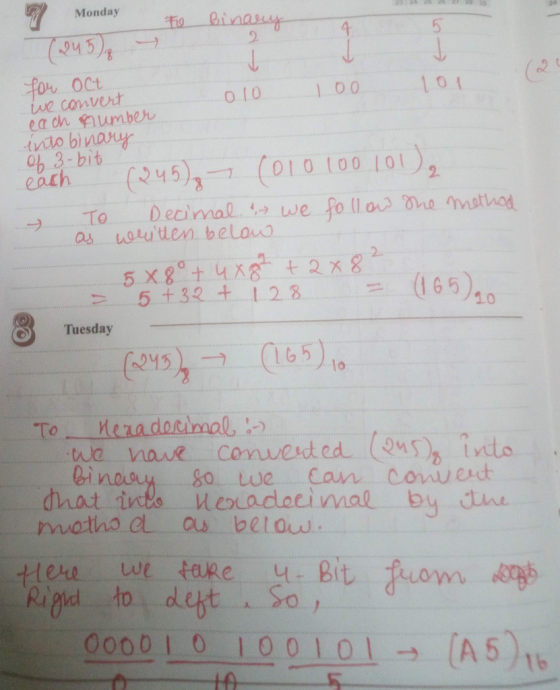
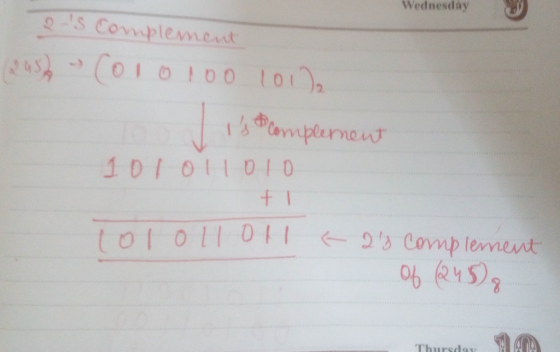
| B | 165 | 10100101 | 245 | A5 | 101011011 | |
| C | 1005 | 1111101101 | 1755 | 3ED | 10011 | |
| D | 9 | 1001 | 11 | 9 | 111 | |
| E | -21 | 1100001 | -25 | -15 | 11111 | |
| F | -53 | 11010011 | -65 | -35 | 101101 | |
and for B explaination is given below...
Add Answer to:
8. Fill the following table using the code conversion rules Base 10 Base 2 (Sign-Magnitude) Base...
Perform the following base conversion 10011000 is in 2's Complement ?) in 7's complement notation 1....
 Perform the following base conversion 10011000 is in 2's Complement ?) in 7's complement notation 1. 2. 0.335 base 6-() base 10. Given a 2K by 8 bit memory device with three enable pins. The device is enabled when E2 E1 E0-110. Show how to connect the device to the 16 bit Address Bus so that it is located at ŞE000 and takes up exactly 2K of memory space 3. 4 Write -27.5 signed base 10 in 16 bit Floating...
convert -99 into 8-bit sign-magnitude, 1's complement, 2's complement. show detailed explanations for all conversions.
convert -99 into 8-bit sign-magnitude, 1's complement, 2's complement. show detailed explanations for all conversions.
Using positional notation, express the number 517 in Base 8 Note: Start your expression with an-s...
 Using positional notation, express the number 517 in Base 8 Note: Start your expression with an-sign. Use symbols+and for your operators. Do not include resulting value Question 47 (1 point) Saved Given a fixed-sized number scheme where 2 is the number of digits used for the 10's complement representation how many positive integers can be represented?
Using positional notation, express the number 517 in Base 8 Note: Start your expression with an-sign. Use symbols+and for your operators. Do not include...
Using positional notation, express the number 517 in Base 8 Note: Start your expression with an-sign. Use symbols+and for your operators. Do not include resulting value Question 47 (1 point) Saved Given a fixed-sized number scheme where 2 is the number of digits used for the 10's complement representation how many positive integers can be represented?
Using positional notation, express the number 517 in Base 8 Note: Start your expression with an-sign. Use symbols+and for your operators. Do not include...
Express the following in one’s complement format using 8 bits: a. (‒46)base 8 : b. –(98)base...
Express the following in one’s complement format using 8 bits: a. (‒46)base 8 : b. –(98)base 10 : c. ‒(011.1010)base 2 : d. (2 5/16)base 10 : e. (‒1 1011.10)base 2 :
In ALL these problems, you MUST show your conversion procedure. No procedure = zero points. a)...
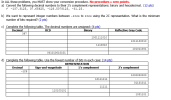 In ALL these problems, you MUST show your conversion procedure. No procedure = zero points. a) Convert the following decimal numbers to their 2's complement representations: binary and hexadecimal. (12 pts) ✓ -137.3125, 37.65625, -128.5078125, -31.25. b) We want to represent integer numbers between -1024 to 1024 using the 2C representation. What is the minimum number of bits required? (2 pts) c) Complete the following table. The decimal numbers are unsigned: 6 pts) Decimal Binary BCD | Reflective Gray Code...
(a) Subtract (78) in base 10 from (97) in base 10 using 2's complement arithmetic ,...
(a) Subtract (78) in base 10 from (97) in base 10 using 2's complement arithmetic , (b) Divide the number (221) in base 10 and (17) in base 10 by converting the original decimal number to its 8-bit equivalent using straight binary.
For problems 8, 9 and 10, convert the following decimal numbers into 8‑bit binary numbers as...
For problems 8, 9 and 10, convert the following decimal numbers into 8‑bit binary numbers as required for 2's complement math, and perform the indicated operations. Circle or bold your binary answer and show your work. Notes: Remember that positive numbers are represented in sign-magnitude format in 2's complement math 8. +26 +15 = 9. +26 - 15 = 10. - 26 +15 =
4-6 with explained work 4. Solve the following conversions: a. (0126F9D4)16 ? in base 8 b.(11100010)2...
 4-6 with explained work
4. Solve the following conversions: a. (0126F9D4)16 ? in base 8 b.(11100010)2 ? in base 16 5. Show the 1's complement representation on 1 Byte for the following signed decimal numbers: b.57 a.-100 6. Show the 2's complement representation on 1 Byte for the following signed decimal numbers: b. 57 a.-100
4-6 with explained work
4. Solve the following conversions: a. (0126F9D4)16 ? in base 8 b.(11100010)2 ? in base 16 5. Show the 1's complement representation on 1 Byte for the following signed decimal numbers: b.57 a.-100 6. Show the 2's complement representation on 1 Byte for the following signed decimal numbers: b. 57 a.-100
question 1 part 2 and 3 thank you (47) Naruto Notone C Sign In er Sign...
 question 1 part 2 and 3 thank you
(47) Naruto Notone C Sign In er Sign Up | Ch ® UFC & MMA × Secure I https://piazza-resourcess3.amazonaws.com/jgopch0cb93d8/j .pdfAWSAccessKeyld-AKAILDNRL/4ALKBWOHA8lexpires-15200435/2&Signature-ol9aXG9 /UAKIHS0QUwMeyBX.. ☆ ミ quations must be properly tyne-set including superscript-s expunents, Always watch the course websile for updates on the assignments. Question 1 (4 points) Show you work I. Convert 2727 into a 32-bit two's complement binary number 2. Convert -5795 into a 16-bit two's complement binary number 3. Add the above...
question 1 part 2 and 3 thank you
(47) Naruto Notone C Sign In er Sign Up | Ch ® UFC & MMA × Secure I https://piazza-resourcess3.amazonaws.com/jgopch0cb93d8/j .pdfAWSAccessKeyld-AKAILDNRL/4ALKBWOHA8lexpires-15200435/2&Signature-ol9aXG9 /UAKIHS0QUwMeyBX.. ☆ ミ quations must be properly tyne-set including superscript-s expunents, Always watch the course websile for updates on the assignments. Question 1 (4 points) Show you work I. Convert 2727 into a 32-bit two's complement binary number 2. Convert -5795 into a 16-bit two's complement binary number 3. Add the above...
Q1) Convert the following negative decimal numbers to 8 bit binary using the 2’s complement (show...
Q1) Convert the following negative decimal numbers to 8 bit binary using the 2’s complement (show the steps): a) -39 b) -127 Q2) Solve the following subtraction problems using 2's complement representation. (Show the steps using 8-bits) a) 19 – 87 b) 89 – 5 Q3) Convert the following numbers into scientific notation: (Note: to show ten raised to the power of n, you can type as 10^n) a) 654.345 b) 0.000000324235 c) 25600000000000 Q4) Convert the following numbers out...
 Perform the following base conversion 10011000 is in 2's Complement ?) in 7's complement notation 1. 2. 0.335 base 6-() base 10. Given a 2K by 8 bit memory device with three enable pins. The device is enabled when E2 E1 E0-110. Show how to connect the device to the 16 bit Address Bus so that it is located at ŞE000 and takes up exactly 2K of memory space 3. 4 Write -27.5 signed base 10 in 16 bit Floating...
 Using positional notation, express the number 517 in Base 8 Note: Start your expression with an-sign. Use symbols+and for your operators. Do not include resulting value Question 47 (1 point) Saved Given a fixed-sized number scheme where 2 is the number of digits used for the 10's complement representation how many positive integers can be represented?
Using positional notation, express the number 517 in Base 8 Note: Start your expression with an-sign. Use symbols+and for your operators. Do not include...
Using positional notation, express the number 517 in Base 8 Note: Start your expression with an-sign. Use symbols+and for your operators. Do not include resulting value Question 47 (1 point) Saved Given a fixed-sized number scheme where 2 is the number of digits used for the 10's complement representation how many positive integers can be represented?
Using positional notation, express the number 517 in Base 8 Note: Start your expression with an-sign. Use symbols+and for your operators. Do not include...
 In ALL these problems, you MUST show your conversion procedure. No procedure = zero points. a) Convert the following decimal numbers to their 2's complement representations: binary and hexadecimal. (12 pts) ✓ -137.3125, 37.65625, -128.5078125, -31.25. b) We want to represent integer numbers between -1024 to 1024 using the 2C representation. What is the minimum number of bits required? (2 pts) c) Complete the following table. The decimal numbers are unsigned: 6 pts) Decimal Binary BCD | Reflective Gray Code...
 4-6 with explained work
4. Solve the following conversions: a. (0126F9D4)16 ? in base 8 b.(11100010)2 ? in base 16 5. Show the 1's complement representation on 1 Byte for the following signed decimal numbers: b.57 a.-100 6. Show the 2's complement representation on 1 Byte for the following signed decimal numbers: b. 57 a.-100
4-6 with explained work
4. Solve the following conversions: a. (0126F9D4)16 ? in base 8 b.(11100010)2 ? in base 16 5. Show the 1's complement representation on 1 Byte for the following signed decimal numbers: b.57 a.-100 6. Show the 2's complement representation on 1 Byte for the following signed decimal numbers: b. 57 a.-100
 question 1 part 2 and 3 thank you
(47) Naruto Notone C Sign In er Sign Up | Ch ® UFC & MMA × Secure I https://piazza-resourcess3.amazonaws.com/jgopch0cb93d8/j .pdfAWSAccessKeyld-AKAILDNRL/4ALKBWOHA8lexpires-15200435/2&Signature-ol9aXG9 /UAKIHS0QUwMeyBX.. ☆ ミ quations must be properly tyne-set including superscript-s expunents, Always watch the course websile for updates on the assignments. Question 1 (4 points) Show you work I. Convert 2727 into a 32-bit two's complement binary number 2. Convert -5795 into a 16-bit two's complement binary number 3. Add the above...
question 1 part 2 and 3 thank you
(47) Naruto Notone C Sign In er Sign Up | Ch ® UFC & MMA × Secure I https://piazza-resourcess3.amazonaws.com/jgopch0cb93d8/j .pdfAWSAccessKeyld-AKAILDNRL/4ALKBWOHA8lexpires-15200435/2&Signature-ol9aXG9 /UAKIHS0QUwMeyBX.. ☆ ミ quations must be properly tyne-set including superscript-s expunents, Always watch the course websile for updates on the assignments. Question 1 (4 points) Show you work I. Convert 2727 into a 32-bit two's complement binary number 2. Convert -5795 into a 16-bit two's complement binary number 3. Add the above...
Most questions answered within 3 hours.
-
Where is the error in this code sequence?
String s1 = "Hello";
String s2 = "ello";...
asked 10 months ago -
Financial data for Joel de Paris, Inc., for last year
follow:
Joel de Paris, Inc.
Balance...
asked 10 months ago -
Consider this reaction:
Al2(SO4)3 (aq)+ BaCl3
(aq) Al2Cl6 (aq)- +
3BaSO4(s) . What is the...
asked 10 months ago -
Suppose that Savneet is considering increasing her
recent random sample from 20 car rentals to 40...
asked 10 months ago -
Trucks arrive at an unloading terminal at an average rate of 120
per hour.
Trucks arrive...
asked 10 months ago -
Why are methanol and ethanol completely soluble in water while
octanol is not very little soluble....
asked 10 months ago -
A facilities manager at a university reads in a research report
that the mean amount of...
asked 10 months ago -
When the CuSO4 is rehydrated by adding water to the anhydrous
compound, is this an endothermic...
asked 10 months ago -
A ray of sunlight is passing from diamond into crown glass; the
angle of incidence is...
asked 10 months ago -
A block of mass 0.249 kg is placed on top of a light, vertical
spring of...
asked 10 months ago -
how do the kidneys compensate in the presences of acidosis
a) trigger hyperventilate
b) reserve acid...
asked 10 months ago -
Question 501 pts
The rental rate of capital to the firm increases. Which of the
following...
asked 10 months ago