Compare equal molar aqueous solutions of the following and place the solutions in decreasing order of...
Compare equal molar aqueous solutions of the following and place the solutions in decreasing order of pH: HBr KI NaOH H2SO4 CH3NH3Cl LiNO2 (show working)
Homework Answers

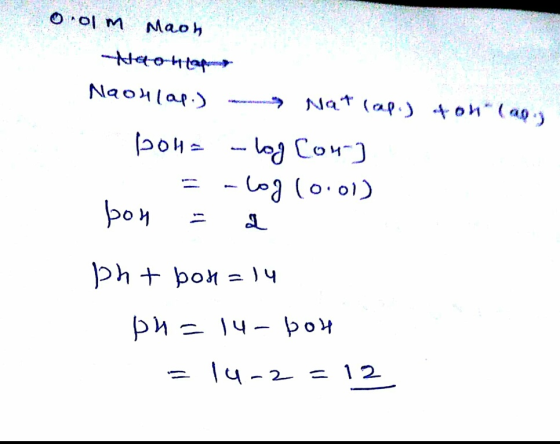

Add Answer to:
Compare equal molar aqueous solutions of the following and place
the solutions in decreasing order of...
Chem help please, thank you! Consider the pH of 0.01 M aqueous solutions of the following...
 Chem help please, thank you!
Consider the pH of 0.01 M aqueous solutions of the following NH3 (aq), HBr (aq), CH3CH2COOH (aq), NaOH (aq) When the solutions are placed in order of decreasing pH (i.e., from highest pH to lowest) the correct order is: O A. NH3> HBr > NaOH > CH3CH2COOH O B. HBr > CH3CH2COOH > NH3 > NaOH O C. NH3 > HBr > CH3CH2COOH > NaOH O D. NaOH > NH3 > CH3CH2COOH> HBr O E....
Chem help please, thank you!
Consider the pH of 0.01 M aqueous solutions of the following NH3 (aq), HBr (aq), CH3CH2COOH (aq), NaOH (aq) When the solutions are placed in order of decreasing pH (i.e., from highest pH to lowest) the correct order is: O A. NH3> HBr > NaOH > CH3CH2COOH O B. HBr > CH3CH2COOH > NH3 > NaOH O C. NH3 > HBr > CH3CH2COOH > NaOH O D. NaOH > NH3 > CH3CH2COOH> HBr O E....
Assuming each solution to be 0.10 M , rank the following aqueous solutions in order of...
Assuming each solution to be 0.10 M , rank the following aqueous solutions in order of decreasing pH. Rank the solutions from the highest to lowest pH. To rank items as equivalent, overlap them N2H2 Ba(OH)2 HOCL NAOH HCL
Arrange the following 0.10 M solutions in order of decreasing pH (highest to lowest): NaCIO, KCI,...
 Arrange the following 0.10 M solutions in order of decreasing pH (highest to lowest): NaCIO, KCI, HBr, NaBro, CH3NH2Br NaBro > NaCIO > KCI > CH3NH3Br > HBr NACIO > NaBro > KCI > CH3NH2Br > HBr CH3NH2Br > NaBro > NaCIO > KCI > HBr NaCIO > CH3NH2Br > NaBro KCI > HBr NaBro > CH3NH2Br > NaCIO > KCI > HBr
Place the following solutions in order of increasing osmotic pressure.
 QUESTION 3 Place the following solutions in order of increasing osmotic pressure. (Hint: the solutes are l. molecule, II. a soluble ionic and III. a weak acid). I.0.15 M C2H6O2 II. 0.15 M NaCI III. 0.15 M HFQUESTION 4 Place the following aqueous solutions of nonvolatile, nonionic compounds in order of decreasing osmotic pressure. I. 0.011 M sucrose II. 0.0095 M glucose III. 0.0060 M glycerin
8. Arrange the following aqueous solutions in order of decreasing normal boiling point. 0.20m sucrose (a...
8. Arrange the following aqueous solutions in order of decreasing normal boiling point. 0.20m sucrose (a non-electrolyte) 0.20m KCl 0.10m CaCl2 0.20m HF (7% ionized) HIGHEST To LOWEST
List the following aqueous solutions in order of decreasing freezing point: 0.13 M NaCl, 0.36 M...
List the following aqueous solutions in order of decreasing freezing point: 0.13 M NaCl, 0.36 M NH3 , 0.12 M NiCl2, 0.12 M NH3.
Which one of the following aqueous solutions will have a pH of 0.00 at 25 °C?...
Which one of the following aqueous solutions will have a pH of 0.00 at 25 °C? (Kw = 1.0 ´ 10–14) 0.10 M HNO3 1.0 M NaOH 1.0 * 10^1 M HBr 1.0 M KCl 1.0 M HCl
I have been looking at conductivity of aqueous solutions. In particular, I want to compare sodium...
I have been looking at conductivity of aqueous solutions. In particular, I want to compare sodium chloride, ammonium nitrate and magnesium sulphate. Electrical conductivity tables (at the same temperature and concentration of solutions) seem to show the order from highest to lowest being NaCl, then NH4NO3, then MgSO4. However, if I work out the molar conductivities using Kohlrausch's law (law of independent ion migration), I get values that show the reverse order. I am confused!! Can you please clarify? So...
Arrange the following in order of decreasing reactivity towards hydrolysis using aqueous NaOH and explain this...
 Arrange the following in order of decreasing reactivity towards hydrolysis using aqueous NaOH and explain this trend. (1.5) (a) CH3CO2CH3 (b) CH3COCI (c) CH3CON(CH3)2 (d) CH3CO2COCH3
Which of the following pairs of aqueous solutions will produce a precipitate when mixed? Which of...
Which of the following pairs of aqueous solutions will produce a precipitate when mixed? Which of the following pairs of aqueous solutions will produce a precipitate when mixed? A)K2CO3 + H2SO4 B)Li2S + HCl CuCl2 + KOH C)HBr + LiOH D)All of these solution pairs will produce a precipitate.
 Chem help please, thank you!
Consider the pH of 0.01 M aqueous solutions of the following NH3 (aq), HBr (aq), CH3CH2COOH (aq), NaOH (aq) When the solutions are placed in order of decreasing pH (i.e., from highest pH to lowest) the correct order is: O A. NH3> HBr > NaOH > CH3CH2COOH O B. HBr > CH3CH2COOH > NH3 > NaOH O C. NH3 > HBr > CH3CH2COOH > NaOH O D. NaOH > NH3 > CH3CH2COOH> HBr O E....
Chem help please, thank you!
Consider the pH of 0.01 M aqueous solutions of the following NH3 (aq), HBr (aq), CH3CH2COOH (aq), NaOH (aq) When the solutions are placed in order of decreasing pH (i.e., from highest pH to lowest) the correct order is: O A. NH3> HBr > NaOH > CH3CH2COOH O B. HBr > CH3CH2COOH > NH3 > NaOH O C. NH3 > HBr > CH3CH2COOH > NaOH O D. NaOH > NH3 > CH3CH2COOH> HBr O E....
 Arrange the following 0.10 M solutions in order of decreasing pH (highest to lowest): NaCIO, KCI, HBr, NaBro, CH3NH2Br NaBro > NaCIO > KCI > CH3NH3Br > HBr NACIO > NaBro > KCI > CH3NH2Br > HBr CH3NH2Br > NaBro > NaCIO > KCI > HBr NaCIO > CH3NH2Br > NaBro KCI > HBr NaBro > CH3NH2Br > NaCIO > KCI > HBr
 Arrange the following in order of decreasing reactivity towards hydrolysis using aqueous NaOH and explain this trend. (1.5) (a) CH3CO2CH3 (b) CH3COCI (c) CH3CON(CH3)2 (d) CH3CO2COCH3
Most questions answered within 3 hours.
-
Where is the error in this code sequence?
String s1 = "Hello";
String s2 = "ello";...
asked 10 months ago -
Financial data for Joel de Paris, Inc., for last year
follow:
Joel de Paris, Inc.
Balance...
asked 10 months ago -
Consider this reaction:
Al2(SO4)3 (aq)+ BaCl3
(aq) Al2Cl6 (aq)- +
3BaSO4(s) . What is the...
asked 10 months ago -
Suppose that Savneet is considering increasing her
recent random sample from 20 car rentals to 40...
asked 10 months ago -
Trucks arrive at an unloading terminal at an average rate of 120
per hour.
Trucks arrive...
asked 10 months ago -
Why are methanol and ethanol completely soluble in water while
octanol is not very little soluble....
asked 10 months ago -
A facilities manager at a university reads in a research report
that the mean amount of...
asked 10 months ago -
When the CuSO4 is rehydrated by adding water to the anhydrous
compound, is this an endothermic...
asked 10 months ago -
A ray of sunlight is passing from diamond into crown glass; the
angle of incidence is...
asked 10 months ago -
A block of mass 0.249 kg is placed on top of a light, vertical
spring of...
asked 10 months ago -
how do the kidneys compensate in the presences of acidosis
a) trigger hyperventilate
b) reserve acid...
asked 10 months ago -
Question 501 pts
The rental rate of capital to the firm increases. Which of the
following...
asked 10 months ago