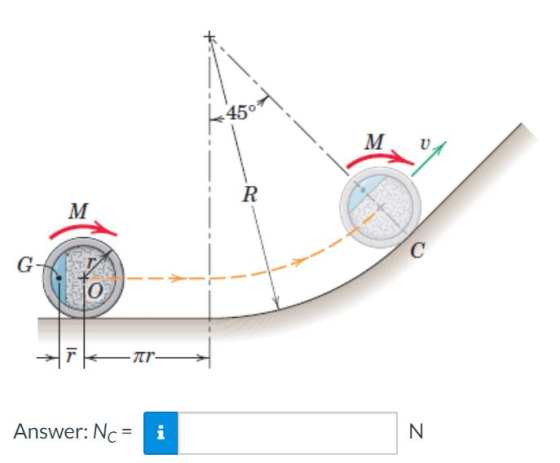
The 17-kg wheel has an eccentric mass which places the center of
mass G a distance r¯ = 142 mm away from the geometric
center O. A constant couple M = 11.8 N∙m is
applied to the initially stationary wheel, which rolls without
slipping along the horizontal surface and enters the curve of
radius R = 1110 mm. Determine the normal force
NC under the wheel just before it exits the
curve at C. The wheel has a rolling radius r =
100 mm and a radius of gyration kO = 141
mm.
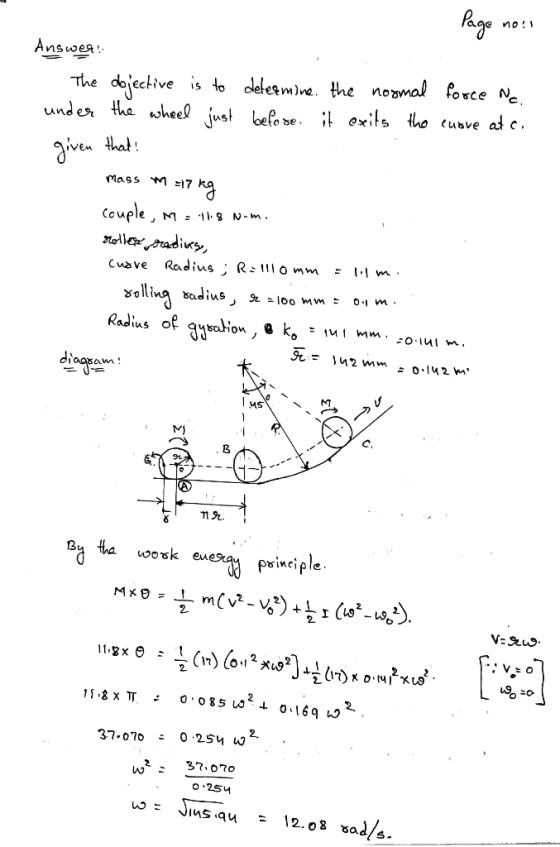
Homework Answers
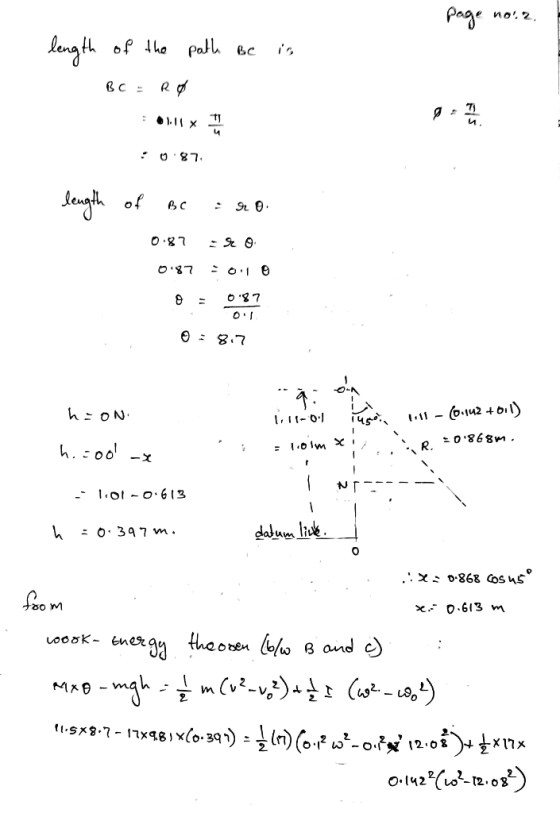
![Page ио3 33-94 2 = 8:5 (о? «- (-чѕ4)) + •5 o-ozo)(u - 1454) 33-42 = o-oss u° - 12 мет) + (-то (8° — 1us •1)] : o-ogs w -2](http://img.homeworklib.com/questions/6b780180-bfa4-11ea-9f2e-c9856671a805.png?x-oss-process=image/resize,w_560)
![N = [m xgx cos us] I fz tfi N: 17x9.81 x cos 45 + 319.34 + 672-43 page no. u. N: 235.16. kn. N: 0.235 kn 2. The normal force](http://img.homeworklib.com/questions/6be43520-bfa4-11ea-a394-83997708a0ad.png?x-oss-process=image/resize,w_560)
Add Answer to:
The 17-kg wheel has an eccentric mass which places the center of
mass G a distance...
. The 40-kg wheel has a radius of gyration about its center of gravity G of...
 .
The 40-kg wheel has a radius of gyration about its center of gravity G of k_G = 250 mm. If it rolls without slipping, determine its angular velocity when it has rotated clockwise 90 degree from the position shown. The spring AB has a stiffness k = 100 N/m and an unstretched length of 500 mm. The wheel is released from rest.
.
The 40-kg wheel has a radius of gyration about its center of gravity G of k_G = 250 mm. If it rolls without slipping, determine its angular velocity when it has rotated clockwise 90 degree from the position shown. The spring AB has a stiffness k = 100 N/m and an unstretched length of 500 mm. The wheel is released from rest.
The wheel consists of a 2.5-kg rim of radius r = 215 mm with hub and...
 The wheel consists of a 2.5-kg rim of radius r = 215 mm with hub and spokes of negligible mass. The wheel is mounted on the 3.0-kg yoke OA with mass center at G and with a radius of gyration about 0 of 350 mm. If the assembly is released from rest in the horizontal position shown and if the wheel rolls on the circular surface without slipping, compute the velocity of point A when it reaches A'. Assume d...
In wheel A, the mass of the wheel assembly is concentrated at the center. (Therefore the...
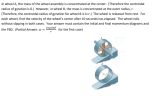 In wheel A, the mass of the wheel assembly is concentrated at the center. (Therefore the centroidal radius of gyration is 0.) However, in wheel B, the mass is concentrated at the outer radius, r. (Therefore, the centroidal radius of gyration for wheel B is k-r.) The wheel is released from rest. For without slipping in both cases. Your answer must contain the initial and final momentum diagrams and the FBD. (Partial Answer: ? = _10gsin6 for the first case)
A wheel rolls up a 3.5m hill without slipping. The wheel has a mass of 20kg,...
 A wheel rolls up a 3.5m hill without slipping. The wheel has a mass of 20kg, a radius of 0.4 m and a radius of gyration of 0.3m. What is the minimum required speed of the center of the wheel (ve) at the bottom o the hill, so that it will make it to the top of the hill? Wheel: R 0.4 m k 0.3 m m 20 kg 3.5 m ve? 4. Piston B is confined to move in...
5. The 18-kg wheel is rolling under constant moment of 80 Nm. If the wheel has...
 5. The 18-kg wheel is rolling under constant moment of 80 Nm. If the wheel has mass center at point G and the radius of gyration is kg = 0.3 m, determine its angular acceleration and the linear acceleration of its mass center. The coefficients of friction between the wheel and the ground are us = 0.33 and uk = 0.3 Hint: Assume no slipping and check if this assumption is correct Ff <usN) Solution: 80 Nm r=0.5 m i...
The wheel consists of a 2.6-kg rim of 420-mm radius with hub and spokes of negligible mass. The w...
 The wheel consists of a 2.6-kg rim of 420-mm radius with hub and
spokes of negligible mass. The wheel is mounted on the 3.7-kg yoke
OA with mass center at G and with a radius of
gyration about O of 495 mm. If the assembly is released
from rest in the horizontal position shown and if the wheel rolls
on the circular surface without slipping, compute the velocity of
point A when it reaches A'.
Answer: vA =
m/s
420...
The wheel consists of a 2.6-kg rim of 420-mm radius with hub and
spokes of negligible mass. The wheel is mounted on the 3.7-kg yoke
OA with mass center at G and with a radius of
gyration about O of 495 mm. If the assembly is released
from rest in the horizontal position shown and if the wheel rolls
on the circular surface without slipping, compute the velocity of
point A when it reaches A'.
Answer: vA =
m/s
420...
The mass of the symmetrical wheel shown below is m = 4 kg and its radius...
 The mass of the symmetrical wheel shown below is m = 4 kg and its radius of gyration about its center is kg = 0.25 m. The outer radius of the wheel is r2 = 0.4 m. The radius of the inner hub, where a cable is wrapped around it, is rı = 0.2 m. The wheel rolls without slipping. The force P, applied to the cable, is increased slowly according to the linear relation P = at, where P...
Needed help with this question, please answer as soon as you can. Thanks! The wheel has...
 Needed help with this question, please answer as soon as you
can. Thanks!
The wheel has a mass of 50 kg and a radius of gyration of 125 mm about its center of mass G. If it rolls without slipping with an angular velocity of wi-5 rad/s before it strikes the step at A, determine its angular velocity after it rolls over the step. The wheel does not loose contact with the step when it strikes it. 150 mm A...
Needed help with this question, please answer as soon as you
can. Thanks!
The wheel has a mass of 50 kg and a radius of gyration of 125 mm about its center of mass G. If it rolls without slipping with an angular velocity of wi-5 rad/s before it strikes the step at A, determine its angular velocity after it rolls over the step. The wheel does not loose contact with the step when it strikes it. 150 mm A...
Please show all steps The 90-kg wheel has a radius of gyration about its mass center...
 Please show all steps
The 90-kg wheel has a radius of gyration about its mass center (Figure 1) of ko = 400 mm. Part A Determine its angular velocity after it has rotated 20 revolutions starting from rest. Express your answer to three significant figures and include the appropriate units. w= Value Units Submit Request Answer Provide Feedback Figure < 1 of 1 > 0.6 m P = 50 N
Please show all steps
The 90-kg wheel has a radius of gyration about its mass center (Figure 1) of ko = 400 mm. Part A Determine its angular velocity after it has rotated 20 revolutions starting from rest. Express your answer to three significant figures and include the appropriate units. w= Value Units Submit Request Answer Provide Feedback Figure < 1 of 1 > 0.6 m P = 50 N
Determine the moment of inertia of the wheel when rolling about its center axis (x-axis). The...
 Determine the moment of inertia of the wheel when rolling about its center axis (x-axis). The wheel is made from steel whose density is 7800 Round your answer to three significant figures. The thickness of the wheel is t = 16 mm and can be treated as a flat disk, with Tin = 132 mm and rout = 150 mm. Also, determine the radius of gyration for this wheel rounded to 3 significant figures. Be careful with units! x Mass...
 .
The 40-kg wheel has a radius of gyration about its center of gravity G of k_G = 250 mm. If it rolls without slipping, determine its angular velocity when it has rotated clockwise 90 degree from the position shown. The spring AB has a stiffness k = 100 N/m and an unstretched length of 500 mm. The wheel is released from rest.
.
The 40-kg wheel has a radius of gyration about its center of gravity G of k_G = 250 mm. If it rolls without slipping, determine its angular velocity when it has rotated clockwise 90 degree from the position shown. The spring AB has a stiffness k = 100 N/m and an unstretched length of 500 mm. The wheel is released from rest.
 The wheel consists of a 2.5-kg rim of radius r = 215 mm with hub and spokes of negligible mass. The wheel is mounted on the 3.0-kg yoke OA with mass center at G and with a radius of gyration about 0 of 350 mm. If the assembly is released from rest in the horizontal position shown and if the wheel rolls on the circular surface without slipping, compute the velocity of point A when it reaches A'. Assume d...
 In wheel A, the mass of the wheel assembly is concentrated at the center. (Therefore the centroidal radius of gyration is 0.) However, in wheel B, the mass is concentrated at the outer radius, r. (Therefore, the centroidal radius of gyration for wheel B is k-r.) The wheel is released from rest. For without slipping in both cases. Your answer must contain the initial and final momentum diagrams and the FBD. (Partial Answer: ? = _10gsin6 for the first case)
 A wheel rolls up a 3.5m hill without slipping. The wheel has a mass of 20kg, a radius of 0.4 m and a radius of gyration of 0.3m. What is the minimum required speed of the center of the wheel (ve) at the bottom o the hill, so that it will make it to the top of the hill? Wheel: R 0.4 m k 0.3 m m 20 kg 3.5 m ve? 4. Piston B is confined to move in...
 5. The 18-kg wheel is rolling under constant moment of 80 Nm. If the wheel has mass center at point G and the radius of gyration is kg = 0.3 m, determine its angular acceleration and the linear acceleration of its mass center. The coefficients of friction between the wheel and the ground are us = 0.33 and uk = 0.3 Hint: Assume no slipping and check if this assumption is correct Ff <usN) Solution: 80 Nm r=0.5 m i...
 The wheel consists of a 2.6-kg rim of 420-mm radius with hub and
spokes of negligible mass. The wheel is mounted on the 3.7-kg yoke
OA with mass center at G and with a radius of
gyration about O of 495 mm. If the assembly is released
from rest in the horizontal position shown and if the wheel rolls
on the circular surface without slipping, compute the velocity of
point A when it reaches A'.
Answer: vA =
m/s
420...
The wheel consists of a 2.6-kg rim of 420-mm radius with hub and
spokes of negligible mass. The wheel is mounted on the 3.7-kg yoke
OA with mass center at G and with a radius of
gyration about O of 495 mm. If the assembly is released
from rest in the horizontal position shown and if the wheel rolls
on the circular surface without slipping, compute the velocity of
point A when it reaches A'.
Answer: vA =
m/s
420...
 The mass of the symmetrical wheel shown below is m = 4 kg and its radius of gyration about its center is kg = 0.25 m. The outer radius of the wheel is r2 = 0.4 m. The radius of the inner hub, where a cable is wrapped around it, is rı = 0.2 m. The wheel rolls without slipping. The force P, applied to the cable, is increased slowly according to the linear relation P = at, where P...
 Needed help with this question, please answer as soon as you
can. Thanks!
The wheel has a mass of 50 kg and a radius of gyration of 125 mm about its center of mass G. If it rolls without slipping with an angular velocity of wi-5 rad/s before it strikes the step at A, determine its angular velocity after it rolls over the step. The wheel does not loose contact with the step when it strikes it. 150 mm A...
Needed help with this question, please answer as soon as you
can. Thanks!
The wheel has a mass of 50 kg and a radius of gyration of 125 mm about its center of mass G. If it rolls without slipping with an angular velocity of wi-5 rad/s before it strikes the step at A, determine its angular velocity after it rolls over the step. The wheel does not loose contact with the step when it strikes it. 150 mm A...
 Please show all steps
The 90-kg wheel has a radius of gyration about its mass center (Figure 1) of ko = 400 mm. Part A Determine its angular velocity after it has rotated 20 revolutions starting from rest. Express your answer to three significant figures and include the appropriate units. w= Value Units Submit Request Answer Provide Feedback Figure < 1 of 1 > 0.6 m P = 50 N
Please show all steps
The 90-kg wheel has a radius of gyration about its mass center (Figure 1) of ko = 400 mm. Part A Determine its angular velocity after it has rotated 20 revolutions starting from rest. Express your answer to three significant figures and include the appropriate units. w= Value Units Submit Request Answer Provide Feedback Figure < 1 of 1 > 0.6 m P = 50 N
 Determine the moment of inertia of the wheel when rolling about its center axis (x-axis). The wheel is made from steel whose density is 7800 Round your answer to three significant figures. The thickness of the wheel is t = 16 mm and can be treated as a flat disk, with Tin = 132 mm and rout = 150 mm. Also, determine the radius of gyration for this wheel rounded to 3 significant figures. Be careful with units! x Mass...
Most questions answered within 3 hours.
-
Where is the error in this code sequence?
String s1 = "Hello";
String s2 = "ello";...
asked 10 months ago -
Financial data for Joel de Paris, Inc., for last year
follow:
Joel de Paris, Inc.
Balance...
asked 10 months ago -
Consider this reaction:
Al2(SO4)3 (aq)+ BaCl3
(aq) Al2Cl6 (aq)- +
3BaSO4(s) . What is the...
asked 10 months ago -
Suppose that Savneet is considering increasing her
recent random sample from 20 car rentals to 40...
asked 10 months ago -
Trucks arrive at an unloading terminal at an average rate of 120
per hour.
Trucks arrive...
asked 10 months ago -
Why are methanol and ethanol completely soluble in water while
octanol is not very little soluble....
asked 10 months ago -
A facilities manager at a university reads in a research report
that the mean amount of...
asked 10 months ago -
When the CuSO4 is rehydrated by adding water to the anhydrous
compound, is this an endothermic...
asked 10 months ago -
A ray of sunlight is passing from diamond into crown glass; the
angle of incidence is...
asked 10 months ago -
A block of mass 0.249 kg is placed on top of a light, vertical
spring of...
asked 10 months ago -
how do the kidneys compensate in the presences of acidosis
a) trigger hyperventilate
b) reserve acid...
asked 10 months ago -
Question 501 pts
The rental rate of capital to the firm increases. Which of the
following...
asked 10 months ago