Why are you able to evaluate CO2 production as a measurement of alcoholic fermentation? What does...
Why are you able to evaluate CO2 production as a measurement of alcoholic fermentation?
What does it tell you about alcoholic fermentation?
Homework Answers
From one mole of glucose, in fermentation two moles of ethanol and two moles of carbon di oxide will be produced.
The reaction is:
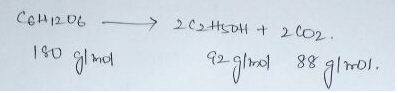
For every 180 grams of glucose, 88 grams of CO2 and 92 grams of Ethanol will be produced, on the basis of this CO2 is using as the measurement for alcholic fermentation.
By using simple cross equation we can find the Ethanol production.
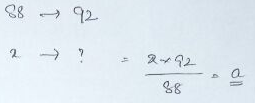
where x= amount of CO2 grams/mol and a = appropriate ethanol quantity
Add Answer to:
Why are you able to evaluate CO2 production as a measurement of
alcoholic fermentation?
What does...
actate Fermentation Alcoholic Fermentation Description Starts with glycolysis Generates pyruvate at the end of glycolysis Does...
 actate Fermentation Alcoholic Fermentation Description Starts with glycolysis Generates pyruvate at the end of glycolysis Does not generate any CO2 Starts with six-carbon glucose and ends with two molecules of a two-carbon by-product 000 Many people enjoy sugary soda pop because it is fizzy. This fizziness is the result of pressurized gas that is artificially added during the manufacturing process. People have also enjoyed the fizziness of beer and sparkling wine for thousands of years, but the gas in beer...
1. Why do yeasts perform alcohol fermentation? 2. What is the chemical reaction for fermentation? 3....
1. Why do yeasts perform alcohol fermentation? 2. What is the chemical reaction for fermentation? 3. Which are the reactants in this reaction? Which are the products? 4. What is the gas that accumulates in the bag, causing it to inflate? In addition to this gas, what is another product of this process? Can you think of one example when either of these products is useful during cooking/baking? 5. How does inflation of the bag correlate with the amount of...
EXERCISE 5B CELLULAR RESPIRATION Alcoholic Fermentation by Yeast OBJECTIVES the completion of thi...
 EXERCISE 5B CELLULAR RESPIRATION Alcoholic Fermentation by Yeast OBJECTIVES the completion of this exercise the student should be able to Upon 1 distinguish between the dependent and independent variables in a controlled experiment. . formulate a basic hypothesis. measure the volume of carbon dioxide generated by anacrobic fermentation in baker's 3. yeast. 4. express data in tabular form. 5, relate data generated in an experiment to a hypothesis previously formulated 6. graph data, calculate the slope of a line, and...
What are the four possible results of a fermentation experiment and what does each indicate? What...
What are the four possible results of a fermentation experiment and what does each indicate? What does a pH indicator tell you? Which pH indicator did we use in fermentation tubes? Explain why E. coli would ferment glucose to acid/gas result while Pseudomonas does not? Why would a bacterium oxidize a molecule instead of fermenting it? If an inoculated OF tube turns yellow and DOES not have mineral oil on top – what process(es) caused the color change?
Why evaluate learning? What does evaluation tell you? Name one method you might use for evaluation.
Why evaluate learning? What does evaluation tell you? Name one method you might use for evaluation.
4) In the absence of O2 fermentation will occur, why?.....what does it yield that the organism...
4) In the absence of O2 fermentation will occur, why?.....what does it yield that the organism needs from these reactions? Why? 5) Gluconeogenesis is the production of glucose from non-carbohydrate precursors. a. What distinguishes glycolysis from gluconeogenesis? (hints: substrates, energetics of reactions, where do they occur) b. What molecule is a key regulator of glycolysis and gluconeogenesis? What does it do? (p. 245)
What conclusions can be drawn about the effects of temperature on the rate of fermentation? Why...
What conclusions can be drawn about the effects of temperature on the rate of fermentation? Why would the different substrates affect the amount of CO2 produced?
Please help * What is cross-price elasticity of demand? Why is this measurement helpful? What does...
Please help * What is cross-price elasticity of demand? Why is this measurement helpful? What does this metric tell us? * describe what is meant by the income elasticity of demand. How is it calculated? Why is this significant or meaningful?
a. Write a unique prediction about a factor that could increase alcohol fermentation. Why do you...
 a. Write a unique prediction about a factor that could increase alcohol fermentation. Why do you think that this factor could increase alcohol production? b. Write a unique prediction about a factor that could decrease alcohol fermentation. Why do you think that this factor could decrease alcohol production? (Choose a different factor to answer this question than the factor you used to answer the previous question.)
what is the oxidation state of oxygen atoms in CO2, H2O and O2 and what does...
what is the oxidation state of oxygen atoms in CO2, H2O and O2 and what does this information tell you about photosynthesis and respiration.
 actate Fermentation Alcoholic Fermentation Description Starts with glycolysis Generates pyruvate at the end of glycolysis Does not generate any CO2 Starts with six-carbon glucose and ends with two molecules of a two-carbon by-product 000 Many people enjoy sugary soda pop because it is fizzy. This fizziness is the result of pressurized gas that is artificially added during the manufacturing process. People have also enjoyed the fizziness of beer and sparkling wine for thousands of years, but the gas in beer...
 EXERCISE 5B CELLULAR RESPIRATION Alcoholic Fermentation by Yeast OBJECTIVES the completion of this exercise the student should be able to Upon 1 distinguish between the dependent and independent variables in a controlled experiment. . formulate a basic hypothesis. measure the volume of carbon dioxide generated by anacrobic fermentation in baker's 3. yeast. 4. express data in tabular form. 5, relate data generated in an experiment to a hypothesis previously formulated 6. graph data, calculate the slope of a line, and...
 a. Write a unique prediction about a factor that could increase alcohol fermentation. Why do you think that this factor could increase alcohol production? b. Write a unique prediction about a factor that could decrease alcohol fermentation. Why do you think that this factor could decrease alcohol production? (Choose a different factor to answer this question than the factor you used to answer the previous question.)
Most questions answered within 3 hours.
-
Where is the error in this code sequence?
String s1 = "Hello";
String s2 = "ello";...
asked 10 months ago -
Financial data for Joel de Paris, Inc., for last year
follow:
Joel de Paris, Inc.
Balance...
asked 10 months ago -
Consider this reaction:
Al2(SO4)3 (aq)+ BaCl3
(aq) Al2Cl6 (aq)- +
3BaSO4(s) . What is the...
asked 10 months ago -
Suppose that Savneet is considering increasing her
recent random sample from 20 car rentals to 40...
asked 10 months ago -
Trucks arrive at an unloading terminal at an average rate of 120
per hour.
Trucks arrive...
asked 10 months ago -
Why are methanol and ethanol completely soluble in water while
octanol is not very little soluble....
asked 10 months ago -
A facilities manager at a university reads in a research report
that the mean amount of...
asked 10 months ago -
When the CuSO4 is rehydrated by adding water to the anhydrous
compound, is this an endothermic...
asked 10 months ago -
A ray of sunlight is passing from diamond into crown glass; the
angle of incidence is...
asked 10 months ago -
A block of mass 0.249 kg is placed on top of a light, vertical
spring of...
asked 10 months ago -
how do the kidneys compensate in the presences of acidosis
a) trigger hyperventilate
b) reserve acid...
asked 10 months ago -
Question 501 pts
The rental rate of capital to the firm increases. Which of the
following...
asked 10 months ago