 Use a loop to find the sum of
all numbers between 0 and #mystery_int, including bounds (meaning
that if #mystery_int = 7, you add 0 + 1 + 2 + 3 + 4 + 5 + 6 +
7).
Use a loop to find the sum of
all numbers between 0 and #mystery_int, including bounds (meaning
that if #mystery_int = 7, you add 0 + 1 + 2 + 3 + 4 + 5 + 6 +
7).
However, there's a twist: mystery_int might be negative.
#So, if mystery_int was -4, you would -4 + -3 + -2 + -1 + 0.
Homework Answers
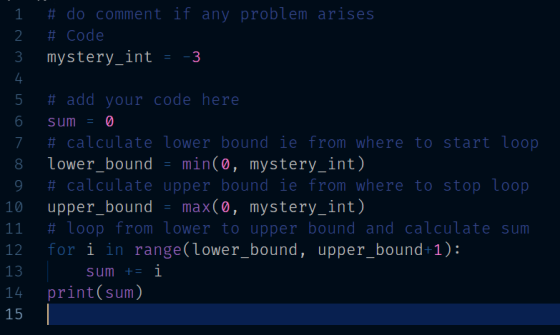
# do comment if any problem arises
# Code
mystery_int = -3
# add your code here
sum = 0
# calculate lower bound ie from where to start loop
lower_bound = min(0, mystery_int)
# calculate upper bound ie from where to stop loop
upper_bound = max(0, mystery_int)
# loop from lower to upper bound and calculate sum
for i in range(lower_bound, upper_bound+1):
sum += i
print(sum)
Screenshot of code:
Output:

Add Answer to:
Use a loop to find the sum of
all numbers between 0 and #mystery_int, including bounds...
Write a for loop to add all the even numbers to sum, between 0 and 100...
Write a for loop to add all the even numbers to sum, between 0 and 100 inclusive, that is, like 0 + 2 + 4 + 6 + ….. + 96 + 98 + 100. Use only two integer variables i and sum. Answer in java please
Using while loop write a python function to find the sum of the negative numbers -3...
Using while loop write a python function to find the sum of the negative numbers -3 to -10 but excluding both -3 and -10.
****python**** Q1. Write a recursive function that returns the sum of all numbers up to and...
 ****python****
Q1.
Write a recursive function that returns the sum of all numbers
up to and including the given value.
This function has to be recursive; you may not use loops!
For example:
Test
Result
print('%d : %d' % (5, sum_up_to(5)))
5 : 15
Q2,
Write a recursive function that counts the number of odd
integers in a given list.
This function has to be recursive; you may not use loops!
For example:
Test
Result
print('%s : %d' % ([2,...
****python****
Q1.
Write a recursive function that returns the sum of all numbers
up to and including the given value.
This function has to be recursive; you may not use loops!
For example:
Test
Result
print('%d : %d' % (5, sum_up_to(5)))
5 : 15
Q2,
Write a recursive function that counts the number of odd
integers in a given list.
This function has to be recursive; you may not use loops!
For example:
Test
Result
print('%s : %d' % ([2,...
Objectives: Use the while loop in a program Use the do-while loop in a second program...
 Objectives:
Use the while loop in a program
Use the do-while loop in a second program
Use the for loop in a third program
Instructions:
Part A. Code a for loop to print the Celsius temperatures for
Fahrenheit temperatures 25 to 125. C = 5/9(F – 32).Output should be
in a table format:
Fahrenheit Celsius
25 ?
. .
. . . .
. .
Turn in the source and the output from Part A.
Part B. Code a while...
Objectives:
Use the while loop in a program
Use the do-while loop in a second program
Use the for loop in a third program
Instructions:
Part A. Code a for loop to print the Celsius temperatures for
Fahrenheit temperatures 25 to 125. C = 5/9(F – 32).Output should be
in a table format:
Fahrenheit Celsius
25 ?
. .
. . . .
. .
Turn in the source and the output from Part A.
Part B. Code a while...
Write a Python program to print all Perfect numbers between 1 to n. (Use any loop...
Write a Python program to print all Perfect numbers between 1 to n. (Use any loop you want) Perfect number is a positive integer which is equal to the sum of its proper positive divisors. Proper divisors of 6 are 1, 2, 3. Sum of its proper divisors = 1 + 2 + 3 = 6. Hence 6 is a perfect number. *** proper divisor means the remainder will be 0 when divided by that number. Sample Input: n =...
In this exercise, write a complete Java program that reads integer numbers from the user until...
In this exercise, write a complete Java program that reads integer numbers from the user until a negative value is entered. It should then output the average of the numbers, not including the negative number. If no non-negative values are entered, the program should issue an error message. You are required to use a do-while loop to solve this problem. Solutions that do not use a do-while loop will be given a zero. Make sure to add appropriate comments to...
you will write two versions of a function that calculates the sum of all the numbers...
you will write two versions of a function that calculates the sum of all the numbers in a LinkedList. In the first version, you should use an iterator and either a while loop or a traditional for loop to compute the sum . In the second version, you should use the range - based for loop. Write one or more tests in a main() function that demonstrate that either version of your function works as intended. I would personally like...
write matlab script 5. Use a for loop to sum the elements in x = [1...
 write matlab script
5. Use a for loop to sum the elements in x = [1 2 3 4 5] Check your answer with sum function 6. Use a while loop to sum the elements in x = [1 2 3 4 5] Check your answer with sum function
write matlab script
5. Use a for loop to sum the elements in x = [1 2 3 4 5] Check your answer with sum function 6. Use a while loop to sum the elements in x = [1 2 3 4 5] Check your answer with sum function
use python: Write a program that reads in X whole numbers and outputs (1) the sum...
use python: Write a program that reads in X whole numbers and outputs (1) the sum of all positive numbers, (2) the sum of all negative numbers, and (3) the sum of all positive and negative numbers. The user can enter the X numbers in any different order every time, and can repeat the program if desired. Sample Run How many numbers would you like to enter? 4 Please enter number 1: 3 Please enter number 2: -4 Please enter...
use Rstudio 1. Write a for loop that prints the first four numbers of the vector:...
 use Rstudio
1. Write a for loop that prints the first four numbers of the vector: x <c(7, 4, 3, 8, 9, 25) HINT: this is a very simple for loop but to print the chosen values you will need to use [ ] notation
use Rstudio
1. Write a for loop that prints the first four numbers of the vector: x <c(7, 4, 3, 8, 9, 25) HINT: this is a very simple for loop but to print the chosen values you will need to use [ ] notation
 ****python****
Q1.
Write a recursive function that returns the sum of all numbers
up to and including the given value.
This function has to be recursive; you may not use loops!
For example:
Test
Result
print('%d : %d' % (5, sum_up_to(5)))
5 : 15
Q2,
Write a recursive function that counts the number of odd
integers in a given list.
This function has to be recursive; you may not use loops!
For example:
Test
Result
print('%s : %d' % ([2,...
****python****
Q1.
Write a recursive function that returns the sum of all numbers
up to and including the given value.
This function has to be recursive; you may not use loops!
For example:
Test
Result
print('%d : %d' % (5, sum_up_to(5)))
5 : 15
Q2,
Write a recursive function that counts the number of odd
integers in a given list.
This function has to be recursive; you may not use loops!
For example:
Test
Result
print('%s : %d' % ([2,...
 Objectives:
Use the while loop in a program
Use the do-while loop in a second program
Use the for loop in a third program
Instructions:
Part A. Code a for loop to print the Celsius temperatures for
Fahrenheit temperatures 25 to 125. C = 5/9(F – 32).Output should be
in a table format:
Fahrenheit Celsius
25 ?
. .
. . . .
. .
Turn in the source and the output from Part A.
Part B. Code a while...
Objectives:
Use the while loop in a program
Use the do-while loop in a second program
Use the for loop in a third program
Instructions:
Part A. Code a for loop to print the Celsius temperatures for
Fahrenheit temperatures 25 to 125. C = 5/9(F – 32).Output should be
in a table format:
Fahrenheit Celsius
25 ?
. .
. . . .
. .
Turn in the source and the output from Part A.
Part B. Code a while...
 write matlab script
5. Use a for loop to sum the elements in x = [1 2 3 4 5] Check your answer with sum function 6. Use a while loop to sum the elements in x = [1 2 3 4 5] Check your answer with sum function
write matlab script
5. Use a for loop to sum the elements in x = [1 2 3 4 5] Check your answer with sum function 6. Use a while loop to sum the elements in x = [1 2 3 4 5] Check your answer with sum function
 use Rstudio
1. Write a for loop that prints the first four numbers of the vector: x <c(7, 4, 3, 8, 9, 25) HINT: this is a very simple for loop but to print the chosen values you will need to use [ ] notation
use Rstudio
1. Write a for loop that prints the first four numbers of the vector: x <c(7, 4, 3, 8, 9, 25) HINT: this is a very simple for loop but to print the chosen values you will need to use [ ] notation
Most questions answered within 3 hours.
-
Where is the error in this code sequence?
String s1 = "Hello";
String s2 = "ello";...
asked 10 months ago -
Financial data for Joel de Paris, Inc., for last year
follow:
Joel de Paris, Inc.
Balance...
asked 10 months ago -
Consider this reaction:
Al2(SO4)3 (aq)+ BaCl3
(aq) Al2Cl6 (aq)- +
3BaSO4(s) . What is the...
asked 10 months ago -
Suppose that Savneet is considering increasing her
recent random sample from 20 car rentals to 40...
asked 10 months ago -
Trucks arrive at an unloading terminal at an average rate of 120
per hour.
Trucks arrive...
asked 10 months ago -
Why are methanol and ethanol completely soluble in water while
octanol is not very little soluble....
asked 10 months ago -
A facilities manager at a university reads in a research report
that the mean amount of...
asked 10 months ago -
When the CuSO4 is rehydrated by adding water to the anhydrous
compound, is this an endothermic...
asked 10 months ago -
A ray of sunlight is passing from diamond into crown glass; the
angle of incidence is...
asked 10 months ago -
A block of mass 0.249 kg is placed on top of a light, vertical
spring of...
asked 10 months ago -
how do the kidneys compensate in the presences of acidosis
a) trigger hyperventilate
b) reserve acid...
asked 10 months ago -
Question 501 pts
The rental rate of capital to the firm increases. Which of the
following...
asked 10 months ago