


Homework Answers
Add Answer to:
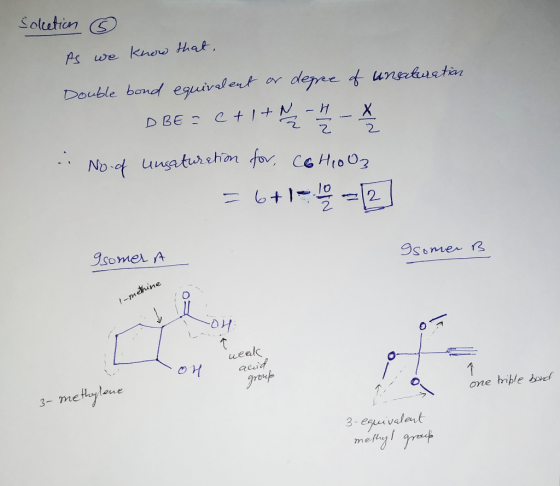
nstitutional Isomer #5 Molecular Formula: CsH200, Calculate Units of Unsaturation Structural Hints for isomer A: 1)...
Homework Problems 8.1 Draw the structural formula for each of the following: a. 5-chloro-4-methyl-2-hexanol b. 2,3-dimethylcyclopentanol...
 Homework Problems 8.1 Draw the structural formula for each of the following: a. 5-chloro-4-methyl-2-hexanol b. 2,3-dimethylcyclopentanol c. 5,5-diethyl-1-heptanol d. 2-ethyl-4-isopropylcyclohexanol e. 4-ethylphenol f. 2-nitrophenol g. cyclopropyl methyl ether h. isopropyl propyl ether 8.2 Give the product for the dehydration of each of the following alcohols. CH-CH2-CH3 a. ОН b. ОН C. OH d. 8.3 What product would result from the oxidation of each of the following alcohols? Write the chemical equations. a. 2-butanol b. 2-methyl-2-pentanol c. cyclohexanol d. 3-ethylcyclopentanol Name...
Week 10- Constitutional isomers Constitutional isomers have the same molecular formula, but their atoms are bonded...
 Week 10- Constitutional isomers Constitutional isomers have the same molecular formula, but their atoms are bonded in different orders. These may be further distinguished as chain isomers, which differ only in hydrocarbon chain structure, positional isomers, which differ in the location of a functional group, and functional group isomers which differ in the nature of their functional groups. Typically chain and position isomers show only modest differences in their physical and chemical properties, while functional group isomers differ greatly from...
You are provided with the molecular formula for each compound. calculate the unsaturation index f...
 You are provided with the molecular formula for each compound. calculate the unsaturation index for each problem. -u2C+2+N-X-H For IR, determine the functional groups present and annotate the absorbances that confirm the functional group (including finger print region absorbances). 2 . For 1H NMR, label each signal (a, b, c,.... starting from the right (0.0 PPM). Draw the structure of the compound in the spectra and annotate. 13C NMR spectra is provided for information. Annotation of the 13C NMR is...
Stick Notation for Organic Molecular Structures The molecular structure of (E)-B-damascone is represented below. In such...
 Stick Notation for Organic Molecular Structures The molecular structure of (E)-B-damascone is represented below. In such shorthand diagrams, the end of each line segment, if not labelled with a chemical symbol, corresponds to a carbon atom. Hydrogen atoms bonded to carbon are frequently not drawn but are always inferred to complete the valence shell for each C atom. Non-bonding electrons for N and O atoms are also omitted from the diagram but can be inferred to complete those valence shells....
7. The IUPAC name for the followe d in the OH controls a) 3-chloro-2-methylcyclohexanol 5-chloro-2-methylcyclohexanol 2-methyl-3-chlorocyclohexanol...
 7. The IUPAC name for the followe d in the OH controls a) 3-chloro-2-methylcyclohexanol 5-chloro-2-methylcyclohexanol 2-methyl-3-chlorocyclohexanol d) 2-methyl-5 chlorocyclohexanol e) 1-chloro-4-methylcyclohexanol Which of the following cannot be an electrophile? a) H b) CH2-CH; c) 'NO ) BF; d) Fee ased on the following enery diagram, which compound is formed slowly Reaction ) B from A c) Cfrom B d) from C a) A from B b 10. Which of the following has the highest priority? -0-H -CH=CHCH -CH=NCH -SC-CH; 11....
Chapter 11: 1. What is a prime rule in naming alkenes? a. Find the longest carbon...
Chapter 11: 1. What is a prime rule in naming alkenes? a. Find the longest carbon chain. b.Find the longest carbon chain containing the alkene. c. Find whether the alkene has a cis- or trans- configuration. d.Find how far the alkene functionality is from either end. 2. What is the IUPAC name of the following alkene? a. cis-5-methyl-2-heptene b. trans-2-ethyl-4-hexene c. trans-5-methyl-2-heptene d. trans-3-methyl-5-heptene 3. What is the hybridization, geometry, and bond angle of the carbon marked by an asterisk?...
A. Enantiomers: Certain substances have the unique property of rotating the plane of plane-polarized light. Such...
 A. Enantiomers: Certain substances have the unique property of rotating the plane of plane-polarized light. Such light rotation is detectable with the aid of a polarimeter. In order for a molecule to be optically active it must be chiral. Chiral objects lack a plane of symmetry and are non-superimposable on their mirror images. A sp?- hybridized carbon atom can fulfill these requirements if all four of its substituents are different. 1. Methane a) Prepare a methane molecule and then substitute...
3. Cyclic compounds The presence of the ring in all but very large ring cyclic molecules...
 3. Cyclic compounds The presence of the ring in all but very large ring cyclic molecules prevents full rotation of the ring atoms. For this reason, stereoisomerism may also occur in cyclic molecules. a) Prepare a model of cyclohexane, C6H12. Draw the condensed formula. b) Build a model of methylcyclohexane (C7H14) by replacing one of the hydrogens of cyclohexane with a methyl group. Draw the skeletal formula for methylcyclohexane. 2 c) How many different isomers exist for methylcyclohexane (CyH34)? d)...
For this compound: 1. Molecular weight 2. Elements present in the molecule 3. Molecular formula 4....
 For this compound:
1. Molecular weight
2. Elements present in the molecule
3. Molecular formula
4. Functional groups from IR
5. SODAR
6. Draw structure and label the protons in your spectrum with
their chemical shifts.
7. Fill in the tables by labeling the carbons in the carbon
spectra with letters of the alphabet from left to right. List the
the chemical shifts and information from the DEPT spectra as to
CH3, CH2, CH, Q including any special structural feature...
For this compound:
1. Molecular weight
2. Elements present in the molecule
3. Molecular formula
4. Functional groups from IR
5. SODAR
6. Draw structure and label the protons in your spectrum with
their chemical shifts.
7. Fill in the tables by labeling the carbons in the carbon
spectra with letters of the alphabet from left to right. List the
the chemical shifts and information from the DEPT spectra as to
CH3, CH2, CH, Q including any special structural feature...
 Homework Problems 8.1 Draw the structural formula for each of the following: a. 5-chloro-4-methyl-2-hexanol b. 2,3-dimethylcyclopentanol c. 5,5-diethyl-1-heptanol d. 2-ethyl-4-isopropylcyclohexanol e. 4-ethylphenol f. 2-nitrophenol g. cyclopropyl methyl ether h. isopropyl propyl ether 8.2 Give the product for the dehydration of each of the following alcohols. CH-CH2-CH3 a. ОН b. ОН C. OH d. 8.3 What product would result from the oxidation of each of the following alcohols? Write the chemical equations. a. 2-butanol b. 2-methyl-2-pentanol c. cyclohexanol d. 3-ethylcyclopentanol Name...
 Week 10- Constitutional isomers Constitutional isomers have the same molecular formula, but their atoms are bonded in different orders. These may be further distinguished as chain isomers, which differ only in hydrocarbon chain structure, positional isomers, which differ in the location of a functional group, and functional group isomers which differ in the nature of their functional groups. Typically chain and position isomers show only modest differences in their physical and chemical properties, while functional group isomers differ greatly from...
 You are provided with the molecular formula for each compound. calculate the unsaturation index for each problem. -u2C+2+N-X-H For IR, determine the functional groups present and annotate the absorbances that confirm the functional group (including finger print region absorbances). 2 . For 1H NMR, label each signal (a, b, c,.... starting from the right (0.0 PPM). Draw the structure of the compound in the spectra and annotate. 13C NMR spectra is provided for information. Annotation of the 13C NMR is...
 Stick Notation for Organic Molecular Structures The molecular structure of (E)-B-damascone is represented below. In such shorthand diagrams, the end of each line segment, if not labelled with a chemical symbol, corresponds to a carbon atom. Hydrogen atoms bonded to carbon are frequently not drawn but are always inferred to complete the valence shell for each C atom. Non-bonding electrons for N and O atoms are also omitted from the diagram but can be inferred to complete those valence shells....
 7. The IUPAC name for the followe d in the OH controls a) 3-chloro-2-methylcyclohexanol 5-chloro-2-methylcyclohexanol 2-methyl-3-chlorocyclohexanol d) 2-methyl-5 chlorocyclohexanol e) 1-chloro-4-methylcyclohexanol Which of the following cannot be an electrophile? a) H b) CH2-CH; c) 'NO ) BF; d) Fee ased on the following enery diagram, which compound is formed slowly Reaction ) B from A c) Cfrom B d) from C a) A from B b 10. Which of the following has the highest priority? -0-H -CH=CHCH -CH=NCH -SC-CH; 11....
 A. Enantiomers: Certain substances have the unique property of rotating the plane of plane-polarized light. Such light rotation is detectable with the aid of a polarimeter. In order for a molecule to be optically active it must be chiral. Chiral objects lack a plane of symmetry and are non-superimposable on their mirror images. A sp?- hybridized carbon atom can fulfill these requirements if all four of its substituents are different. 1. Methane a) Prepare a methane molecule and then substitute...
 3. Cyclic compounds The presence of the ring in all but very large ring cyclic molecules prevents full rotation of the ring atoms. For this reason, stereoisomerism may also occur in cyclic molecules. a) Prepare a model of cyclohexane, C6H12. Draw the condensed formula. b) Build a model of methylcyclohexane (C7H14) by replacing one of the hydrogens of cyclohexane with a methyl group. Draw the skeletal formula for methylcyclohexane. 2 c) How many different isomers exist for methylcyclohexane (CyH34)? d)...
 For this compound:
1. Molecular weight
2. Elements present in the molecule
3. Molecular formula
4. Functional groups from IR
5. SODAR
6. Draw structure and label the protons in your spectrum with
their chemical shifts.
7. Fill in the tables by labeling the carbons in the carbon
spectra with letters of the alphabet from left to right. List the
the chemical shifts and information from the DEPT spectra as to
CH3, CH2, CH, Q including any special structural feature...
For this compound:
1. Molecular weight
2. Elements present in the molecule
3. Molecular formula
4. Functional groups from IR
5. SODAR
6. Draw structure and label the protons in your spectrum with
their chemical shifts.
7. Fill in the tables by labeling the carbons in the carbon
spectra with letters of the alphabet from left to right. List the
the chemical shifts and information from the DEPT spectra as to
CH3, CH2, CH, Q including any special structural feature...
Most questions answered within 3 hours.
-
Where is the error in this code sequence?
String s1 = "Hello";
String s2 = "ello";...
asked 10 months ago -
Financial data for Joel de Paris, Inc., for last year
follow:
Joel de Paris, Inc.
Balance...
asked 10 months ago -
Consider this reaction:
Al2(SO4)3 (aq)+ BaCl3
(aq) Al2Cl6 (aq)- +
3BaSO4(s) . What is the...
asked 10 months ago -
Suppose that Savneet is considering increasing her
recent random sample from 20 car rentals to 40...
asked 10 months ago -
Trucks arrive at an unloading terminal at an average rate of 120
per hour.
Trucks arrive...
asked 10 months ago -
Why are methanol and ethanol completely soluble in water while
octanol is not very little soluble....
asked 10 months ago -
A facilities manager at a university reads in a research report
that the mean amount of...
asked 10 months ago -
When the CuSO4 is rehydrated by adding water to the anhydrous
compound, is this an endothermic...
asked 10 months ago -
A ray of sunlight is passing from diamond into crown glass; the
angle of incidence is...
asked 10 months ago -
A block of mass 0.249 kg is placed on top of a light, vertical
spring of...
asked 10 months ago -
how do the kidneys compensate in the presences of acidosis
a) trigger hyperventilate
b) reserve acid...
asked 10 months ago -
Question 501 pts
The rental rate of capital to the firm increases. Which of the
following...
asked 10 months ago