
Homework Answers
Add Answer to:
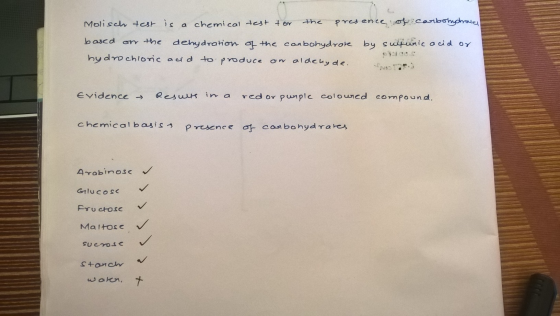
Molisch Test 1,2,3
Carbohydrates A. Molisch Test 1. Describe the evidence for a positive test. 10R...
What test would you use to distinguish between the members of the following pairs of carbohydrates?...
 What test would you use to distinguish between the members of the following pairs of carbohydrates? Describe chemistry and observations behind the tests you will use to distinguish between these pairs of carbohydrates. 1. Glycogen and Starch 2. Pentose (Arabinose) and Glucose 3. Sucrose and Lactose 4. Glucose and Fructose
organic chemistry help 7) A student was given unknown #1. It showed the following test results:...
 organic chemistry help
7) A student was given unknown #1. It showed the following test results: Molisch-clear to purple interface, lodine-lodide-red/brown persists, Barfoed - remains clear, Bial = clear to brown, Benedict - remains blue, Seliwanoff - clear to red. The unknown is: a) Starch b) Maltose c) Sucrose d) Fructose e) Glucose f) Xylose 8) A student was given unknown #11. It showed the following test results: Molisch=clear to purple interface, lodine-lodide=red/brown persists, Barfoed = remains clear, Bial =...
organic chemistry help
7) A student was given unknown #1. It showed the following test results: Molisch-clear to purple interface, lodine-lodide-red/brown persists, Barfoed - remains clear, Bial = clear to brown, Benedict - remains blue, Seliwanoff - clear to red. The unknown is: a) Starch b) Maltose c) Sucrose d) Fructose e) Glucose f) Xylose 8) A student was given unknown #11. It showed the following test results: Molisch=clear to purple interface, lodine-lodide=red/brown persists, Barfoed = remains clear, Bial =...
Experiment 33 PART B. SOME REACTIONS OF CARBOHYDRATES Spor Test Results with Carbohydrates Sucrose Carbohyd- Starch...
 Experiment 33 PART B. SOME REACTIONS OF CARBOHYDRATES Spor Test Results with Carbohydrates Sucrose Carbohyd- Starch Fructose Glucose rate class Benedict's test Fehling's test Tollens test Glucose oxidase test Iodine test What class of carbohydrate can be expected to give a positive test with the spot tests below? Benedict's glucose oxidase Fehling's iodine Tollens Hydrolysis of polysaccharides Test Results Results of Result from Benedict's test strips Solution Result from iodine test Initial starch Initial sucrose Initial cellulose Final starch Final...
Carbohydrates What is the purpose of this experiment? Please write one paragraph in complete sentences. A. SOLUBILI...
 Carbohydrates What is the purpose of this experiment? Please write one paragraph in complete sentences. A. SOLUBILITY Conclusion Carbohydrate Starch Observation(s) acody lwhite Glucose cloor Clear Sucrose B. BENEDICT'S AND IODINE TESTS Benedict's Test 1% Sugar/Starch Observation(s) and lodine Test Observation(s) Conclusion and Conclusion Glucose Yellow light no change orange Iclear Fructose no change Maltose light geen clear no change Green I clear no charge Lactose purple clear Sucrose no chonge sta blue clear Starch black Iclumps Lab Report: Carbohydra
2. Indicate whether the followin g carbohydrates will give a positive (+) or a negative (...
 2. Indicate whether the followin g carbohydrates will give a positive (+) or a negative ( -) result with each test listed below Benedict's test Seliwanoff's test Fermentation test lodine test glucose fructose galactose sucrose lactose maltose amylose amylopectin
Some reactions of carbohydrates Indicate a (+) or (-) for each test. Example, if starch is...
 Some reactions of carbohydrates Indicate a (+) or (-) for each test. Example, if starch is positive for the lodine test, place a (+) in the polysaccharide column. poly mono Carbohydrate dissacharide ketone aldehyde saccharide saccharide starch fructose sucrose glucose lactose are yollow Based on your observations in the table above, answer the following questions. 1. Which of the carbohydrates were polysaccharides? 2. Which of the carbohydrates were monosaccharides? 3. Which of the carbohydrates were disaccharides? 4. Which of the...
Question : Making use of the tests for carbohydrates outlined in experiment number (5 and 6),...
 Question : Making use of the tests for carbohydrates outlined in experiment number (5 and 6), design your own scheme for the identification of different classes of carbohydrates (eg: Mono, di, polysaccharides). Starch, Sucrose, Galactose, Glucose, Fructose, Pentose, Lactose, Maltose Test Reagents Positive results Indication Distilled water Formation of precipitate or cloudiness. Differentiate between mono/disaccharides & polysaccharides Solubility Appearance of reddish-brown colour Differentiate between starch and glycogen (branching effect) Differentiate between reducing& non-reducing sugars. Differentiate between reducing& non-reducing sugars. General...
please help me answer the following questions 33 DE CARBOHYDRATES THE Starch Carbohyd- rate class monosacchetides P...
 please help me answer the following questions
33 DE CARBOHYDRATES THE Starch Carbohyd- rate class monosacchetides Precipitate PART B. SOME REACTIONS OF CARBOHYDRATES Spor Test Results with Carbohydrates Glucose Fructose Sucrose Benedict's Grick red Brick red negative negative test blues (blue) Fehling's Positive Positive Negativ test burnt orange brown l Tollens negative regate negative test clearish cleau clear Glucose oxidase test Iodine dark test blue negative | reaction mono saccharid sitive What class of carbohydrate can be expected to give...
please help me answer the following questions
33 DE CARBOHYDRATES THE Starch Carbohyd- rate class monosacchetides Precipitate PART B. SOME REACTIONS OF CARBOHYDRATES Spor Test Results with Carbohydrates Glucose Fructose Sucrose Benedict's Grick red Brick red negative negative test blues (blue) Fehling's Positive Positive Negativ test burnt orange brown l Tollens negative regate negative test clearish cleau clear Glucose oxidase test Iodine dark test blue negative | reaction mono saccharid sitive What class of carbohydrate can be expected to give...
PRE-LABORATORY ASSIGNMENT Carbohydrates 1. Draw the structures of fructose (ring structures) present in a solution at...
 PRE-LABORATORY ASSIGNMENT Carbohydrates 1. Draw the structures of fructose (ring structures) present in a solution at equilibrium. 2. An unknown carbohydrate showed a positive test reaction when tested with Fehling's reagent, turned red when reacted with Seliwanoff's reagent, and reacted quickly with Barfoed's reagent. What conclusions can be made about this compound? 3. What test could be used to differentiate between the compounds in each set? a. sucrose and maltose b. fructose and glucose c. lactose and glucose
Report Sheet Carbohydrates Results of Carbohydrate Tests D. Benedict's Test E. Seliwano T Glucose e rmentation...
 Report Sheet Carbohydrates Results of Carbohydrate Tests D. Benedict's Test E. Seliwano T Glucose e rmentation Test G. Todine Test Fructose Sucrose Lactose Starch Water Questions and Problems 0.6 From the results above, list the sugars that are reducing sugars and those that are not Reducing sugars Nonreducing sugars Q.7 What sugars are ketoses? Q.8 What sugars give a positive fermentation test? Q.9 Which carbohydrates give a blue-black color in the iodine test?
 What test would you use to distinguish between the members of the following pairs of carbohydrates? Describe chemistry and observations behind the tests you will use to distinguish between these pairs of carbohydrates. 1. Glycogen and Starch 2. Pentose (Arabinose) and Glucose 3. Sucrose and Lactose 4. Glucose and Fructose
 organic chemistry help
7) A student was given unknown #1. It showed the following test results: Molisch-clear to purple interface, lodine-lodide-red/brown persists, Barfoed - remains clear, Bial = clear to brown, Benedict - remains blue, Seliwanoff - clear to red. The unknown is: a) Starch b) Maltose c) Sucrose d) Fructose e) Glucose f) Xylose 8) A student was given unknown #11. It showed the following test results: Molisch=clear to purple interface, lodine-lodide=red/brown persists, Barfoed = remains clear, Bial =...
organic chemistry help
7) A student was given unknown #1. It showed the following test results: Molisch-clear to purple interface, lodine-lodide-red/brown persists, Barfoed - remains clear, Bial = clear to brown, Benedict - remains blue, Seliwanoff - clear to red. The unknown is: a) Starch b) Maltose c) Sucrose d) Fructose e) Glucose f) Xylose 8) A student was given unknown #11. It showed the following test results: Molisch=clear to purple interface, lodine-lodide=red/brown persists, Barfoed = remains clear, Bial =...
 Experiment 33 PART B. SOME REACTIONS OF CARBOHYDRATES Spor Test Results with Carbohydrates Sucrose Carbohyd- Starch Fructose Glucose rate class Benedict's test Fehling's test Tollens test Glucose oxidase test Iodine test What class of carbohydrate can be expected to give a positive test with the spot tests below? Benedict's glucose oxidase Fehling's iodine Tollens Hydrolysis of polysaccharides Test Results Results of Result from Benedict's test strips Solution Result from iodine test Initial starch Initial sucrose Initial cellulose Final starch Final...
 Carbohydrates What is the purpose of this experiment? Please write one paragraph in complete sentences. A. SOLUBILITY Conclusion Carbohydrate Starch Observation(s) acody lwhite Glucose cloor Clear Sucrose B. BENEDICT'S AND IODINE TESTS Benedict's Test 1% Sugar/Starch Observation(s) and lodine Test Observation(s) Conclusion and Conclusion Glucose Yellow light no change orange Iclear Fructose no change Maltose light geen clear no change Green I clear no charge Lactose purple clear Sucrose no chonge sta blue clear Starch black Iclumps Lab Report: Carbohydra
 2. Indicate whether the followin g carbohydrates will give a positive (+) or a negative ( -) result with each test listed below Benedict's test Seliwanoff's test Fermentation test lodine test glucose fructose galactose sucrose lactose maltose amylose amylopectin
 Some reactions of carbohydrates Indicate a (+) or (-) for each test. Example, if starch is positive for the lodine test, place a (+) in the polysaccharide column. poly mono Carbohydrate dissacharide ketone aldehyde saccharide saccharide starch fructose sucrose glucose lactose are yollow Based on your observations in the table above, answer the following questions. 1. Which of the carbohydrates were polysaccharides? 2. Which of the carbohydrates were monosaccharides? 3. Which of the carbohydrates were disaccharides? 4. Which of the...
 Question : Making use of the tests for carbohydrates outlined in experiment number (5 and 6), design your own scheme for the identification of different classes of carbohydrates (eg: Mono, di, polysaccharides). Starch, Sucrose, Galactose, Glucose, Fructose, Pentose, Lactose, Maltose Test Reagents Positive results Indication Distilled water Formation of precipitate or cloudiness. Differentiate between mono/disaccharides & polysaccharides Solubility Appearance of reddish-brown colour Differentiate between starch and glycogen (branching effect) Differentiate between reducing& non-reducing sugars. Differentiate between reducing& non-reducing sugars. General...
 please help me answer the following questions
33 DE CARBOHYDRATES THE Starch Carbohyd- rate class monosacchetides Precipitate PART B. SOME REACTIONS OF CARBOHYDRATES Spor Test Results with Carbohydrates Glucose Fructose Sucrose Benedict's Grick red Brick red negative negative test blues (blue) Fehling's Positive Positive Negativ test burnt orange brown l Tollens negative regate negative test clearish cleau clear Glucose oxidase test Iodine dark test blue negative | reaction mono saccharid sitive What class of carbohydrate can be expected to give...
please help me answer the following questions
33 DE CARBOHYDRATES THE Starch Carbohyd- rate class monosacchetides Precipitate PART B. SOME REACTIONS OF CARBOHYDRATES Spor Test Results with Carbohydrates Glucose Fructose Sucrose Benedict's Grick red Brick red negative negative test blues (blue) Fehling's Positive Positive Negativ test burnt orange brown l Tollens negative regate negative test clearish cleau clear Glucose oxidase test Iodine dark test blue negative | reaction mono saccharid sitive What class of carbohydrate can be expected to give...
 PRE-LABORATORY ASSIGNMENT Carbohydrates 1. Draw the structures of fructose (ring structures) present in a solution at equilibrium. 2. An unknown carbohydrate showed a positive test reaction when tested with Fehling's reagent, turned red when reacted with Seliwanoff's reagent, and reacted quickly with Barfoed's reagent. What conclusions can be made about this compound? 3. What test could be used to differentiate between the compounds in each set? a. sucrose and maltose b. fructose and glucose c. lactose and glucose
 Report Sheet Carbohydrates Results of Carbohydrate Tests D. Benedict's Test E. Seliwano T Glucose e rmentation Test G. Todine Test Fructose Sucrose Lactose Starch Water Questions and Problems 0.6 From the results above, list the sugars that are reducing sugars and those that are not Reducing sugars Nonreducing sugars Q.7 What sugars are ketoses? Q.8 What sugars give a positive fermentation test? Q.9 Which carbohydrates give a blue-black color in the iodine test?
Most questions answered within 3 hours.
-
Where is the error in this code sequence?
String s1 = "Hello";
String s2 = "ello";...
asked 10 months ago -
Financial data for Joel de Paris, Inc., for last year
follow:
Joel de Paris, Inc.
Balance...
asked 10 months ago -
Consider this reaction:
Al2(SO4)3 (aq)+ BaCl3
(aq) Al2Cl6 (aq)- +
3BaSO4(s) . What is the...
asked 10 months ago -
Suppose that Savneet is considering increasing her
recent random sample from 20 car rentals to 40...
asked 10 months ago -
Trucks arrive at an unloading terminal at an average rate of 120
per hour.
Trucks arrive...
asked 10 months ago -
Why are methanol and ethanol completely soluble in water while
octanol is not very little soluble....
asked 10 months ago -
A facilities manager at a university reads in a research report
that the mean amount of...
asked 10 months ago -
When the CuSO4 is rehydrated by adding water to the anhydrous
compound, is this an endothermic...
asked 10 months ago -
A ray of sunlight is passing from diamond into crown glass; the
angle of incidence is...
asked 10 months ago -
A block of mass 0.249 kg is placed on top of a light, vertical
spring of...
asked 10 months ago -
how do the kidneys compensate in the presences of acidosis
a) trigger hyperventilate
b) reserve acid...
asked 10 months ago -
Question 501 pts
The rental rate of capital to the firm increases. Which of the
following...
asked 10 months ago