

Homework Answers
Add Answer to:
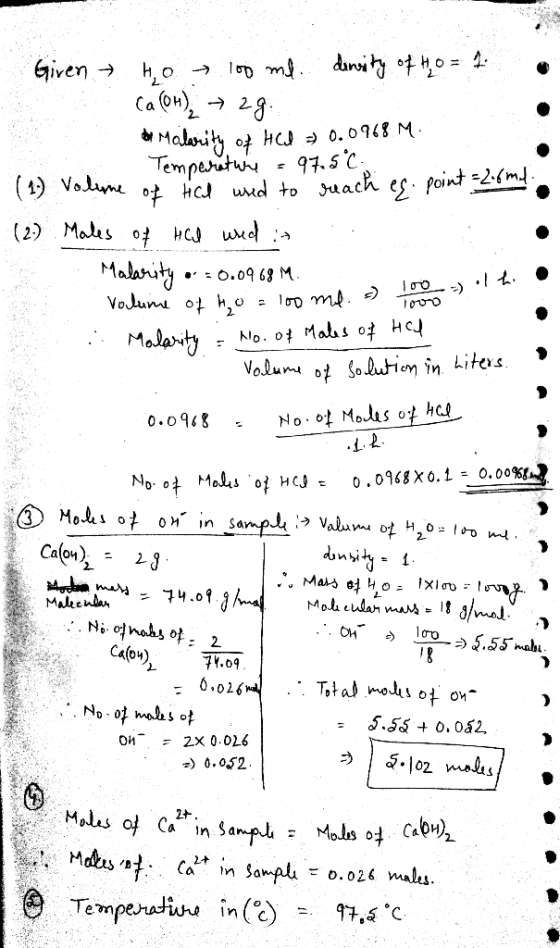
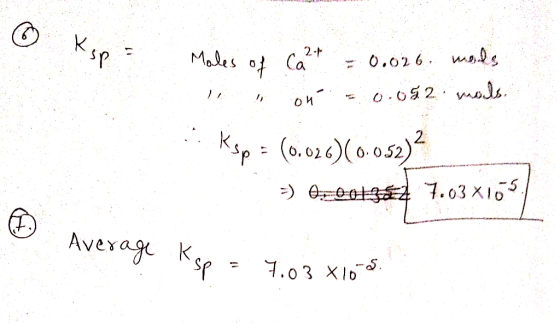
Part B: Boing Water temperature 7sec e 15co F levten/ Volume HCi used to reach the...
Partner Data Molarity of HCI solution: A. Saturated Ca(OH) at Room Temperature Temperature of calcium hydroside...
 Partner Data Molarity of HCI solution: A. Saturated Ca(OH) at Room Temperature Temperature of calcium hydroside solution:1.5 c Titration 1 Volume of saturated Ca(OH)2 solution Initial buret reading Final buret reading Volume of HCI mL. 2 ml titrant added B. Saturated Ca(OH)2 at Boiling Temperature Temperature of calcium hydroxide solution: --S9.3. Titration 1 Volume of saturated Ca(OH)2 solution 13 il Initial buret reading 例3mno mL8segomi. Final buret reading mL Volume of HCI titrant added We were unable to transcribe this...
Place 3.0 g of salicylic acid in a 125-ml Erlenmeyer flask. Carefully add, stirring constantly, 6...
 Place 3.0 g of salicylic acid in a 125-ml Erlenmeyer flask. Carefully add, stirring constantly, 6 mL of acetic anhydride, followed by 10 drops of concentrated sulfuric acid. Swirl the contents of the flask so that the reactants are thoroughly mixed. Stopper the flask with a one- hole cork fitted with an inverted Pasteur pipet to prevent condensation of water in the reaction flask during heating on the steam bath. Heat the flask in a boiling-water or steam bath for...
Draw a pathway for the reaction of phenylboronic acid with 4-iodophenol to obtain 4-phenylphenol in the...
 Draw a pathway for the
reaction of phenylboronic acid with 4-iodophenol to obtain
4-phenylphenol in the form of a catalytic
cycle. EXPLAIN and STATE all complexes formed in
EACH STEP by their electron counts (count how many
e- are there, e.g. 18 e- or 16
e- etc.), formal
oxidation states and all the reactions with
mechanistic labels (i.e. oxidative
addition, reductive elimination, etc.)
(note the amount of base used). Be sure to
EXPLAIN the catalytic cycle as to what happens...
Draw a pathway for the
reaction of phenylboronic acid with 4-iodophenol to obtain
4-phenylphenol in the form of a catalytic
cycle. EXPLAIN and STATE all complexes formed in
EACH STEP by their electron counts (count how many
e- are there, e.g. 18 e- or 16
e- etc.), formal
oxidation states and all the reactions with
mechanistic labels (i.e. oxidative
addition, reductive elimination, etc.)
(note the amount of base used). Be sure to
EXPLAIN the catalytic cycle as to what happens...
THE EMPIRICAL FORMULA OF SELECTED HYDRATES experiment PROCEDURE THIS EXPERIMENT SHOULD BE DONE IN PAIRS. 1....
THE EMPIRICAL FORMULA OF SELECTED HYDRATES experiment PROCEDURE THIS EXPERIMENT SHOULD BE DONE IN PAIRS. 1. Available to you should be: a Büchner funnel, a rubber funnel adapter, side-arm filter flask, thick-walled rubber tubing, plastic forceps and a plastic spatula. 2. Before you turn the hotplate on, wipe the hotplate down with a damp paper towel. During this experiment you will be placing filter paper containing products directly onto the surface of the hotplate. As such, you will want to...
Question 1. An insulated container is used to hold 54.0 g of water at 17.6°C. A...
Question 1. An insulated container is used to hold 54.0 g of water at 17.6°C. A sample of copper weighing 7.10 g is placed in a dry test tube and heated for 30 minutes in a boiling water bath at 100.1°C. The heated test tube is carefully removed from the water bath with laboratory tongs and inclined so that the copper slides into the water in the insulated container. Given that the specific heat of solid copper is 0.385 J/(g·°C),...
ALT CHEM 125 Name Determining the Ksp of Calcium Hydroxide Calcium hydroxide is an ionie solid...
 ALT CHEM 125 Name Determining the Ksp of Calcium Hydroxide Calcium hydroxide is an ionie solid that is sparingly soluble in water. A saturated, aqueous, solution of Ca(OH), is represented in equation form as shown below. Ca(OH)2 (5) --- Ca' (aq) + 2OH(aq) The solubility product expression describes, in mathematical terms, the equilibrium that is established between the solid substance and its dissolved ions in an aqueous system. The equilibrium expression for calcium hydroxide is shown below. Kp - [Ca][OHT...
Running the Reaction Add 0.100 g benzil and 0.30 mL 95% ethanol to a 3-mL conical vial. Place a s...
 Determine the theoretical yield and limiting reagent
Running the Reaction Add 0.100 g benzil and 0.30 mL 95% ethanol to a 3-mL conical vial. Place a spin vane in the vial and attach an air condenser. Heat the mixture with an aluminum block (90-100°C) while stirring until the benzil has dissolved (see inset in Tech- nique 6, Figure 6.1A). Using a 9-inch Pasteur pipette, add dropwise 0.25 mL of an aqueous potassium hydroxide solution' downward through the condenser into the...
Determine the theoretical yield and limiting reagent
Running the Reaction Add 0.100 g benzil and 0.30 mL 95% ethanol to a 3-mL conical vial. Place a spin vane in the vial and attach an air condenser. Heat the mixture with an aluminum block (90-100°C) while stirring until the benzil has dissolved (see inset in Tech- nique 6, Figure 6.1A). Using a 9-inch Pasteur pipette, add dropwise 0.25 mL of an aqueous potassium hydroxide solution' downward through the condenser into the...
Experiment 17A. A Solubility Product Constant Procedure Getting Started 1. Obtain a 10 ml pipet, ...
 question#1
Experiment 17A. A Solubility Product Constant Procedure Getting Started 1. Obtain a 10 ml pipet, a 50 mL buret, and 2 pieces of 120 cm filter paper Preparing Saturated Solutions of M10J MIO), is an insoluble divalent iodate salt. The identity of the cation M-is unknown. 1 Prepare MIO,), by adding S0 ml of o.2 M KIO, to 20 mL of 1 Molar M(NO,J, in a 150 mt 2. Stir the mixture vigorously with a stirring rod. A white,...
question#1
Experiment 17A. A Solubility Product Constant Procedure Getting Started 1. Obtain a 10 ml pipet, a 50 mL buret, and 2 pieces of 120 cm filter paper Preparing Saturated Solutions of M10J MIO), is an insoluble divalent iodate salt. The identity of the cation M-is unknown. 1 Prepare MIO,), by adding S0 ml of o.2 M KIO, to 20 mL of 1 Molar M(NO,J, in a 150 mt 2. Stir the mixture vigorously with a stirring rod. A white,...
numbers 1-3 Post-Laboratory Questions-EXP 3 Nitration of Aromatic Compounds Name: Due after completing the lab. 1....
 numbers 1-3
Post-Laboratory Questions-EXP 3 Nitration of Aromatic Compounds Name: Due after completing the lab. 1. Why is concentrated sulfuric acid emploved in thie on? What is the electrophile that is produced by the reaction of sulfuric acid and nitric acid? 2. Why is it important to maintain the reaction temperature low and the addition of nitric acid-sulfuric acid mixture carried out slowly? 3. Explain why concentrated H2SO4, not concentrated HC1, was used in this experiment? 4. Which ring of...
numbers 1-3
Post-Laboratory Questions-EXP 3 Nitration of Aromatic Compounds Name: Due after completing the lab. 1. Why is concentrated sulfuric acid emploved in thie on? What is the electrophile that is produced by the reaction of sulfuric acid and nitric acid? 2. Why is it important to maintain the reaction temperature low and the addition of nitric acid-sulfuric acid mixture carried out slowly? 3. Explain why concentrated H2SO4, not concentrated HC1, was used in this experiment? 4. Which ring of...
3-5 pls Post-Laboratory Questions-EXP 3 Nitration of Aromatic Compounds Name: Due after completing the lab. 1....
 3-5 pls
Post-Laboratory Questions-EXP 3 Nitration of Aromatic Compounds Name: Due after completing the lab. 1. Why is concentrated sulfuric acid employed in this reaction? What is the electrophile that is produced by the reaction of sulfuric acid and nitric acid? 2. Why is it important to maintain the reaction temperature low and the addition of nitric acid-sulfuric acid mixture carried out slowly? 3. Explain why concentrated H2SO, not concentrated HCl, was used in this experiment? 4. Which ring of...
3-5 pls
Post-Laboratory Questions-EXP 3 Nitration of Aromatic Compounds Name: Due after completing the lab. 1. Why is concentrated sulfuric acid employed in this reaction? What is the electrophile that is produced by the reaction of sulfuric acid and nitric acid? 2. Why is it important to maintain the reaction temperature low and the addition of nitric acid-sulfuric acid mixture carried out slowly? 3. Explain why concentrated H2SO, not concentrated HCl, was used in this experiment? 4. Which ring of...
 Partner Data Molarity of HCI solution: A. Saturated Ca(OH) at Room Temperature Temperature of calcium hydroside solution:1.5 c Titration 1 Volume of saturated Ca(OH)2 solution Initial buret reading Final buret reading Volume of HCI mL. 2 ml titrant added B. Saturated Ca(OH)2 at Boiling Temperature Temperature of calcium hydroxide solution: --S9.3. Titration 1 Volume of saturated Ca(OH)2 solution 13 il Initial buret reading 例3mno mL8segomi. Final buret reading mL Volume of HCI titrant added We were unable to transcribe this...
 Place 3.0 g of salicylic acid in a 125-ml Erlenmeyer flask. Carefully add, stirring constantly, 6 mL of acetic anhydride, followed by 10 drops of concentrated sulfuric acid. Swirl the contents of the flask so that the reactants are thoroughly mixed. Stopper the flask with a one- hole cork fitted with an inverted Pasteur pipet to prevent condensation of water in the reaction flask during heating on the steam bath. Heat the flask in a boiling-water or steam bath for...
 Draw a pathway for the
reaction of phenylboronic acid with 4-iodophenol to obtain
4-phenylphenol in the form of a catalytic
cycle. EXPLAIN and STATE all complexes formed in
EACH STEP by their electron counts (count how many
e- are there, e.g. 18 e- or 16
e- etc.), formal
oxidation states and all the reactions with
mechanistic labels (i.e. oxidative
addition, reductive elimination, etc.)
(note the amount of base used). Be sure to
EXPLAIN the catalytic cycle as to what happens...
Draw a pathway for the
reaction of phenylboronic acid with 4-iodophenol to obtain
4-phenylphenol in the form of a catalytic
cycle. EXPLAIN and STATE all complexes formed in
EACH STEP by their electron counts (count how many
e- are there, e.g. 18 e- or 16
e- etc.), formal
oxidation states and all the reactions with
mechanistic labels (i.e. oxidative
addition, reductive elimination, etc.)
(note the amount of base used). Be sure to
EXPLAIN the catalytic cycle as to what happens...
 ALT CHEM 125 Name Determining the Ksp of Calcium Hydroxide Calcium hydroxide is an ionie solid that is sparingly soluble in water. A saturated, aqueous, solution of Ca(OH), is represented in equation form as shown below. Ca(OH)2 (5) --- Ca' (aq) + 2OH(aq) The solubility product expression describes, in mathematical terms, the equilibrium that is established between the solid substance and its dissolved ions in an aqueous system. The equilibrium expression for calcium hydroxide is shown below. Kp - [Ca][OHT...
 Determine the theoretical yield and limiting reagent
Running the Reaction Add 0.100 g benzil and 0.30 mL 95% ethanol to a 3-mL conical vial. Place a spin vane in the vial and attach an air condenser. Heat the mixture with an aluminum block (90-100°C) while stirring until the benzil has dissolved (see inset in Tech- nique 6, Figure 6.1A). Using a 9-inch Pasteur pipette, add dropwise 0.25 mL of an aqueous potassium hydroxide solution' downward through the condenser into the...
Determine the theoretical yield and limiting reagent
Running the Reaction Add 0.100 g benzil and 0.30 mL 95% ethanol to a 3-mL conical vial. Place a spin vane in the vial and attach an air condenser. Heat the mixture with an aluminum block (90-100°C) while stirring until the benzil has dissolved (see inset in Tech- nique 6, Figure 6.1A). Using a 9-inch Pasteur pipette, add dropwise 0.25 mL of an aqueous potassium hydroxide solution' downward through the condenser into the...
 question#1
Experiment 17A. A Solubility Product Constant Procedure Getting Started 1. Obtain a 10 ml pipet, a 50 mL buret, and 2 pieces of 120 cm filter paper Preparing Saturated Solutions of M10J MIO), is an insoluble divalent iodate salt. The identity of the cation M-is unknown. 1 Prepare MIO,), by adding S0 ml of o.2 M KIO, to 20 mL of 1 Molar M(NO,J, in a 150 mt 2. Stir the mixture vigorously with a stirring rod. A white,...
question#1
Experiment 17A. A Solubility Product Constant Procedure Getting Started 1. Obtain a 10 ml pipet, a 50 mL buret, and 2 pieces of 120 cm filter paper Preparing Saturated Solutions of M10J MIO), is an insoluble divalent iodate salt. The identity of the cation M-is unknown. 1 Prepare MIO,), by adding S0 ml of o.2 M KIO, to 20 mL of 1 Molar M(NO,J, in a 150 mt 2. Stir the mixture vigorously with a stirring rod. A white,...
 numbers 1-3
Post-Laboratory Questions-EXP 3 Nitration of Aromatic Compounds Name: Due after completing the lab. 1. Why is concentrated sulfuric acid emploved in thie on? What is the electrophile that is produced by the reaction of sulfuric acid and nitric acid? 2. Why is it important to maintain the reaction temperature low and the addition of nitric acid-sulfuric acid mixture carried out slowly? 3. Explain why concentrated H2SO4, not concentrated HC1, was used in this experiment? 4. Which ring of...
numbers 1-3
Post-Laboratory Questions-EXP 3 Nitration of Aromatic Compounds Name: Due after completing the lab. 1. Why is concentrated sulfuric acid emploved in thie on? What is the electrophile that is produced by the reaction of sulfuric acid and nitric acid? 2. Why is it important to maintain the reaction temperature low and the addition of nitric acid-sulfuric acid mixture carried out slowly? 3. Explain why concentrated H2SO4, not concentrated HC1, was used in this experiment? 4. Which ring of...
 3-5 pls
Post-Laboratory Questions-EXP 3 Nitration of Aromatic Compounds Name: Due after completing the lab. 1. Why is concentrated sulfuric acid employed in this reaction? What is the electrophile that is produced by the reaction of sulfuric acid and nitric acid? 2. Why is it important to maintain the reaction temperature low and the addition of nitric acid-sulfuric acid mixture carried out slowly? 3. Explain why concentrated H2SO, not concentrated HCl, was used in this experiment? 4. Which ring of...
3-5 pls
Post-Laboratory Questions-EXP 3 Nitration of Aromatic Compounds Name: Due after completing the lab. 1. Why is concentrated sulfuric acid employed in this reaction? What is the electrophile that is produced by the reaction of sulfuric acid and nitric acid? 2. Why is it important to maintain the reaction temperature low and the addition of nitric acid-sulfuric acid mixture carried out slowly? 3. Explain why concentrated H2SO, not concentrated HCl, was used in this experiment? 4. Which ring of...
Most questions answered within 3 hours.
-
Where is the error in this code sequence?
String s1 = "Hello";
String s2 = "ello";...
asked 11 months ago -
Financial data for Joel de Paris, Inc., for last year
follow:
Joel de Paris, Inc.
Balance...
asked 11 months ago -
Consider this reaction:
Al2(SO4)3 (aq)+ BaCl3
(aq) Al2Cl6 (aq)- +
3BaSO4(s) . What is the...
asked 11 months ago -
Suppose that Savneet is considering increasing her
recent random sample from 20 car rentals to 40...
asked 11 months ago -
Trucks arrive at an unloading terminal at an average rate of 120
per hour.
Trucks arrive...
asked 11 months ago -
Why are methanol and ethanol completely soluble in water while
octanol is not very little soluble....
asked 11 months ago -
A facilities manager at a university reads in a research report
that the mean amount of...
asked 11 months ago -
When the CuSO4 is rehydrated by adding water to the anhydrous
compound, is this an endothermic...
asked 11 months ago -
A ray of sunlight is passing from diamond into crown glass; the
angle of incidence is...
asked 11 months ago -
A block of mass 0.249 kg is placed on top of a light, vertical
spring of...
asked 11 months ago -
how do the kidneys compensate in the presences of acidosis
a) trigger hyperventilate
b) reserve acid...
asked 11 months ago -
Question 501 pts
The rental rate of capital to the firm increases. Which of the
following...
asked 11 months ago