a crossflow heat echanger cools liquid water from 190F to 110F using air at 1atm entering...
a crossflow heat echanger cools liquid water from 190F to 110F using air at 1atm entering at 90F and heating to 130F. the water rate is 1 gpm and the heat echanger area is 10 ft^2. estimate the overall heat transfer coefficient
Homework Answers
liquid
T1 =190F
T0 = 110F
Air
T1' = 130F
T0' = 90 F
Q = UATm
Tm = {(190-130) -(110-90)} / [ln(60/20)}
=60x20/1.098
1092.8 F = 589.33 C
A = 10 ft 2 =0.92 m2
Q = mCdT
m = 0.06 kg
C = 4181 j/kg/c
Q = 0.06x4181x80
20068.8 = Ux0.92x589.33
U =37.01 J/m^2C
Add Answer to:
a crossflow heat echanger cools liquid water from 190F to 110F
using air at 1atm entering...
4. A Cross-Flow Air-to-Water Heat Exchanger with an effectiveness of 0.58 is used to heat water, ...
 4. A Cross-Flow Air-to-Water Heat Exchanger with an effectiveness of 0.58 is used to heat water, entering at 20°C at a rate of 4 kg/s, using hot air, entering at 127oC at a rate of 10 kg/s. The Overall Heat Transfer Coefficient for the Heat exchanger is 275 W/m'K. Assuming both fluids are unmixed, determine; (i) The Heat Capacity rates for both the air and the water (ii) The heat transfer surface area. ii) The exit temperature of the water...
A single shell pass, two tube pass heat exchanger is used to heat water entering at...
A single shell pass, two tube pass heat exchanger is used to heat water entering at Tc, in=15°C and mass flow rate 2 kg/s with ethylene glycol entering at Th, in= 85°C with a mass flow rate of 1kg/s. Calculate the rate of heat transfer Q and the outlet temperatures of the water and ethylene glycol if the heat transfer area is 10m2. (10 marks) Data: Specific Heat Capacity of ethylene glycol = 2600J/kg.°C Specific Heat Capacity of water =...
2) Hot air enters a heat exchanger at 350°C and exits at 153°C. The heat extracted...
 2) Hot air enters a heat exchanger at 350°C and exits at 153°C. The heat extracted is used to boil 0.277 kg/s of 100°C water (from saturated liquid to saturated steam). The heat exchanger is a single-shell shell-and-tube heat exchanger with two tube passes. The overall heat transfer coefficient for the hot side is 240 W/(m2). Assume a constant specific heat for air of cp = 1.005 kJ/(kg°C). The pressure of the hot air and the boiling water is P...
Hot air enters a heat exchanger at 350°C and exits at (149°C. The heat extracted is...
 Hot air enters a heat exchanger at 350°C and exits at (149°C. The heat extracted is used to boil (0.263) kg/s of 100°C water (from saturated liquid to saturated steam). The heat exchanger is a single-shell shell-and-tube heat exchanger with two tube passes. The overall heat transfer coefficient for the hot side is 240 W/(m2°C). Assume a constant specific heat for air of Cp = 1.005 kJ/(kgC). The pressure of the hot air and the boiling water is P =...
2) Hot air enters a heat exchanger at 350°C and exits at 155°C. The heat extracted...
 2) Hot air enters a heat exchanger at 350°C and exits at 155°C. The heat extracted is used to boil 0.283 kg/s of 100°C water (from saturated liquid to saturated steam). The heat exchanger is a single-shell shell-and-tube heat exchanger with two tube passes. The overall heat transfer coefficient for the hot side is 240 W/(m²°C). Assume a constant specific heat for air of Cp = 1.005 kJ/(kg °C). The pressure of the hot air and the boiling water is...
QUESTION 1: Heat Exchanges A concentric tube parallel floween s hot water saturated liquid from 30...
 QUESTION 1: Heat Exchanges A concentric tube parallel floween s hot water saturated liquid from 30 to 90%Catate of St. The exh , having thermopla properties similar to air, enter and exit the exchange 254 and 100 p ectively. The heat force 1000 W/mK The water pipe has a diameter of 50 cm a) Determine the required length for the exchanger. b) Assuming water flow inside the tube to be fully developed, estimate the convection heat transfer coefficient c) If...
A cross-flow heat exchanger used in a cardiopulmonary bypass procedure cools blood flowing at 4 L/min...
 A cross-flow heat exchanger used in a cardiopulmonary bypass procedure cools blood flowing at 4 L/min from a body temperature of 37°C to 25°C in order to induce body hypothermia, which reduces metabolic and oxygen requirements. The coolant is ice water at 0°C, and its flow rate is adjusted to provide an outlet temperature of 13°C. The heat exchanger operates with the blood flow unmixed and the water flow mixed, and the overall heat transfer coefficient is 750 W/m2.K. The...
A concentric-pipe parallel-flow heat exchanger is to heat water (cp = 4.18 kJ/kg.K) from 20°C to...
 A concentric-pipe parallel-flow heat exchanger is to heat water (cp = 4.18 kJ/kg.K) from 20°C to 80°C at a rate of 1.2 kg/s. The heating is to be accomplished by geothermal water (Cp =4.31 kJ/kg.K) available at 160°C at a mass flow rate of 2.0 kg/s. The inner pipe is thin-walled and has a diameter of 1.5 cm. If the overall heat transfer coefficient of the heat exchanger is 640 W/m2.K, determine the length of the pipe required to achieve...
We are trying to remove tetrachloroethene (C_2Cl_4) from ground water by air stripping process. The maximum...
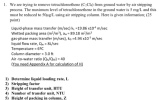 We are trying to remove tetrachloroethene (C_2Cl_4) from ground water by air stripping process. The maximum level of tetrachloroethene in the ground water is 5 mg/L and this must be reduced to 50 mu g/L using air stripping column. Here is given information; Liquid-phase mass transfer (m/sec) kL = 19.86 times 10^-4 m/sec Wetted packing area (m^2/m^3), a_w = 89.18 m^2/m^3 gas-phase mass transfer (m/sec), k_G = 4.94 times 10^-3 m/sec liquid flow rate, Q_w = 8L/sec Temperature = 6...
(3.14) An organic liquid at 185 F is to be cooled with water that is available...
 (3.14) An organic liquid at 185 F is to be cooled with water that is available at 80°E. A double-pipe beat exchanger consisting of six hairpins connected in series will be used. The heat exchanger pipes are schedule 40. Bach hairpin is 20 ft long and is made with 2- and 1-in. stainless steel (k 9.4 Btu/h ft F) pipes. Flow rates and fuid properties, which may be assumed constant, are given below. The organic liquid will flow through the...
 4. A Cross-Flow Air-to-Water Heat Exchanger with an effectiveness of 0.58 is used to heat water, entering at 20°C at a rate of 4 kg/s, using hot air, entering at 127oC at a rate of 10 kg/s. The Overall Heat Transfer Coefficient for the Heat exchanger is 275 W/m'K. Assuming both fluids are unmixed, determine; (i) The Heat Capacity rates for both the air and the water (ii) The heat transfer surface area. ii) The exit temperature of the water...
 2) Hot air enters a heat exchanger at 350°C and exits at 153°C. The heat extracted is used to boil 0.277 kg/s of 100°C water (from saturated liquid to saturated steam). The heat exchanger is a single-shell shell-and-tube heat exchanger with two tube passes. The overall heat transfer coefficient for the hot side is 240 W/(m2). Assume a constant specific heat for air of cp = 1.005 kJ/(kg°C). The pressure of the hot air and the boiling water is P...
 Hot air enters a heat exchanger at 350°C and exits at (149°C. The heat extracted is used to boil (0.263) kg/s of 100°C water (from saturated liquid to saturated steam). The heat exchanger is a single-shell shell-and-tube heat exchanger with two tube passes. The overall heat transfer coefficient for the hot side is 240 W/(m2°C). Assume a constant specific heat for air of Cp = 1.005 kJ/(kgC). The pressure of the hot air and the boiling water is P =...
 2) Hot air enters a heat exchanger at 350°C and exits at 155°C. The heat extracted is used to boil 0.283 kg/s of 100°C water (from saturated liquid to saturated steam). The heat exchanger is a single-shell shell-and-tube heat exchanger with two tube passes. The overall heat transfer coefficient for the hot side is 240 W/(m²°C). Assume a constant specific heat for air of Cp = 1.005 kJ/(kg °C). The pressure of the hot air and the boiling water is...
 QUESTION 1: Heat Exchanges A concentric tube parallel floween s hot water saturated liquid from 30 to 90%Catate of St. The exh , having thermopla properties similar to air, enter and exit the exchange 254 and 100 p ectively. The heat force 1000 W/mK The water pipe has a diameter of 50 cm a) Determine the required length for the exchanger. b) Assuming water flow inside the tube to be fully developed, estimate the convection heat transfer coefficient c) If...
 A cross-flow heat exchanger used in a cardiopulmonary bypass procedure cools blood flowing at 4 L/min from a body temperature of 37°C to 25°C in order to induce body hypothermia, which reduces metabolic and oxygen requirements. The coolant is ice water at 0°C, and its flow rate is adjusted to provide an outlet temperature of 13°C. The heat exchanger operates with the blood flow unmixed and the water flow mixed, and the overall heat transfer coefficient is 750 W/m2.K. The...
 A concentric-pipe parallel-flow heat exchanger is to heat water (cp = 4.18 kJ/kg.K) from 20°C to 80°C at a rate of 1.2 kg/s. The heating is to be accomplished by geothermal water (Cp =4.31 kJ/kg.K) available at 160°C at a mass flow rate of 2.0 kg/s. The inner pipe is thin-walled and has a diameter of 1.5 cm. If the overall heat transfer coefficient of the heat exchanger is 640 W/m2.K, determine the length of the pipe required to achieve...
 We are trying to remove tetrachloroethene (C_2Cl_4) from ground water by air stripping process. The maximum level of tetrachloroethene in the ground water is 5 mg/L and this must be reduced to 50 mu g/L using air stripping column. Here is given information; Liquid-phase mass transfer (m/sec) kL = 19.86 times 10^-4 m/sec Wetted packing area (m^2/m^3), a_w = 89.18 m^2/m^3 gas-phase mass transfer (m/sec), k_G = 4.94 times 10^-3 m/sec liquid flow rate, Q_w = 8L/sec Temperature = 6...
 (3.14) An organic liquid at 185 F is to be cooled with water that is available at 80°E. A double-pipe beat exchanger consisting of six hairpins connected in series will be used. The heat exchanger pipes are schedule 40. Bach hairpin is 20 ft long and is made with 2- and 1-in. stainless steel (k 9.4 Btu/h ft F) pipes. Flow rates and fuid properties, which may be assumed constant, are given below. The organic liquid will flow through the...
Most questions answered within 3 hours.
-
Where is the error in this code sequence?
String s1 = "Hello";
String s2 = "ello";...
asked 10 months ago -
Financial data for Joel de Paris, Inc., for last year
follow:
Joel de Paris, Inc.
Balance...
asked 10 months ago -
Consider this reaction:
Al2(SO4)3 (aq)+ BaCl3
(aq) Al2Cl6 (aq)- +
3BaSO4(s) . What is the...
asked 10 months ago -
Suppose that Savneet is considering increasing her
recent random sample from 20 car rentals to 40...
asked 10 months ago -
Trucks arrive at an unloading terminal at an average rate of 120
per hour.
Trucks arrive...
asked 10 months ago -
Why are methanol and ethanol completely soluble in water while
octanol is not very little soluble....
asked 10 months ago -
A facilities manager at a university reads in a research report
that the mean amount of...
asked 10 months ago -
When the CuSO4 is rehydrated by adding water to the anhydrous
compound, is this an endothermic...
asked 10 months ago -
A ray of sunlight is passing from diamond into crown glass; the
angle of incidence is...
asked 10 months ago -
A block of mass 0.249 kg is placed on top of a light, vertical
spring of...
asked 10 months ago -
how do the kidneys compensate in the presences of acidosis
a) trigger hyperventilate
b) reserve acid...
asked 10 months ago -
Question 501 pts
The rental rate of capital to the firm increases. Which of the
following...
asked 10 months ago