Show the output of the following piece of code: public static void main(String[] args) { char...
Homework Answers
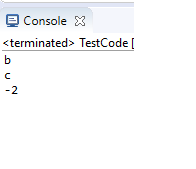
The output of the above code is:
b
c
-2
For understanding I have palced comments in the code which specifies what each statement does.
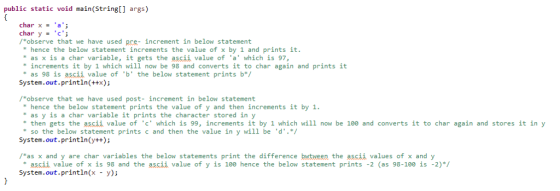
Output generated:
Add Answer to:
Show the output of the following piece of code:
public static void main(String[] args)
{
char...
What is the output of the following code: public static void main(String []args){ int x =...
What is the output of the following code: public static void main(String []args){ int x = 10; int y = 10; try{ System.out.println(function1(y, x)); } catch (Exception e) { System.out.println(“ERROR”); } } static int function1 (int x, int y) { x += 10; y += 7; return (x + y); }
What output is produced by the following program? public class MysteryNums public static void main(String[] args)...
 What output is produced by the following program? public class MysteryNums public static void main(String[] args) - int x = 12; int y = x - 3; 3, sentence (y, x + y); . public static void sentence (int numi, int num2) { 4: System.out.println(num1 + " + num2);
Review the following code: public class Looping { public static void main(String[] args) { ...
Review the following code: public class Looping { public static void main(String[] args) { for (int i = 1; i <= 5; i++) { for (int j = 1; j <= 5; j++) { System.out.println(i + " x " + j + " = " + (i * j)); } } } } What is the output from the code above? Replace this text with your solution What happens if you change the...
how to change this code to string instead of int public static void main(String[] args)...
how to change this code to string instead of int public static void main(String[] args) { int[] sample = { 212, 580, 6, 7, 28, 84, 112, 434}; Dictionary bst = new Dictionary(); for (int x : sample) { bst.insert(x); } System.out.println(bst.find(65)); System.out.println(bst.smallest()); System.out.println(bst.largest()); // bst.delete(84); System.out.println(bst.numOfLeafNodes()); System.out.println(bst.height()); bst.traverseInOrder(); } }
Analyze the following code: public class Test { private int t; public static void main(String[] args)...
 Analyze the following code: public class Test { private int t; public static void main(String[] args) { int x; System.out.println(t); } } t is non-static and it cannot be referenced in a static context in the main method. The program compiles and runs fine. The variable t is not initialized and therefore causes errors. The variable x is not initialized and therefore causes errors.
Analyze the following code: public class Test { private int t; public static void main(String[] args)...
 Analyze the following code: public class Test { private int t; public static void main(String[] args) { int x; System.out.println(t); } } The variable t is private and therefore cannot be accessed in the main method. The program compiles and runs fine. t is non-static and it cannot be referenced in a static context in the main method. The variablet is not initialized and therefore causes errors. The variable x is not initialized and therefore causes errors.
1. What is the output when you run printIn()? public static void main(String[] args) { if...
1. What is the output when you run printIn()? public static void main(String[] args) { if (true) { int num = 1; if (num > 0) { num++; } } int num = 1; addOne(num); num = num - 1 System.out.println(num); } public void addOne(int num) { num = num + 1; } 2. When creating an array for primitive data types, the default values are: a. Numeric type b. Char type c. Boolean type d. String type e. Float...
10. What prints when the following code is executed? public static void main (String args) "Cattywampus"; for (...
 10. What prints when the following code is executed? public static void main (String args) "Cattywampus"; for (int i-s.length )-1 i> 0 i-2) if (s.charAt (i)a') System.out.print(""); ] else if (s.charAt (i)'t') System.out.print (s.charAt (i-2)) i+ti else System. out. print (s . charAt (İ) ) ; if (i<2) System.out.print ("y"); System.out.println ()
10. What prints when the following code is executed? public static void main (String args) "Cattywampus"; for (int i-s.length )-1 i> 0 i-2) if (s.charAt (i)a') System.out.print(""); ]...
10. What prints when the following code is executed? public static void main (String args) "Cattywampus"; for (int i-s.length )-1 i> 0 i-2) if (s.charAt (i)a') System.out.print(""); ] else if (s.charAt (i)'t') System.out.print (s.charAt (i-2)) i+ti else System. out. print (s . charAt (İ) ) ; if (i<2) System.out.print ("y"); System.out.println ()
10. What prints when the following code is executed? public static void main (String args) "Cattywampus"; for (int i-s.length )-1 i> 0 i-2) if (s.charAt (i)a') System.out.print(""); ]...
What will be the output of the following Java code? class Output { public static void...
What will be the output of the following Java code? class Output { public static void main(String args[]) { boolean a = true; boolean b = false; boolean c = a ^ b; System.out.println(!c); } } a) 0 b) 1 c) false d) true
Given the following Java code: public static void main (String[] args) { int num; System.out.println("Enter a...
Given the following Java code: public static void main (String[] args) { int num; System.out.println("Enter a number"); num = scan.nextInt(); <-first input statement while (num != 0) { System.out.println ("The number is: " + num); System.out.println("Enter a number"); num = scan.nextInt(); } //End While } //End Module The first input statement shown above is called the:
 What output is produced by the following program? public class MysteryNums public static void main(String[] args) - int x = 12; int y = x - 3; 3, sentence (y, x + y); . public static void sentence (int numi, int num2) { 4: System.out.println(num1 + " + num2);
 Analyze the following code: public class Test { private int t; public static void main(String[] args) { int x; System.out.println(t); } } t is non-static and it cannot be referenced in a static context in the main method. The program compiles and runs fine. The variable t is not initialized and therefore causes errors. The variable x is not initialized and therefore causes errors.
 Analyze the following code: public class Test { private int t; public static void main(String[] args) { int x; System.out.println(t); } } The variable t is private and therefore cannot be accessed in the main method. The program compiles and runs fine. t is non-static and it cannot be referenced in a static context in the main method. The variablet is not initialized and therefore causes errors. The variable x is not initialized and therefore causes errors.
 10. What prints when the following code is executed? public static void main (String args) "Cattywampus"; for (int i-s.length )-1 i> 0 i-2) if (s.charAt (i)a') System.out.print(""); ] else if (s.charAt (i)'t') System.out.print (s.charAt (i-2)) i+ti else System. out. print (s . charAt (İ) ) ; if (i<2) System.out.print ("y"); System.out.println ()
10. What prints when the following code is executed? public static void main (String args) "Cattywampus"; for (int i-s.length )-1 i> 0 i-2) if (s.charAt (i)a') System.out.print(""); ]...
10. What prints when the following code is executed? public static void main (String args) "Cattywampus"; for (int i-s.length )-1 i> 0 i-2) if (s.charAt (i)a') System.out.print(""); ] else if (s.charAt (i)'t') System.out.print (s.charAt (i-2)) i+ti else System. out. print (s . charAt (İ) ) ; if (i<2) System.out.print ("y"); System.out.println ()
10. What prints when the following code is executed? public static void main (String args) "Cattywampus"; for (int i-s.length )-1 i> 0 i-2) if (s.charAt (i)a') System.out.print(""); ]...
Most questions answered within 3 hours.
-
Where is the error in this code sequence?
String s1 = "Hello";
String s2 = "ello";...
asked 11 months ago -
Financial data for Joel de Paris, Inc., for last year
follow:
Joel de Paris, Inc.
Balance...
asked 11 months ago -
Consider this reaction:
Al2(SO4)3 (aq)+ BaCl3
(aq) Al2Cl6 (aq)- +
3BaSO4(s) . What is the...
asked 11 months ago -
Suppose that Savneet is considering increasing her
recent random sample from 20 car rentals to 40...
asked 11 months ago -
Trucks arrive at an unloading terminal at an average rate of 120
per hour.
Trucks arrive...
asked 11 months ago -
Why are methanol and ethanol completely soluble in water while
octanol is not very little soluble....
asked 11 months ago -
A facilities manager at a university reads in a research report
that the mean amount of...
asked 11 months ago -
When the CuSO4 is rehydrated by adding water to the anhydrous
compound, is this an endothermic...
asked 11 months ago -
A ray of sunlight is passing from diamond into crown glass; the
angle of incidence is...
asked 11 months ago -
A block of mass 0.249 kg is placed on top of a light, vertical
spring of...
asked 11 months ago -
how do the kidneys compensate in the presences of acidosis
a) trigger hyperventilate
b) reserve acid...
asked 11 months ago -
Question 501 pts
The rental rate of capital to the firm increases. Which of the
following...
asked 11 months ago