
Homework Answers

Add Answer to:
10. What prints when the following code is executed? public static void main (String args) "Cattywampus"; for (...
10. What prints when the following code is executed? public static void main (String args) "Cattywampus";...
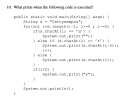 10. What prints when the following code is executed? public static void main (String args) "Cattywampus"; for (int i-s.length )-1 i> 0 i-2) if (s.charAt (i)a') System.out.print(""); ] else if (s.charAt (i)'t') System.out.print (s.charAt (i-2)) i+ti else System. out. print (s . charAt (İ) ) ; if (i<2) System.out.print ("y"); System.out.println ()
Given the following code: public static void foo3(String s) { if (s.length() >0) { System.out.print(s.charAt(s.length() -1));...
Given the following code: public static void foo3(String s) { if (s.length() >0) { System.out.print(s.charAt(s.length() -1)); foo3(s.substring(0, s.length() -1)); } } What is the output of: foo3(“”); 2, You coded the following in the file Test.java : System.out.println( foo(5)); //more code here public static int foo(int n) //line 9 { if (n = = 0) return 1; else System.out.println(n* foo(n-1) ); } //line 15 At compile time, you get the following error: Text.java: 15: missing return statement } ...
What is the Java output? Part One: class Driver { public static void main(String[] args) {...
What is the Java output? Part One: class Driver { public static void main(String[] args) { int a = 5; int b = 3; if (a < b || a * 2 < b) System.out.print(a - b); System.out.print(b + a); } } Part Two: class Driver { public static void main(String[] args) { int a = 5; int b = 8; if (a < b) if (a * 2 < b) System.out.print("foo"); else System.out.print("bar"); else System.out.print("buz"); } }
What is printed by running the following code? public static void main(String[] args) { int[] nums...
What is printed by running the following code? public static void main(String[] args) { int[] nums = {2, 3, 4}; int n = 5; changeMe1(n, nums); System.out.print( n ); System.out.print(nums[0]); changeMe2(n, nums); System.out.print( n ); System.out.print(nums[0]); } public static void changeMe1(int number, int[] list) { number++; list[0]++; } public static void changeMe2(int number, int[] list) { number = 9; list = new int[1]; list[0] = 99; }
What is the output of following program: public class Test{ public static void main(String[] args) {...
 What is the output of following program: public class Test{ public static void main(String[] args) { A a = new A(): a method B(): } } class A{ public A(){ System out println("A's constructor is executed"): } public void method(){ System out printin ("methodA is executed"): } public void methodAB(){ System out printin ("As methodAB is executed"): } } class B extends A { private int num = 0: public B (){ super(): System out printin ("B's constructor is executed"):...
Review the following code: public class Looping { public static void main(String[] args) { ...
Review the following code: public class Looping { public static void main(String[] args) { for (int i = 1; i <= 5; i++) { for (int j = 1; j <= 5; j++) { System.out.println(i + " x " + j + " = " + (i * j)); } } } } What is the output from the code above? Replace this text with your solution What happens if you change the...
Explain this java code, please. import java.util.Scanner; public class Program11 { public static void main(String[] args)...
Explain this java code, please. import java.util.Scanner; public class Program11 { public static void main(String[] args) { Scanner stdIn = new Scanner(System.in); final int maxSize = 128; String[] titles = new String[maxSize]; int[] lengths = new int[maxSize]; int numDVDs = 0; String op; op = menu(stdIn); System.out.println(); while (!op.equalsIgnoreCase("q")) { if (op.equalsIgnoreCase("a")) { if (numDVDs < maxSize) numDVDs = addDVD(titles, lengths, numDVDs, stdIn); } else if (op.equalsIgnoreCase("t")) searchByTitle(titles, lengths, numDVDs, stdIn); else if (op.equalsIgnoreCase("l")) searchByLength(titles, lengths, numDVDs, stdIn); System.out.println('\n');...
1. What is the output when you run printIn()? public static void main(String[] args) { if...
1. What is the output when you run printIn()? public static void main(String[] args) { if (true) { int num = 1; if (num > 0) { num++; } } int num = 1; addOne(num); num = num - 1 System.out.println(num); } public void addOne(int num) { num = num + 1; } 2. When creating an array for primitive data types, the default values are: a. Numeric type b. Char type c. Boolean type d. String type e. Float...
import java.util.Scanner; public class TriangleMaker { public static void main(String[] args) { //...
import java.util.Scanner; public class TriangleMaker { public static void main(String[] args) { // TODO Auto-generated method stub System.out.println("Welcome to the Triangle Maker! Enter the size of the triangle."); Scanner keyboard = new Scanner(System.in); int size = keyboard.nextInt(); for (int i = 1; i <= size; i++) { for (int j = 0; j < i; j++) { System.out.print("*"); } System.out.println(); } for (int...
What is the output of the following code: public static void main(String []args){ int x =...
What is the output of the following code: public static void main(String []args){ int x = 10; int y = 10; try{ System.out.println(function1(y, x)); } catch (Exception e) { System.out.println(“ERROR”); } } static int function1 (int x, int y) { x += 10; y += 7; return (x + y); }
 10. What prints when the following code is executed? public static void main (String args) "Cattywampus"; for (int i-s.length )-1 i> 0 i-2) if (s.charAt (i)a') System.out.print(""); ] else if (s.charAt (i)'t') System.out.print (s.charAt (i-2)) i+ti else System. out. print (s . charAt (İ) ) ; if (i<2) System.out.print ("y"); System.out.println ()
 What is the output of following program: public class Test{ public static void main(String[] args) { A a = new A(): a method B(): } } class A{ public A(){ System out println("A's constructor is executed"): } public void method(){ System out printin ("methodA is executed"): } public void methodAB(){ System out printin ("As methodAB is executed"): } } class B extends A { private int num = 0: public B (){ super(): System out printin ("B's constructor is executed"):...
Most questions answered within 3 hours.
-
Where is the error in this code sequence?
String s1 = "Hello";
String s2 = "ello";...
asked 11 months ago -
Financial data for Joel de Paris, Inc., for last year
follow:
Joel de Paris, Inc.
Balance...
asked 11 months ago -
Consider this reaction:
Al2(SO4)3 (aq)+ BaCl3
(aq) Al2Cl6 (aq)- +
3BaSO4(s) . What is the...
asked 11 months ago -
Suppose that Savneet is considering increasing her
recent random sample from 20 car rentals to 40...
asked 11 months ago -
Trucks arrive at an unloading terminal at an average rate of 120
per hour.
Trucks arrive...
asked 11 months ago -
Why are methanol and ethanol completely soluble in water while
octanol is not very little soluble....
asked 11 months ago -
A facilities manager at a university reads in a research report
that the mean amount of...
asked 11 months ago -
When the CuSO4 is rehydrated by adding water to the anhydrous
compound, is this an endothermic...
asked 11 months ago -
A ray of sunlight is passing from diamond into crown glass; the
angle of incidence is...
asked 11 months ago -
A block of mass 0.249 kg is placed on top of a light, vertical
spring of...
asked 11 months ago -
how do the kidneys compensate in the presences of acidosis
a) trigger hyperventilate
b) reserve acid...
asked 11 months ago -
Question 501 pts
The rental rate of capital to the firm increases. Which of the
following...
asked 11 months ago