Given the following code: public static void foo3(String s) { if (s.length() >0) { System.out.print(s.charAt(s.length() -1));...
- Given the following code:
public static void foo3(String s)
{
if (s.length() >0)
{
System.out.print(s.charAt(s.length() -1));
foo3(s.substring(0, s.length() -1));
}
}
What is the output of: foo3(“”);
2, You coded the following in the file Test.java :
System.out.println( foo(5));
//more code here
public static int foo(int n) //line 9
{
if (n = = 0)
return 1;
else
System.out.println(n* foo(n-1) );
} //line 15
At compile time, you get the following error:
Text.java: 15: missing return statement
} //line 15
^
1 error
Explain what the problem is and how to fix it.
3) Fill in the missing code:
This recursive method returns “even” if the length of a give String is even, and “odd” if the length of the String is odd.
public static String foo(String s)
{
if (s.length() ==0)
return “even”;
else if (s.length() = = 1)
return “odd”;
else
//the code goes here
}
Homework Answers
Question 1:
"".length() is 0
As it is not greater than 0 it does not prints anything.

Question 2:
public static int foo(int n) //line 9
{
    if (n == 0)
        return 1;
    else
        // we have to return value without printing it
        return n* foo(n-1);
}

Question 3:
public static String foo(String s)
{
    if (s.length() ==0)
       return "even";
    else if (s.length() == 1)
       return "odd";
    else
        return foo(s.substring(2));
}
Add Answer to:
Given the following code:
public static void foo3(String s)
{
if (s.length() >0)
{
System.out.print(s.charAt(s.length()
-1));...
(20 pts) Fill in the missing code: This recursive method returns “even” if the length of...
(20 pts) Fill in the missing code: This recursive method returns “even” if the length of a give String is even, and “odd” if the length of the String is odd. public static String foo(String s) { if (s.length() ==0) return “even”; else if (s.length() = = 1) return “odd”; else //your code goes here } (40 pts) You coded the following in the file Test.java : System.out.println( foo(5)); //more code here public static int foo(int n)...
10. What prints when the following code is executed? public static void main (String args) "Cattywampus"; for (...
 10. What prints when the following code is executed? public static void main (String args) "Cattywampus"; for (int i-s.length )-1 i> 0 i-2) if (s.charAt (i)a') System.out.print(""); ] else if (s.charAt (i)'t') System.out.print (s.charAt (i-2)) i+ti else System. out. print (s . charAt (İ) ) ; if (i<2) System.out.print ("y"); System.out.println ()
10. What prints when the following code is executed? public static void main (String args) "Cattywampus"; for (int i-s.length )-1 i> 0 i-2) if (s.charAt (i)a') System.out.print(""); ]...
10. What prints when the following code is executed? public static void main (String args) "Cattywampus"; for (int i-s.length )-1 i> 0 i-2) if (s.charAt (i)a') System.out.print(""); ] else if (s.charAt (i)'t') System.out.print (s.charAt (i-2)) i+ti else System. out. print (s . charAt (İ) ) ; if (i<2) System.out.print ("y"); System.out.println ()
10. What prints when the following code is executed? public static void main (String args) "Cattywampus"; for (int i-s.length )-1 i> 0 i-2) if (s.charAt (i)a') System.out.print(""); ]...
10. What prints when the following code is executed? public static void main (String args) "Cattywampus";...
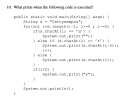 10. What prints when the following code is executed? public static void main (String args) "Cattywampus"; for (int i-s.length )-1 i> 0 i-2) if (s.charAt (i)a') System.out.print(""); ] else if (s.charAt (i)'t') System.out.print (s.charAt (i-2)) i+ti else System. out. print (s . charAt (İ) ) ; if (i<2) System.out.print ("y"); System.out.println ()
JAVA Write a method that accepts a String as an argument. The method should use recursion...
JAVA Write a method that accepts a String as an argument. The method should use recursion to display each individual character in the String. Then, modify the method you just wrote so it displays the String backwards. The following code does not correctly display the String backwards. It merely moves the first character of the String to the end: public static void displayCharacter(String s) { if(s.length() == 0) return; else ...
Java class quiz need help~ This is the Backwards.java code. public class Backwards { /** *...
Java class quiz need help~ This is the Backwards.java code. public class Backwards { /** * Program starts with this method. * * @param args A String to be printed backwards */ public static void main(String[] args) { if (args.length == 0) { System.out.println("ERROR: Enter a String on commandline."); } else { String word = args[0]; String backwards = iterativeBack(word); // A (return address) System.out.println("Iterative solution: " + backwards); backwards = recursiveBack(word); // B (return address) System.out.println("\n\nRecursive solution: " +...
instructions These questions should test if you have understood the contents of Chapter 18 "Recursion". 1....
instructions These questions should test if you have understood the contents of Chapter 18 "Recursion". 1. What will this method return if you call it this: xMethod (4) static int xMethod (int n) { if (n == 1) return 1; else return n + xMethod (n - 1); } 1. 10 2. 11 3. 12 4. 9 2. Analyze the following code: public class Test { public static void main (String [] args) { int [] x = {1, 2,...
Explain this java code, please. import java.util.Scanner; public class Program11 { public static void main(String[] args)...
Explain this java code, please. import java.util.Scanner; public class Program11 { public static void main(String[] args) { Scanner stdIn = new Scanner(System.in); final int maxSize = 128; String[] titles = new String[maxSize]; int[] lengths = new int[maxSize]; int numDVDs = 0; String op; op = menu(stdIn); System.out.println(); while (!op.equalsIgnoreCase("q")) { if (op.equalsIgnoreCase("a")) { if (numDVDs < maxSize) numDVDs = addDVD(titles, lengths, numDVDs, stdIn); } else if (op.equalsIgnoreCase("t")) searchByTitle(titles, lengths, numDVDs, stdIn); else if (op.equalsIgnoreCase("l")) searchByLength(titles, lengths, numDVDs, stdIn); System.out.println('\n');...
For Questions 1-3: consider the following code: public class A { private int number; protected String...
For Questions 1-3: consider the following code: public class A { private int number; protected String name; public double price; public A() { System.out.println(“A() called”); } private void foo1() { System.out.println(“A version of foo1() called”); } protected int foo2() { Sysem.out.println(“A version of foo2() called); return number; } public String foo3() { System.out.println(“A version of foo3() called”); Return “Hi”; } }//end class A public class B extends A { private char service; public B() { super(); System.out.println(“B() called”);...
For Questions 1-3: consider the following code: public class A { private int number; protected String...
For Questions 1-3: consider the following code: public class A { private int number; protected String name; public double price; public A() { System.out.println(“A() called”); } private void foo1() { System.out.println(“A version of foo1() called”); } protected int foo2() { Sysem.out.println(“A version of foo2() called); return number; } public String foo3() { System.out.println(“A version of foo3() called”); Return “Hi”; } }//end class A public class B extends A { private char service; public B() { super(); System.out.println(“B() called”); } public...
b) Consider the following code. public static int f(int n) if (n == 1) return 0;...
 b) Consider the following code. public static int f(int n) if (n == 1) return 0; else if (n % 2 == 0). return g(n/2); else return g(n+1); public static int g(int n) int r = n % 3; if (r == 0) return f(n/3); else if (r == 1) return f(n+2); else return f(2 * n); // (HERE) public static void main(String[] args) { int x = 3; System.out.println(f(x)); (1) (5 points) Draw the call stack as it would...
 10. What prints when the following code is executed? public static void main (String args) "Cattywampus"; for (int i-s.length )-1 i> 0 i-2) if (s.charAt (i)a') System.out.print(""); ] else if (s.charAt (i)'t') System.out.print (s.charAt (i-2)) i+ti else System. out. print (s . charAt (İ) ) ; if (i<2) System.out.print ("y"); System.out.println ()
10. What prints when the following code is executed? public static void main (String args) "Cattywampus"; for (int i-s.length )-1 i> 0 i-2) if (s.charAt (i)a') System.out.print(""); ]...
10. What prints when the following code is executed? public static void main (String args) "Cattywampus"; for (int i-s.length )-1 i> 0 i-2) if (s.charAt (i)a') System.out.print(""); ] else if (s.charAt (i)'t') System.out.print (s.charAt (i-2)) i+ti else System. out. print (s . charAt (İ) ) ; if (i<2) System.out.print ("y"); System.out.println ()
10. What prints when the following code is executed? public static void main (String args) "Cattywampus"; for (int i-s.length )-1 i> 0 i-2) if (s.charAt (i)a') System.out.print(""); ]...
 10. What prints when the following code is executed? public static void main (String args) "Cattywampus"; for (int i-s.length )-1 i> 0 i-2) if (s.charAt (i)a') System.out.print(""); ] else if (s.charAt (i)'t') System.out.print (s.charAt (i-2)) i+ti else System. out. print (s . charAt (İ) ) ; if (i<2) System.out.print ("y"); System.out.println ()
 b) Consider the following code. public static int f(int n) if (n == 1) return 0; else if (n % 2 == 0). return g(n/2); else return g(n+1); public static int g(int n) int r = n % 3; if (r == 0) return f(n/3); else if (r == 1) return f(n+2); else return f(2 * n); // (HERE) public static void main(String[] args) { int x = 3; System.out.println(f(x)); (1) (5 points) Draw the call stack as it would...
Most questions answered within 3 hours.
-
Where is the error in this code sequence?
String s1 = "Hello";
String s2 = "ello";...
asked 11 months ago -
Financial data for Joel de Paris, Inc., for last year
follow:
Joel de Paris, Inc.
Balance...
asked 11 months ago -
Consider this reaction:
Al2(SO4)3 (aq)+ BaCl3
(aq) Al2Cl6 (aq)- +
3BaSO4(s) . What is the...
asked 11 months ago -
Suppose that Savneet is considering increasing her
recent random sample from 20 car rentals to 40...
asked 11 months ago -
Trucks arrive at an unloading terminal at an average rate of 120
per hour.
Trucks arrive...
asked 11 months ago -
Why are methanol and ethanol completely soluble in water while
octanol is not very little soluble....
asked 11 months ago -
A facilities manager at a university reads in a research report
that the mean amount of...
asked 11 months ago -
When the CuSO4 is rehydrated by adding water to the anhydrous
compound, is this an endothermic...
asked 11 months ago -
A ray of sunlight is passing from diamond into crown glass; the
angle of incidence is...
asked 11 months ago -
A block of mass 0.249 kg is placed on top of a light, vertical
spring of...
asked 11 months ago -
how do the kidneys compensate in the presences of acidosis
a) trigger hyperventilate
b) reserve acid...
asked 11 months ago -
Question 501 pts
The rental rate of capital to the firm increases. Which of the
following...
asked 11 months ago