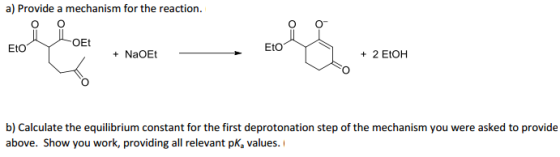
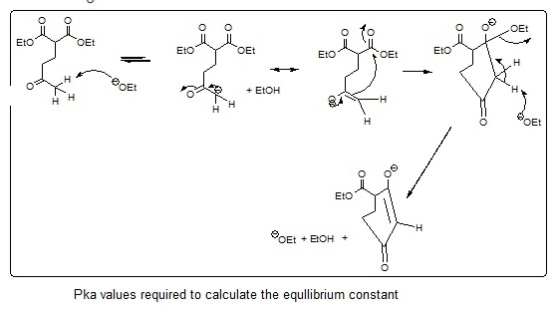
Provide a mechanism for the reaction.
Calculate the equlibirum constnat for the first deprotonation step of the mechanism.
Homework Answers
Add Answer to:
Provide a mechanism for the reaction.
Calculate the equlibirum constnat for the first deprotonation
step of...
Provide a feasible multi-step synthesis for the following compound. Each blank corresponds to a one letter...
 Provide a feasible multi-step synthesis for the following compound. Each blank corresponds to a one letter answer. Assume you have enough of your reagent to do the reaction: if you need two equivalence you don't need to repeat the letter. Assume a mild acid aqueous workup at the very end of the reaction sequence. COMPOUND: Starting material and Reagent Bank: D G ce * Br NaOEt, EtOH OEt B E H Br H307, heat Eto OEt F - Br CO2...
3. (3 pts) Provide a reasonable arrow-pushing mechanism for the following transformation. Why does the more...
 3. (3 pts) Provide a reasonable arrow-pushing mechanism for the following transformation. Why does the more substituted cyclopentanone not form? Me OEt 1. NaOET, ETOH X 2. NH4Cl (aq soln) Eto EIO Me
Identify the products of the following reactions and propose a mechanism for its formation. Please explain each step i.e. protonation, deprotonation, loss of leaving group, or nucleophilic attack and...
 Identify the products of the following reactions and propose a
mechanism for its formation. Please explain each step i.e.
protonation, deprotonation, loss of leaving group, or nucleophilic
attack and describe what kind of reactions they are. Include BOTH
major and minor products. Thank you in advance.
NaOEt EtOH Me H0 2 CI 6 12 CI acetone
NaOEt EtOH Me
H0 2 CI 6 12 CI acetone
Identify the products of the following reactions and propose a
mechanism for its formation. Please explain each step i.e.
protonation, deprotonation, loss of leaving group, or nucleophilic
attack and describe what kind of reactions they are. Include BOTH
major and minor products. Thank you in advance.
NaOEt EtOH Me H0 2 CI 6 12 CI acetone
NaOEt EtOH Me
H0 2 CI 6 12 CI acetone
Provide a step-by-step mechanism to account for the product of each of the following reactions. Show...
 Provide a step-by-step mechanism to account for the product of
each of the following reactions. Show the structure of each of the
intermediates and use curved arrows to indicate electron flow in
each of these steps.
3. Provide a step-by-step mechanism to account for the product of each of the following reactions. Show the structure of each of the intermediates and use curved arrows to indicate electron flow in each of these steps. a) NaOEt (1 equiv) EtOH O OH...
Provide a step-by-step mechanism to account for the product of
each of the following reactions. Show the structure of each of the
intermediates and use curved arrows to indicate electron flow in
each of these steps.
3. Provide a step-by-step mechanism to account for the product of each of the following reactions. Show the structure of each of the intermediates and use curved arrows to indicate electron flow in each of these steps. a) NaOEt (1 equiv) EtOH O OH...
8. Provide a complete mechanism to account for the formation of the following product. & det...
 8. Provide a complete mechanism to account for the formation of the following product. & det NaOH, A 7. Provide a complete mechanism to account for the formation of the following product (only need to show ester hydrolysis and decarboxylation once). 1. NaOEt olyan emos OET 2 Eto 2. H30+, A
What's the major product in each step of the reaction? e) 1. NaOEt, EtOH dilute OEt...
 What's the major product in each step of the reaction?
e) 1. NaOEt, EtOH dilute OEt Eto 2. HyO*, heat 1. LiAIH4, ether 1. DIBAL, THF 2. H', H2O h) 1.2 eq. CH,CH2MgBr, ether 2. D3O OCH, 1) OH, H20 3) EtOH, H,o* 2) H,o 4) excess CHMgBr 5) H,O
What's the major product in each step of the reaction?
e) 1. NaOEt, EtOH dilute OEt Eto 2. HyO*, heat 1. LiAIH4, ether 1. DIBAL, THF 2. H', H2O h) 1.2 eq. CH,CH2MgBr, ether 2. D3O OCH, 1) OH, H20 3) EtOH, H,o* 2) H,o 4) excess CHMgBr 5) H,O
please provide the mechanism for the reaction to produce A and B as well ! OH...
 please provide the mechanism for the reaction to produce A and B as
well !
OH HO paraformaldehyde NH OAc NH2OAC Ph EtO OEt EtO но Н.о NT B A Scheme 3. Hantzsch Ester synthesis under aqueous conditions O:
please provide the mechanism for the reaction to produce A and B as
well !
OH HO paraformaldehyde NH OAc NH2OAC Ph EtO OEt EtO но Н.о NT B A Scheme 3. Hantzsch Ester synthesis under aqueous conditions O:
1) The reaction below proceeds via a multistep mechanism involving several intermediate structures en route to...
 1) The reaction below proceeds via a multistep mechanism involving several intermediate structures en route to the final product. Some possible structures for the intermediates and product have been provided below. Decide which intermediates are involved in the reaction, and what the final product is, and place them in the correct order (e.g. A +B+C where C would be the final product isolated). (4 points) 1) NaOET, Eto OEt 2) NHACI, H20 Possible intermediates/products: Eto OET Eto OET Eto OET...
(b) For TWO of the following reactions provide a mechanism that explains the product shown and...
 (b) For TWO of the following reactions provide a mechanism that explains the product shown and explain any regiochemical control that has occurred in its formation. [2 x 5 marks] EtO2C LCOMEt CO2Et NaOEt mwag mo (i) NaOEt, Ph Br (ii) 0 1 Eto V 0 L oEt HO (ii) aqueous acid, heat EtO2 CO2Et NaOEt EtO2C CO2Et
Please provide a reaction mechanism with a chair state to show how the stereochemistry was achieved....
 Please provide a reaction
mechanism with a chair state to show how the stereochemistry was
achieved. Also, please explain the reasoning/methodology behind the
type reaction.
NaOEt/EtOH
Please provide a reaction
mechanism with a chair state to show how the stereochemistry was
achieved. Also, please explain the reasoning/methodology behind the
type reaction.
NaOEt/EtOH
 Provide a feasible multi-step synthesis for the following compound. Each blank corresponds to a one letter answer. Assume you have enough of your reagent to do the reaction: if you need two equivalence you don't need to repeat the letter. Assume a mild acid aqueous workup at the very end of the reaction sequence. COMPOUND: Starting material and Reagent Bank: D G ce * Br NaOEt, EtOH OEt B E H Br H307, heat Eto OEt F - Br CO2...
 3. (3 pts) Provide a reasonable arrow-pushing mechanism for the following transformation. Why does the more substituted cyclopentanone not form? Me OEt 1. NaOET, ETOH X 2. NH4Cl (aq soln) Eto EIO Me
 Identify the products of the following reactions and propose a
mechanism for its formation. Please explain each step i.e.
protonation, deprotonation, loss of leaving group, or nucleophilic
attack and describe what kind of reactions they are. Include BOTH
major and minor products. Thank you in advance.
NaOEt EtOH Me H0 2 CI 6 12 CI acetone
NaOEt EtOH Me
H0 2 CI 6 12 CI acetone
Identify the products of the following reactions and propose a
mechanism for its formation. Please explain each step i.e.
protonation, deprotonation, loss of leaving group, or nucleophilic
attack and describe what kind of reactions they are. Include BOTH
major and minor products. Thank you in advance.
NaOEt EtOH Me H0 2 CI 6 12 CI acetone
NaOEt EtOH Me
H0 2 CI 6 12 CI acetone
 Provide a step-by-step mechanism to account for the product of
each of the following reactions. Show the structure of each of the
intermediates and use curved arrows to indicate electron flow in
each of these steps.
3. Provide a step-by-step mechanism to account for the product of each of the following reactions. Show the structure of each of the intermediates and use curved arrows to indicate electron flow in each of these steps. a) NaOEt (1 equiv) EtOH O OH...
Provide a step-by-step mechanism to account for the product of
each of the following reactions. Show the structure of each of the
intermediates and use curved arrows to indicate electron flow in
each of these steps.
3. Provide a step-by-step mechanism to account for the product of each of the following reactions. Show the structure of each of the intermediates and use curved arrows to indicate electron flow in each of these steps. a) NaOEt (1 equiv) EtOH O OH...
 8. Provide a complete mechanism to account for the formation of the following product. & det NaOH, A 7. Provide a complete mechanism to account for the formation of the following product (only need to show ester hydrolysis and decarboxylation once). 1. NaOEt olyan emos OET 2 Eto 2. H30+, A
 What's the major product in each step of the reaction?
e) 1. NaOEt, EtOH dilute OEt Eto 2. HyO*, heat 1. LiAIH4, ether 1. DIBAL, THF 2. H', H2O h) 1.2 eq. CH,CH2MgBr, ether 2. D3O OCH, 1) OH, H20 3) EtOH, H,o* 2) H,o 4) excess CHMgBr 5) H,O
What's the major product in each step of the reaction?
e) 1. NaOEt, EtOH dilute OEt Eto 2. HyO*, heat 1. LiAIH4, ether 1. DIBAL, THF 2. H', H2O h) 1.2 eq. CH,CH2MgBr, ether 2. D3O OCH, 1) OH, H20 3) EtOH, H,o* 2) H,o 4) excess CHMgBr 5) H,O
 please provide the mechanism for the reaction to produce A and B as
well !
OH HO paraformaldehyde NH OAc NH2OAC Ph EtO OEt EtO но Н.о NT B A Scheme 3. Hantzsch Ester synthesis under aqueous conditions O:
please provide the mechanism for the reaction to produce A and B as
well !
OH HO paraformaldehyde NH OAc NH2OAC Ph EtO OEt EtO но Н.о NT B A Scheme 3. Hantzsch Ester synthesis under aqueous conditions O:
 1) The reaction below proceeds via a multistep mechanism involving several intermediate structures en route to the final product. Some possible structures for the intermediates and product have been provided below. Decide which intermediates are involved in the reaction, and what the final product is, and place them in the correct order (e.g. A +B+C where C would be the final product isolated). (4 points) 1) NaOET, Eto OEt 2) NHACI, H20 Possible intermediates/products: Eto OET Eto OET Eto OET...
 (b) For TWO of the following reactions provide a mechanism that explains the product shown and explain any regiochemical control that has occurred in its formation. [2 x 5 marks] EtO2C LCOMEt CO2Et NaOEt mwag mo (i) NaOEt, Ph Br (ii) 0 1 Eto V 0 L oEt HO (ii) aqueous acid, heat EtO2 CO2Et NaOEt EtO2C CO2Et
 Please provide a reaction
mechanism with a chair state to show how the stereochemistry was
achieved. Also, please explain the reasoning/methodology behind the
type reaction.
NaOEt/EtOH
Please provide a reaction
mechanism with a chair state to show how the stereochemistry was
achieved. Also, please explain the reasoning/methodology behind the
type reaction.
NaOEt/EtOH
Most questions answered within 3 hours.
-
Where is the error in this code sequence?
String s1 = "Hello";
String s2 = "ello";...
asked 10 months ago -
Financial data for Joel de Paris, Inc., for last year
follow:
Joel de Paris, Inc.
Balance...
asked 10 months ago -
Consider this reaction:
Al2(SO4)3 (aq)+ BaCl3
(aq) Al2Cl6 (aq)- +
3BaSO4(s) . What is the...
asked 10 months ago -
Suppose that Savneet is considering increasing her
recent random sample from 20 car rentals to 40...
asked 10 months ago -
Trucks arrive at an unloading terminal at an average rate of 120
per hour.
Trucks arrive...
asked 10 months ago -
Why are methanol and ethanol completely soluble in water while
octanol is not very little soluble....
asked 10 months ago -
A facilities manager at a university reads in a research report
that the mean amount of...
asked 10 months ago -
When the CuSO4 is rehydrated by adding water to the anhydrous
compound, is this an endothermic...
asked 10 months ago -
A ray of sunlight is passing from diamond into crown glass; the
angle of incidence is...
asked 10 months ago -
A block of mass 0.249 kg is placed on top of a light, vertical
spring of...
asked 10 months ago -
how do the kidneys compensate in the presences of acidosis
a) trigger hyperventilate
b) reserve acid...
asked 10 months ago -
Question 501 pts
The rental rate of capital to the firm increases. Which of the
following...
asked 10 months ago