![1. (25 Points) In the figure below, figure (a) shows a uniform beam subject to a linearly increasing distributed load which starts a 0 at the left end and increases to Wo on the right end. As depicted in (b), the beam deflection can be computed with 4 120EIL where E is the modulus of elasticity [kN/cm2] and I is the moment of inertia [cm]. Calculate each of thee following quantities (take the derivatives by hand) and plot them versus distance along the beam using Matlab (a) Displacement y, (b) Slope )dyld] (c) Moment [M) EIdy/d*], (d) Shear V) Eldy/d:] Use the following parameters f L-500[cm, E- 35,000 [kN/cm2], 1- 35,000 [cm, Wo 2.75 [kN/cm]. Calculate the deflection every 20 [cm] Use the subplot function to display the plots in a 2x2 array in the or your computation: the same figure in the order (a) to (d). Type help subplot at the Matlab prompt to learn how to use it. Include a title and axis labels (with units in square brackets) for each subplot. Plot the displacement with a solid blue line with dots at the data points, slope with a red dashed line, moment with a green dash-dot line, and shear with a magenta dotted line](http://img.homeworklib.com/questions/9fef3500-bfd3-11ea-8e77-a9a48dc1ea9b.png?x-oss-process=image/resize,w_560)
Homework Answers
MATLAB CODE
clc
clear all
%Given
L=500;
E=35000;
I=35000;
wo=2.75;
x=0:20:500;
Y=(wo./(120*E*I*L)).*(2*L.^2.*x.^3-x.*L^4-x.^5); %Given deflection
eq.
S=(wo./(120*E*I*L)).*(6*L^2.*x.^2-L^2-5*x.^4); %Slope equation hand
calculation
M=(wo./(120*E*I*L)).*(12*L^2.*x-20*x.^3); %Moment equation hand
calculation
SF=(wo./(120*E*I*L)).*(12*L^2-60*x.^2); %Shear equation force hand
calculation
subplot(2,2,1)
plot(x,Y)
axis([0 500 min(Y) max(Y)])
title('Deflection')
subplot(2,2,2)
plot(x,S)
axis([0 500 min(S) max(S)])
title('Slope')
subplot(2,2,3)
plot(x,M)
axis([0 500 min(M) max(M)])
title('Moment')
subplot(2,2,4)
plot(x,SF)
axis([0 500 min(SF) max(SF)])
title('Shear Force')
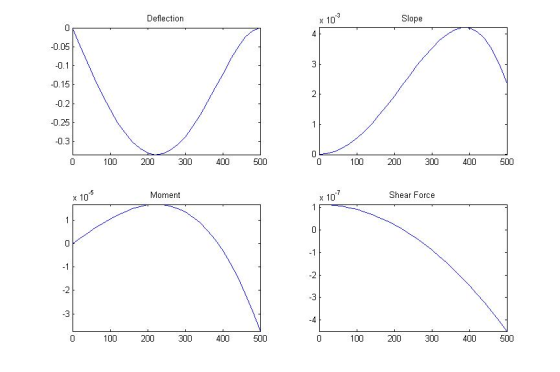
OUTPUT GRAPH
Add Answer to:
Need help!!
1. (25 Points) In the figure below, figure (a) shows a uniform beam subject...
The deflection of a uniform beam subject to a linearly increasing distributed load can be compute...
 The deflection of a uniform beam subject to a linearly increasing distributed load can be computed by using the following equation: y = ( 120EIL Given that L 600 cm, I 30,000 cm, wo-2500 N/cm, and E 50,000 KN/cm2 2. Develop a Matlab code that would implement the Golden-Section search method to find the maximum deflection until the error falls below 1% with initial guesses of Xi = 0 and Xu-L. Display all of the following: xl, xu, d, x1...
Uniform beam under distributed load
 Case 1: Uniform beam under distributed load.In the shown Figure, a uniform beam subject to a linearly increasing distributed load. The deflection \(y(\mathrm{~m})\) can be expressed by \(y=\frac{w_{o}}{120 E I L}\left(-x^{5}+2 L^{2} x^{3}-L^{4} x\right)\)Where \(E\) is the modulus of elasticity and \(I\) is the moment of inertia \(\left(\mathrm{m}^{4}\right), L\) length of beam.Use the following parameters \(L=600 \mathrm{~cm}\), \(E=50,000 \mathrm{kN} / \mathrm{cm}^{2}, I=30.000 \mathrm{~cm}^{4}, w_{\mathrm{o}}=2.5\)\(\mathrm{kN} / \mathrm{cm}\), to find the requirements1) Develop MATLAB code to
determine the point of maximum
deflection...
Case 1: Uniform beam under distributed load.In the shown Figure, a uniform beam subject to a linearly increasing distributed load. The deflection \(y(\mathrm{~m})\) can be expressed by \(y=\frac{w_{o}}{120 E I L}\left(-x^{5}+2 L^{2} x^{3}-L^{4} x\right)\)Where \(E\) is the modulus of elasticity and \(I\) is the moment of inertia \(\left(\mathrm{m}^{4}\right), L\) length of beam.Use the following parameters \(L=600 \mathrm{~cm}\), \(E=50,000 \mathrm{kN} / \mathrm{cm}^{2}, I=30.000 \mathrm{~cm}^{4}, w_{\mathrm{o}}=2.5\)\(\mathrm{kN} / \mathrm{cm}\), to find the requirements1) Develop MATLAB code to
determine the point of maximum
deflection...
For the loading shown in the below figure, knowing that wo 2 kN/m, the length of the beam is L 2 ...
 For the loading shown in the below figure, knowing that wo 2 kN/m, the length of the beam is L 2 m, and the bending rigidity EI-204 kN-m2, a) Find the deflection equation for the beam by integration. Clearly specify the conditions to determine the constants of integration b) Find the vertical force needed at point A to prevent vertical displacement at point A (v(0)-0) c) Find the moment needed at point A to have zero slope at point A...
TODEH Figure P2.26 shuws a unilorm beam sbjest to a linearly increusing distributed kd. As depicted...
 TODEH Figure P2.26 shuws a unilorm beam sbjest to a linearly increusing distributed kd. As depicted in Flg. P2 deflection y (m) can be computed with (+21-1) y 120EIL (a) (b) FIGURE P2.2s where E the modalus of elasticity and / the moment of inertia ( plces of the following quantities versas distance along the heans Employ this equation and calculus to penerate MATLAD displacement Qs slope 10) d mone(M) -Eld yid shear [V Eld yid, and looding wr)IEld idy...
QUESTION 4 (25 marks) A simply supported beam is loaded by an uniform distributed load, wkN/m, over the span of the beam, L, as shown in Figure Q4. (a) Determine the end reactions at point A and...
 QUESTION 4 (25 marks) A simply supported beam is loaded by an uniform distributed load, wkN/m, over the span of the beam, L, as shown in Figure Q4. (a) Determine the end reactions at point A and B in terms of w and L. (4 marks) (b) At an arbitrary point, x, express the internal mom (c) Show that the deflection curve of the beam under the loading situation is ent, M(x), in x, w, and L. (5 marks) 24EI...
1. The beam below is supported by rollers on the left side and is fixed on...
 1. The beam below is supported by rollers on the left side and is fixed on the right side. There is a linear distributed load along the length of the beam shown in figure (a) and the deflection of the beam is given and shown in figure (b). The figures are not drawn to scale. (x = L. y = 0) (x = 0, y = 0) (a) Length, L = 600 (cm) Youngs Modulus, E = 50,000 (KM) Area...
Use bisection method to determine the point of maximum deflection of the beam subject to a linearly increasing distributed load shown in the figure below
 Use bisection method to determine the point of maximum deflection of the beam subject to a linearly increasing distributed load shown in the figure below (the value of x where dy/dx= 0). Then substitute this value into the equation to determine the value of the maximum deflection. Use the following parameter values in your computation: L = 600 cm, E=50,000 kN/cm2, I=30,000 cm4, and w0 =1.75 kN/cm.
Problem 1 Indeterminate Beam Reactions (50 pts.) With reference to Figure 1, determine the beam reactions...
 Problem 1 Indeterminate Beam Reactions (50 pts.) With reference to Figure 1, determine the beam reactions (forces and moments). Use the slope deflection method. Draw the shear and bending moment diagrams E 29,000 ksi I 1830 in FIGURE 1 3
4. (25 pt.) The beam subjected to a uniform distributed load as shown in Figure 4(a)...
 4. (25 pt.) The beam subjected to a uniform distributed load as shown in Figure 4(a) has a triangular cross-section as shown in Figure 4(b). 1) (6 pt.) Determine mathematical descriptions of the shear force function V(x) and the moment function M(x). 2) (6 pt.) Draw the shear and moment diagrams for the beam. 3) (5 pt.) What is the maximum internal moment Mmar in the beam? Where on the beam does it occur? 4) (8 pt.) Determine the absolute...
Figure P5.13a shows a uniform beam subject to a linearly increasing distributed load. The equation for the resulting elastic curve is (see Fig. P5.135)
 Figure P5.13a shows a uniform beam subject to a linearly increasing distributed load. The equation for the resulting elastic curve is (see Fig. P5.135) Use bisection to determine the point of maximum deflection (that is, the value of x where dy/dx = 0). Then substitute this value into Eq. (P5.13) to determine the value of the maximum deflection. Use the following parameter values in your com- putation: L = 600 cm, E = 50,000 kN/cm², I = 30,000 cm, and w0...
 The deflection of a uniform beam subject to a linearly increasing distributed load can be computed by using the following equation: y = ( 120EIL Given that L 600 cm, I 30,000 cm, wo-2500 N/cm, and E 50,000 KN/cm2 2. Develop a Matlab code that would implement the Golden-Section search method to find the maximum deflection until the error falls below 1% with initial guesses of Xi = 0 and Xu-L. Display all of the following: xl, xu, d, x1...
 For the loading shown in the below figure, knowing that wo 2 kN/m, the length of the beam is L 2 m, and the bending rigidity EI-204 kN-m2, a) Find the deflection equation for the beam by integration. Clearly specify the conditions to determine the constants of integration b) Find the vertical force needed at point A to prevent vertical displacement at point A (v(0)-0) c) Find the moment needed at point A to have zero slope at point A...
 TODEH Figure P2.26 shuws a unilorm beam sbjest to a linearly increusing distributed kd. As depicted in Flg. P2 deflection y (m) can be computed with (+21-1) y 120EIL (a) (b) FIGURE P2.2s where E the modalus of elasticity and / the moment of inertia ( plces of the following quantities versas distance along the heans Employ this equation and calculus to penerate MATLAD displacement Qs slope 10) d mone(M) -Eld yid shear [V Eld yid, and looding wr)IEld idy...
 QUESTION 4 (25 marks) A simply supported beam is loaded by an uniform distributed load, wkN/m, over the span of the beam, L, as shown in Figure Q4. (a) Determine the end reactions at point A and B in terms of w and L. (4 marks) (b) At an arbitrary point, x, express the internal mom (c) Show that the deflection curve of the beam under the loading situation is ent, M(x), in x, w, and L. (5 marks) 24EI...
 1. The beam below is supported by rollers on the left side and is fixed on the right side. There is a linear distributed load along the length of the beam shown in figure (a) and the deflection of the beam is given and shown in figure (b). The figures are not drawn to scale. (x = L. y = 0) (x = 0, y = 0) (a) Length, L = 600 (cm) Youngs Modulus, E = 50,000 (KM) Area...
 Problem 1 Indeterminate Beam Reactions (50 pts.) With reference to Figure 1, determine the beam reactions (forces and moments). Use the slope deflection method. Draw the shear and bending moment diagrams E 29,000 ksi I 1830 in FIGURE 1 3
 4. (25 pt.) The beam subjected to a uniform distributed load as shown in Figure 4(a) has a triangular cross-section as shown in Figure 4(b). 1) (6 pt.) Determine mathematical descriptions of the shear force function V(x) and the moment function M(x). 2) (6 pt.) Draw the shear and moment diagrams for the beam. 3) (5 pt.) What is the maximum internal moment Mmar in the beam? Where on the beam does it occur? 4) (8 pt.) Determine the absolute...
Most questions answered within 3 hours.
-
Where is the error in this code sequence?
String s1 = "Hello";
String s2 = "ello";...
asked 10 months ago -
Financial data for Joel de Paris, Inc., for last year
follow:
Joel de Paris, Inc.
Balance...
asked 10 months ago -
Consider this reaction:
Al2(SO4)3 (aq)+ BaCl3
(aq) Al2Cl6 (aq)- +
3BaSO4(s) . What is the...
asked 10 months ago -
Suppose that Savneet is considering increasing her
recent random sample from 20 car rentals to 40...
asked 10 months ago -
Trucks arrive at an unloading terminal at an average rate of 120
per hour.
Trucks arrive...
asked 10 months ago -
Why are methanol and ethanol completely soluble in water while
octanol is not very little soluble....
asked 10 months ago -
A facilities manager at a university reads in a research report
that the mean amount of...
asked 10 months ago -
When the CuSO4 is rehydrated by adding water to the anhydrous
compound, is this an endothermic...
asked 10 months ago -
A ray of sunlight is passing from diamond into crown glass; the
angle of incidence is...
asked 10 months ago -
A block of mass 0.249 kg is placed on top of a light, vertical
spring of...
asked 10 months ago -
how do the kidneys compensate in the presences of acidosis
a) trigger hyperventilate
b) reserve acid...
asked 10 months ago -
Question 501 pts
The rental rate of capital to the firm increases. Which of the
following...
asked 10 months ago