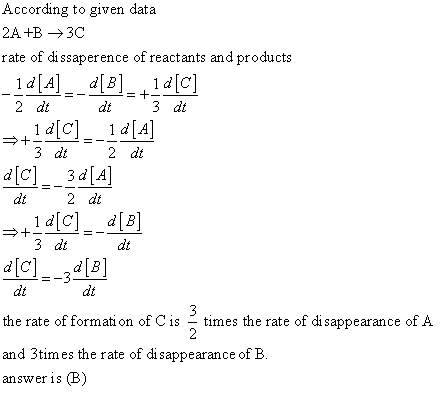
For the reaction 2 A + B → 3 C the rate of formation of C...
For the reaction
2 A + B → 3 C
the rate of formation of C is ___ times the rate of disappearance of A and ____ times the rate of disappearance of B.
A ) 2, 1
B) 3/2, 3
C) 2, 3
D) 1/2, 1
Homework Answers
6A.2 The rate of formation of C in the reaction 2 A + B -->4 C...
6A.2 The rate of formation of C in the reaction 2 A + B -->4 C + 3 D is 3.2 mol dm-3 s·'. State the rates of formation and consumption of A. B. and D. 6A.3 Equation 2a defines the unique rate of a reaction. Write expressions for vfor each of the species in the reaction 2 A+B --> 4 C + 3 D. What is the value of v given the rate of forma- tionofCis3.2moldm-3 s·'?
1. In the reaction 2 A + B - C + 3D, reactant A is found...
 1. In the reaction 2 A + B - C + 3D, reactant A is found to disappear at the rate of 6.2 X 10⁻⁴Ms-1 (a) What is the rate of reaction at this point? (b) What is the rate of disappearance of B? (c) What is the rate of formation of D?
2. Consider the following generic reaction: 2 A+3 B C+D a. Define the reaction rate in...
 2. Consider the following generic reaction: 2 A+3 B C+D a. Define the reaction rate in terms of the relative rates of disappearance/appearance of each species in the equation. b. I rate of appearance of C is 1.20 0M s'at a particular instant, what rate is B disappearing at that instant? If A is disappearing at a rate of 2.90 x 10 Mst at a particular instant, at what rate is B disappearing at that instant? c.
For the reaction: 2A + 3B ---> 3D, if the rate of formation of D is...
For the reaction: 2A + 3B ---> 3D, if the rate of formation of D is 0.00645 M/s, determine the rate of disappearance of A: a. 0.00646 M/s b. 0.0194 M/s c. 0.00968 M/s d. 0.00430 M/s e. 0.00323 M/s
Consider the reaction, S2O82- + 3 I- à 2 SO42- + I3-. Data obtained in measuring rate of formation of I3- are...
Consider the reaction, S2O82- + 3 I- à 2 SO42- + I3-. Data obtained in measuring rate of formation of I3- are listed in the table. Experiment [S2O82-], M [I‑], M Initial rate, Ms-1 1 0.035 0.055 1.5 x 10⁻⁵ 2 0.070 0.055 3.0 x 10⁻⁵ 3 0.070 0.110 6.0 x 10⁻⁵ Determine the order of reaction with respect to S2O82-. What is the order of reaction with respect to I-? Give the overall order of reaction. Write the rate law for the reaction. Determine the...
Consider the reaction C2H3Cl3 + 3H2 -> C2H6 + 3HCl If the rate of formation of...
Consider the reaction C2H3Cl3 + 3H2 -> C2H6 + 3HCl If the rate of formation of HCl is 25x10-6 gmol/g.cat-min a) What is the rate of disappearance of trichloroethane? b) What is the rate of formation of ethane? I don't know what the unit of gmol/g.cat-min is. How specific is the unit in this question?
The rate of a chemical reaction can be measured as the rate of appearance of any...
 The rate of a chemical reaction can be measured as the rate of appearance of any of the products or as the rate of disappearance of any of the reactants. These relative rates of reaction are related through the stoichiometry of the overall reaction. For example, the rate of the reaction shown below can be determined by measuring the initial rate of disappearance of I, -A[I/At. Cl03-(aq) + 91. (aq)+ 6 H+ (aq) → 31.3 (aq) + Cl-(aq) + 3H20...
for the following reaction, to get the rate of formation of H2O - 2x C @...
 for the following reaction, to get the rate of formation of
H2O
- 2x C @ 2 - 2 hours 3/34 QUESTION 7.1 POINT For the following reaction to get the rate of formation of H,O, what must we multiply the rate of formation of Sio, by? 2 Si,H+70,- 4 Si0, +6H,0 Select the correct answer below: 0 0 0 FEEDBACK
for the following reaction, to get the rate of formation of
H2O
- 2x C @ 2 - 2 hours 3/34 QUESTION 7.1 POINT For the following reaction to get the rate of formation of H,O, what must we multiply the rate of formation of Sio, by? 2 Si,H+70,- 4 Si0, +6H,0 Select the correct answer below: 0 0 0 FEEDBACK
Consider the following reaction: AB The average rate of appearance of B is given by A[B]At....
 Consider the following reaction: AB The average rate of appearance of B is given by A[B]At. Comparing the rate of appearance of B and the rate of disappearance of A, we get A[B]/At = * (-A[A]/At). A) +1 B) +2 C) -1 D) +1/2 E) -1/2
The overall reaction A + 2B → C involves several intermediate steps. Which of the following...
The overall reaction A + 2B → C involves several intermediate steps. Which of the following statements is/are correct? 1. The rate of disappearance of A, -d[A]/dt, is equal to the rate of production of C, d[C]/dt. 2. The rate of reaction is one-half the rate of disappearance of B. 3. The order of the reaction must be determined experimentally. A. 1 only B. all C. 3 only D. 2 only E. 1 & 2 only
 1. In the reaction 2 A + B - C + 3D, reactant A is found to disappear at the rate of 6.2 X 10⁻⁴Ms-1 (a) What is the rate of reaction at this point? (b) What is the rate of disappearance of B? (c) What is the rate of formation of D?
 2. Consider the following generic reaction: 2 A+3 B C+D a. Define the reaction rate in terms of the relative rates of disappearance/appearance of each species in the equation. b. I rate of appearance of C is 1.20 0M s'at a particular instant, what rate is B disappearing at that instant? If A is disappearing at a rate of 2.90 x 10 Mst at a particular instant, at what rate is B disappearing at that instant? c.
 The rate of a chemical reaction can be measured as the rate of appearance of any of the products or as the rate of disappearance of any of the reactants. These relative rates of reaction are related through the stoichiometry of the overall reaction. For example, the rate of the reaction shown below can be determined by measuring the initial rate of disappearance of I, -A[I/At. Cl03-(aq) + 91. (aq)+ 6 H+ (aq) → 31.3 (aq) + Cl-(aq) + 3H20...
 for the following reaction, to get the rate of formation of
H2O
- 2x C @ 2 - 2 hours 3/34 QUESTION 7.1 POINT For the following reaction to get the rate of formation of H,O, what must we multiply the rate of formation of Sio, by? 2 Si,H+70,- 4 Si0, +6H,0 Select the correct answer below: 0 0 0 FEEDBACK
for the following reaction, to get the rate of formation of
H2O
- 2x C @ 2 - 2 hours 3/34 QUESTION 7.1 POINT For the following reaction to get the rate of formation of H,O, what must we multiply the rate of formation of Sio, by? 2 Si,H+70,- 4 Si0, +6H,0 Select the correct answer below: 0 0 0 FEEDBACK
 Consider the following reaction: AB The average rate of appearance of B is given by A[B]At. Comparing the rate of appearance of B and the rate of disappearance of A, we get A[B]/At = * (-A[A]/At). A) +1 B) +2 C) -1 D) +1/2 E) -1/2
Most questions answered within 3 hours.
-
Where is the error in this code sequence?
String s1 = "Hello";
String s2 = "ello";...
asked 11 months ago -
Financial data for Joel de Paris, Inc., for last year
follow:
Joel de Paris, Inc.
Balance...
asked 11 months ago -
Consider this reaction:
Al2(SO4)3 (aq)+ BaCl3
(aq) Al2Cl6 (aq)- +
3BaSO4(s) . What is the...
asked 11 months ago -
Suppose that Savneet is considering increasing her
recent random sample from 20 car rentals to 40...
asked 11 months ago -
Trucks arrive at an unloading terminal at an average rate of 120
per hour.
Trucks arrive...
asked 11 months ago -
Why are methanol and ethanol completely soluble in water while
octanol is not very little soluble....
asked 11 months ago -
A facilities manager at a university reads in a research report
that the mean amount of...
asked 11 months ago -
When the CuSO4 is rehydrated by adding water to the anhydrous
compound, is this an endothermic...
asked 11 months ago -
A ray of sunlight is passing from diamond into crown glass; the
angle of incidence is...
asked 11 months ago -
A block of mass 0.249 kg is placed on top of a light, vertical
spring of...
asked 11 months ago -
how do the kidneys compensate in the presences of acidosis
a) trigger hyperventilate
b) reserve acid...
asked 11 months ago -
Question 501 pts
The rental rate of capital to the firm increases. Which of the
following...
asked 11 months ago