Ibvp wave equation
Solve the following initial boundry value problem. 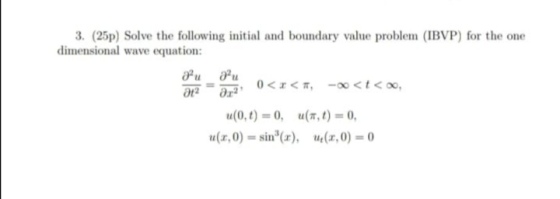
Homework Answers
Request Answer!
We need at least 9 more requests to produce the answer.
1 / 10 have requested this problem solution
The more requests, the faster the answer.
6. (10 pts) The traveling of a wave is governed by the one-way wave equation, диди...
 6. (10 pts) The traveling of a wave is governed by the one-way wave equation, диди Ət +Qax = 0, u(x,0) = f(2). Assuming that a > 0, this equation describes a wave, whose form is given by f(x), travels to the right at speed a. In this exercise, we use Fourier transform methods to solve this equation. (a) (4 pts) Apply Fourier transform (with regard to x) to the equations above to derive the initial value problem of uw,t)...
4. Consider the following initial value problem of the 1D wave equation with mixed boundary condition...
 4. Consider the following initial value problem of the 1D wave equation with mixed boundary condition IC: u(z, t = 0) = g(x), ut(z, t = 0) = h(z), BC: u(0, t)0, u(l,t) 0, t>0 0 < x < 1, (a)Use the energy method to show that there is at most one solution for the initial-boundary value problem. (b)Suppose u(x,t)-X()T(t) is a seperable solution. Show that X and T satisfy for some λ E R. Find all the eigenvalues An...
Problem 1 (Submit): Solve the following inhomogeneous initial boundary value problem for the wave equation: qu=cu,...
 Problem 1 (Submit): Solve the following inhomogeneous initial boundary value problem for the wave equation: qu=cu, te+cos (31), 0<=<5, t>0 13(0,t) = 0 and u(t)=t, t>0 u(1,0) = cos(I), 24(1,0) = 1 + cos(51), 0<I
PROBLEM 1 IS SUPPOSED TO BE A WAVE EQUATION NOT HEAT EQUATION 1. Find the solution...
 PROBLEM 1 IS SUPPOSED TO BE A WAVE EQUATION NOT HEAT
EQUATION
1. Find the solution to the following boundary value initial value problem for the Heat Equation au 22u 22 = 22+ 2 0<x<1, c=1 <3 <1, C u(0,t) = 0 u(1,t) = 0 (L = 1) u(x,0) = f(x) = 3 sin(7x) + 2 sin (3x) (initial conditions) (2,0) = g(x) = sin(2x) 2. Find the solution to the following boundary value problem on the rectangle 0 <...
PROBLEM 1 IS SUPPOSED TO BE A WAVE EQUATION NOT HEAT
EQUATION
1. Find the solution to the following boundary value initial value problem for the Heat Equation au 22u 22 = 22+ 2 0<x<1, c=1 <3 <1, C u(0,t) = 0 u(1,t) = 0 (L = 1) u(x,0) = f(x) = 3 sin(7x) + 2 sin (3x) (initial conditions) (2,0) = g(x) = sin(2x) 2. Find the solution to the following boundary value problem on the rectangle 0 <...
2. Solve the initial value problem for the given differential equation. 2. Solve the initial value problem for the given differential equation.
 2. Solve the initial value problem for the given differential equation.
2. Solve the initial value problem for the given differential equation.
2. Solve the initial value problem for the given differential equation.
3. Consider another Volterra integral equation (a) Solve the integral equation (4) by using the Laplace...
 3. Consider another Volterra integral equation (a) Solve the integral equation (4) by using the Laplace transform. (b) Convert the integral equation (4) into an initial value problem, as in Problem 2. (c) Solve the initial value problem in part (b), and verify the solution is the same as the one in part (a)
Solve the initial-boundary value problem for the following equation U = N Ux with U(x, 0)...
 Solve the initial-boundary value problem for the following equation
U = N Ux with U(x, 0) = sin (x) +N ,U(0, t) = 0, and U, (N, t) = 0
Q4| (5 Marks)
my question
please answer
Solve the initial-boundary value problem for the
following equation U = N Ux with U(x, 0) = sin (x) +N ,U(0, t) = 0,
and U, (N, t) = 0 Q4| (5 Marks)
Solve the initial-boundary value problem for the following equation Uų...
Solve the initial-boundary value problem for the following equation
U = N Ux with U(x, 0) = sin (x) +N ,U(0, t) = 0, and U, (N, t) = 0
Q4| (5 Marks)
my question
please answer
Solve the initial-boundary value problem for the
following equation U = N Ux with U(x, 0) = sin (x) +N ,U(0, t) = 0,
and U, (N, t) = 0 Q4| (5 Marks)
Solve the initial-boundary value problem for the following equation Uų...
Section 1.3 3. a. Solve the following initial boundary value problem for the heat equation 0x<L...
 Section 1.3 3. a. Solve the following initial boundary value problem for the heat equation 0x<L t0 at u(r, 0) f() u(0, t)u(L, t) 0, t>0, 9Tr when f(r)6 sin L b. Solve the following initial boundary value problem for the diffusion equation au D 0 L t0 at u(r, 0) f() (0, t) (L, t) 0, t 0, x < L/2 0. when f(r) r > L/2. 1
Section 1.3 3. a. Solve the following initial boundary value problem...
Section 1.3 3. a. Solve the following initial boundary value problem for the heat equation 0x<L t0 at u(r, 0) f() u(0, t)u(L, t) 0, t>0, 9Tr when f(r)6 sin L b. Solve the following initial boundary value problem for the diffusion equation au D 0 L t0 at u(r, 0) f() (0, t) (L, t) 0, t 0, x < L/2 0. when f(r) r > L/2. 1
Section 1.3 3. a. Solve the following initial boundary value problem...
Differential Equations 1. (10 points) Identify the equation and solve it. 2. (10 points) Solve the...
 Differential Equations
1. (10 points) Identify the equation and solve it. 2. (10 points) Solve the following initial value problem 3.(5 points) Solve the following exact equation. (Solve it by using the method for exact equations)
Differential Equations
1. (10 points) Identify the equation and solve it. 2. (10 points) Solve the following initial value problem 3.(5 points) Solve the following exact equation. (Solve it by using the method for exact equations)
1. Let u be a solution of the wave equation u 0. Let the points A, B, C, D be the vertices of the...
 1. Let u be a solution of the wave equation u 0. Let the points A, B, C, D be the vertices of the paralleogram formed by the two pairs of characteristic lines r-ctC1,x- ct-2,+ ct- di,r +ct- d2 Show that u (A)+u (C)-u (B) + u (D Use this to find u satisfying For which (x, t) can you determine u (x, t) uniquely this way? 2. Suppose u satisfies the wave equation utt -curr0 in the strip 0...
 6. (10 pts) The traveling of a wave is governed by the one-way wave equation, диди Ət +Qax = 0, u(x,0) = f(2). Assuming that a > 0, this equation describes a wave, whose form is given by f(x), travels to the right at speed a. In this exercise, we use Fourier transform methods to solve this equation. (a) (4 pts) Apply Fourier transform (with regard to x) to the equations above to derive the initial value problem of uw,t)...
 4. Consider the following initial value problem of the 1D wave equation with mixed boundary condition IC: u(z, t = 0) = g(x), ut(z, t = 0) = h(z), BC: u(0, t)0, u(l,t) 0, t>0 0 < x < 1, (a)Use the energy method to show that there is at most one solution for the initial-boundary value problem. (b)Suppose u(x,t)-X()T(t) is a seperable solution. Show that X and T satisfy for some λ E R. Find all the eigenvalues An...
 Problem 1 (Submit): Solve the following inhomogeneous initial boundary value problem for the wave equation: qu=cu, te+cos (31), 0<=<5, t>0 13(0,t) = 0 and u(t)=t, t>0 u(1,0) = cos(I), 24(1,0) = 1 + cos(51), 0<I
 PROBLEM 1 IS SUPPOSED TO BE A WAVE EQUATION NOT HEAT
EQUATION
1. Find the solution to the following boundary value initial value problem for the Heat Equation au 22u 22 = 22+ 2 0<x<1, c=1 <3 <1, C u(0,t) = 0 u(1,t) = 0 (L = 1) u(x,0) = f(x) = 3 sin(7x) + 2 sin (3x) (initial conditions) (2,0) = g(x) = sin(2x) 2. Find the solution to the following boundary value problem on the rectangle 0 <...
PROBLEM 1 IS SUPPOSED TO BE A WAVE EQUATION NOT HEAT
EQUATION
1. Find the solution to the following boundary value initial value problem for the Heat Equation au 22u 22 = 22+ 2 0<x<1, c=1 <3 <1, C u(0,t) = 0 u(1,t) = 0 (L = 1) u(x,0) = f(x) = 3 sin(7x) + 2 sin (3x) (initial conditions) (2,0) = g(x) = sin(2x) 2. Find the solution to the following boundary value problem on the rectangle 0 <...
 2. Solve the initial value problem for the given differential equation.
2. Solve the initial value problem for the given differential equation.
2. Solve the initial value problem for the given differential equation.
 3. Consider another Volterra integral equation (a) Solve the integral equation (4) by using the Laplace transform. (b) Convert the integral equation (4) into an initial value problem, as in Problem 2. (c) Solve the initial value problem in part (b), and verify the solution is the same as the one in part (a)
 Solve the initial-boundary value problem for the following equation
U = N Ux with U(x, 0) = sin (x) +N ,U(0, t) = 0, and U, (N, t) = 0
Q4| (5 Marks)
my question
please answer
Solve the initial-boundary value problem for the
following equation U = N Ux with U(x, 0) = sin (x) +N ,U(0, t) = 0,
and U, (N, t) = 0 Q4| (5 Marks)
Solve the initial-boundary value problem for the following equation Uų...
Solve the initial-boundary value problem for the following equation
U = N Ux with U(x, 0) = sin (x) +N ,U(0, t) = 0, and U, (N, t) = 0
Q4| (5 Marks)
my question
please answer
Solve the initial-boundary value problem for the
following equation U = N Ux with U(x, 0) = sin (x) +N ,U(0, t) = 0,
and U, (N, t) = 0 Q4| (5 Marks)
Solve the initial-boundary value problem for the following equation Uų...
 Section 1.3 3. a. Solve the following initial boundary value problem for the heat equation 0x<L t0 at u(r, 0) f() u(0, t)u(L, t) 0, t>0, 9Tr when f(r)6 sin L b. Solve the following initial boundary value problem for the diffusion equation au D 0 L t0 at u(r, 0) f() (0, t) (L, t) 0, t 0, x < L/2 0. when f(r) r > L/2. 1
Section 1.3 3. a. Solve the following initial boundary value problem...
Section 1.3 3. a. Solve the following initial boundary value problem for the heat equation 0x<L t0 at u(r, 0) f() u(0, t)u(L, t) 0, t>0, 9Tr when f(r)6 sin L b. Solve the following initial boundary value problem for the diffusion equation au D 0 L t0 at u(r, 0) f() (0, t) (L, t) 0, t 0, x < L/2 0. when f(r) r > L/2. 1
Section 1.3 3. a. Solve the following initial boundary value problem...
 Differential Equations
1. (10 points) Identify the equation and solve it. 2. (10 points) Solve the following initial value problem 3.(5 points) Solve the following exact equation. (Solve it by using the method for exact equations)
Differential Equations
1. (10 points) Identify the equation and solve it. 2. (10 points) Solve the following initial value problem 3.(5 points) Solve the following exact equation. (Solve it by using the method for exact equations)
 1. Let u be a solution of the wave equation u 0. Let the points A, B, C, D be the vertices of the paralleogram formed by the two pairs of characteristic lines r-ctC1,x- ct-2,+ ct- di,r +ct- d2 Show that u (A)+u (C)-u (B) + u (D Use this to find u satisfying For which (x, t) can you determine u (x, t) uniquely this way? 2. Suppose u satisfies the wave equation utt -curr0 in the strip 0...
Most questions answered within 3 hours.
-
Where is the error in this code sequence?
String s1 = "Hello";
String s2 = "ello";...
asked 11 months ago -
Financial data for Joel de Paris, Inc., for last year
follow:
Joel de Paris, Inc.
Balance...
asked 11 months ago -
Consider this reaction:
Al2(SO4)3 (aq)+ BaCl3
(aq) Al2Cl6 (aq)- +
3BaSO4(s) . What is the...
asked 11 months ago -
Suppose that Savneet is considering increasing her
recent random sample from 20 car rentals to 40...
asked 11 months ago -
Trucks arrive at an unloading terminal at an average rate of 120
per hour.
Trucks arrive...
asked 11 months ago -
Why are methanol and ethanol completely soluble in water while
octanol is not very little soluble....
asked 11 months ago -
A facilities manager at a university reads in a research report
that the mean amount of...
asked 11 months ago -
When the CuSO4 is rehydrated by adding water to the anhydrous
compound, is this an endothermic...
asked 11 months ago -
A ray of sunlight is passing from diamond into crown glass; the
angle of incidence is...
asked 11 months ago -
A block of mass 0.249 kg is placed on top of a light, vertical
spring of...
asked 11 months ago -
how do the kidneys compensate in the presences of acidosis
a) trigger hyperventilate
b) reserve acid...
asked 11 months ago -
Question 501 pts
The rental rate of capital to the firm increases. Which of the
following...
asked 11 months ago