

Homework Answers
Add Answer to:
(1 point) A physics student wants to measure the stiffness of a spring (force required per...
A student measures the force required to stretch a spring by various amounts and makes the graph...
 A student measures the force required to stretch a spring by various amounts and makes the graph shown in Figure, which plots this force as a function of the distance the spring has stretched. (a) Does this spring obey Hooke’s law? How do you know? (b) What is the force constant of the spring, in N/m? (c) What force would be needed to stretch the spring a distance of 17 cm from its unstretched length, assuming that it continues to...
Many physical properties, such as force and mass, cannot be measured directly. Rather, some other physical...
 Many physical properties, such as force and mass, cannot be measured directly. Rather, some other physical property is measured and the desired physical property is computed from the results. For example, a bathroom scale does not actually measure mass or "weight," but rather the compression distance of a spring. The numerical values on the scale are calibrated from the compression distance using basic physics principles such as Newton's second law. Coefficients of friction cannot be measured directly. In this problem,...
HW-02: Problem 7 Previous Problem Problem List Next Problem (1 point) Refer to the previous question,...
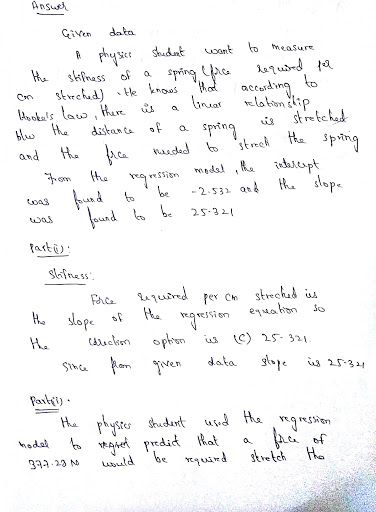
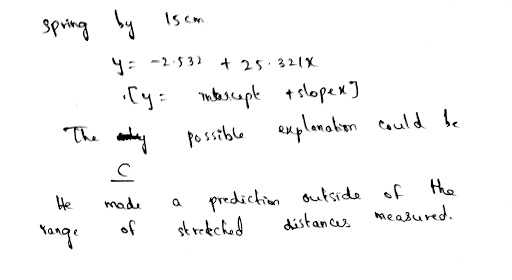
 HW-02: Problem 7 Previous Problem Problem List Next Problem (1 point) Refer to the previous question, the physics student used the regression model to make a prediction: in order to stretch the spring by 15cm, the force required is predicted to be 377.28N. Remarkably, his prediction was horribly wrong. Can you explain why? (Check all that apply) A. Correlation does not imply causation. B. He made a prediction outside of the range of stretched distances measured. C. He had outliers...
General Physics Integration Examples to Solve F 1. Find the total force on an acquarium window....
 General Physics Integration Examples to Solve F 1. Find the total force on an acquarium window. Given that force is related to pressune area thusly: F-p. And that the pressure varies with depth below the surface according top-ped where ρ is the water density, g is acceleration due to gravity, and d is depth below the surface. (Problem: The force is not the same over the window. Hint: divide the window into pieces so that within each piece the pressure...
I need guidance here is the graph that I just created for #2 FI= \kAl 1....
 I need guidance
here is the graph that I just created for #2
FI= \kAl 1. Where k is the spring constant and Al is the change in the length of the spring. This relationship is called Hooke's Law. In your class vou will discuss this in more detail and include direction, and any appropriate offset or discussion of relaxed or equilibrium position. we find the spring constant by applying a force and measuring how far the spring stretches from...
I need guidance
here is the graph that I just created for #2
FI= \kAl 1. Where k is the spring constant and Al is the change in the length of the spring. This relationship is called Hooke's Law. In your class vou will discuss this in more detail and include direction, and any appropriate offset or discussion of relaxed or equilibrium position. we find the spring constant by applying a force and measuring how far the spring stretches from...
1. (10 Marks)A load of 50 N attached to a spring hanging vertically stretches the spring...
 1. (10 Marks)A load of 50 N attached to a spring hanging vertically stretches the spring 5.0 cm. The spring is now placed horizontally on a table and stretched 11 cm. (a)What force is required to stretch the spring by that amount? (b) Plot a graph of force (on the y-axis) versus spring displacement from the equilibrium position along the x-axis x(cm) 2. (10 Marks) What are the (a) amplitude, (b) frequency 20 and (c) phase constant of the oscillation...
1. (10 Marks)A load of 50 N attached to a spring hanging vertically stretches the spring...
 1. (10 Marks)A load of 50 N attached to a spring hanging vertically stretches the spring 5.0 cm. The spring is now placed horizontally on a table and stretched 11 cm. (a)What force is required to stretch the spring by that amount? (b) Plot a graph of force (on the y-axis) versus spring displacement from the equilibrium position along the x-axis. x(cm) 2. (10 Marks) What are the (a) amplitude, (b) frequency 20 and (c) phase constant of the oscillation...
Question 1. What does the slope of the plot of tension force vs. position represent? Question 2. ...
 Question 1. What does the slope of the plot of tension
force vs. position represent?
Question 2. For the second run, do you notice nonlinear
behavior at high tension forces? Does this indicate the material is
becoming stiffer or slinkier?
Question 3. What does the trend in the graph indicate
will happen if you keep adding even more tension to the
wire?
Question 4. For a wire that has twice the radius of our
wire, how much would it stretch...
Question 1. What does the slope of the plot of tension
force vs. position represent?
Question 2. For the second run, do you notice nonlinear
behavior at high tension forces? Does this indicate the material is
becoming stiffer or slinkier?
Question 3. What does the trend in the graph indicate
will happen if you keep adding even more tension to the
wire?
Question 4. For a wire that has twice the radius of our
wire, how much would it stretch...
A group of physics students collected data from a test of the projectile motion problem that...
 A group of physics students collected data from a test of the projectile motion problem that was analyzed in a previous lab exercise (L5). In their test, the students varied the angle and initial velocity Vo at which the projectile was launched, and then measured the resulting time of flight (tright). Note that tright was the dependent variable, while and Vo were independent variables. The results are listed below. (degrees) Time of Flight (s) Initial Velocity V. (m/s) 15 20...
ECE Review Worksheet 1 AP Physics Mr. Marrash 1. A space traveler weighs 980 N on...
 ECE Review Worksheet 1 AP Physics Mr. Marrash 1. A space traveler weighs 980 N on Earth. What will the traveler weight on another planet whose radius is 3 times that of the Earth and whose mass is also 9 times that of the Earth. Do not use any numerical values of the universal gravitational constant G, the mass of Earth, or the radius of Earth to get your answer. 2. Two skaters, a man and a woman, are standing...
 A student measures the force required to stretch a spring by various amounts and makes the graph shown in Figure, which plots this force as a function of the distance the spring has stretched. (a) Does this spring obey Hooke’s law? How do you know? (b) What is the force constant of the spring, in N/m? (c) What force would be needed to stretch the spring a distance of 17 cm from its unstretched length, assuming that it continues to...
 Many physical properties, such as force and mass, cannot be measured directly. Rather, some other physical property is measured and the desired physical property is computed from the results. For example, a bathroom scale does not actually measure mass or "weight," but rather the compression distance of a spring. The numerical values on the scale are calibrated from the compression distance using basic physics principles such as Newton's second law. Coefficients of friction cannot be measured directly. In this problem,...
 HW-02: Problem 7 Previous Problem Problem List Next Problem (1 point) Refer to the previous question, the physics student used the regression model to make a prediction: in order to stretch the spring by 15cm, the force required is predicted to be 377.28N. Remarkably, his prediction was horribly wrong. Can you explain why? (Check all that apply) A. Correlation does not imply causation. B. He made a prediction outside of the range of stretched distances measured. C. He had outliers...
 General Physics Integration Examples to Solve F 1. Find the total force on an acquarium window. Given that force is related to pressune area thusly: F-p. And that the pressure varies with depth below the surface according top-ped where ρ is the water density, g is acceleration due to gravity, and d is depth below the surface. (Problem: The force is not the same over the window. Hint: divide the window into pieces so that within each piece the pressure...
 I need guidance
here is the graph that I just created for #2
FI= \kAl 1. Where k is the spring constant and Al is the change in the length of the spring. This relationship is called Hooke's Law. In your class vou will discuss this in more detail and include direction, and any appropriate offset or discussion of relaxed or equilibrium position. we find the spring constant by applying a force and measuring how far the spring stretches from...
I need guidance
here is the graph that I just created for #2
FI= \kAl 1. Where k is the spring constant and Al is the change in the length of the spring. This relationship is called Hooke's Law. In your class vou will discuss this in more detail and include direction, and any appropriate offset or discussion of relaxed or equilibrium position. we find the spring constant by applying a force and measuring how far the spring stretches from...
 1. (10 Marks)A load of 50 N attached to a spring hanging vertically stretches the spring 5.0 cm. The spring is now placed horizontally on a table and stretched 11 cm. (a)What force is required to stretch the spring by that amount? (b) Plot a graph of force (on the y-axis) versus spring displacement from the equilibrium position along the x-axis x(cm) 2. (10 Marks) What are the (a) amplitude, (b) frequency 20 and (c) phase constant of the oscillation...
 1. (10 Marks)A load of 50 N attached to a spring hanging vertically stretches the spring 5.0 cm. The spring is now placed horizontally on a table and stretched 11 cm. (a)What force is required to stretch the spring by that amount? (b) Plot a graph of force (on the y-axis) versus spring displacement from the equilibrium position along the x-axis. x(cm) 2. (10 Marks) What are the (a) amplitude, (b) frequency 20 and (c) phase constant of the oscillation...
 Question 1. What does the slope of the plot of tension
force vs. position represent?
Question 2. For the second run, do you notice nonlinear
behavior at high tension forces? Does this indicate the material is
becoming stiffer or slinkier?
Question 3. What does the trend in the graph indicate
will happen if you keep adding even more tension to the
wire?
Question 4. For a wire that has twice the radius of our
wire, how much would it stretch...
Question 1. What does the slope of the plot of tension
force vs. position represent?
Question 2. For the second run, do you notice nonlinear
behavior at high tension forces? Does this indicate the material is
becoming stiffer or slinkier?
Question 3. What does the trend in the graph indicate
will happen if you keep adding even more tension to the
wire?
Question 4. For a wire that has twice the radius of our
wire, how much would it stretch...
 A group of physics students collected data from a test of the projectile motion problem that was analyzed in a previous lab exercise (L5). In their test, the students varied the angle and initial velocity Vo at which the projectile was launched, and then measured the resulting time of flight (tright). Note that tright was the dependent variable, while and Vo were independent variables. The results are listed below. (degrees) Time of Flight (s) Initial Velocity V. (m/s) 15 20...
 ECE Review Worksheet 1 AP Physics Mr. Marrash 1. A space traveler weighs 980 N on Earth. What will the traveler weight on another planet whose radius is 3 times that of the Earth and whose mass is also 9 times that of the Earth. Do not use any numerical values of the universal gravitational constant G, the mass of Earth, or the radius of Earth to get your answer. 2. Two skaters, a man and a woman, are standing...
Most questions answered within 3 hours.
-
Where is the error in this code sequence?
String s1 = "Hello";
String s2 = "ello";...
asked 10 months ago -
Financial data for Joel de Paris, Inc., for last year
follow:
Joel de Paris, Inc.
Balance...
asked 10 months ago -
Consider this reaction:
Al2(SO4)3 (aq)+ BaCl3
(aq) Al2Cl6 (aq)- +
3BaSO4(s) . What is the...
asked 10 months ago -
Suppose that Savneet is considering increasing her
recent random sample from 20 car rentals to 40...
asked 10 months ago -
Trucks arrive at an unloading terminal at an average rate of 120
per hour.
Trucks arrive...
asked 10 months ago -
Why are methanol and ethanol completely soluble in water while
octanol is not very little soluble....
asked 10 months ago -
A facilities manager at a university reads in a research report
that the mean amount of...
asked 10 months ago -
When the CuSO4 is rehydrated by adding water to the anhydrous
compound, is this an endothermic...
asked 10 months ago -
A ray of sunlight is passing from diamond into crown glass; the
angle of incidence is...
asked 10 months ago -
A block of mass 0.249 kg is placed on top of a light, vertical
spring of...
asked 10 months ago -
how do the kidneys compensate in the presences of acidosis
a) trigger hyperventilate
b) reserve acid...
asked 10 months ago -
Question 501 pts
The rental rate of capital to the firm increases. Which of the
following...
asked 10 months ago