![1. Question Details Q4 P1 [4006861] - A climber whose mass is 53 kg hangs from a rope 11 m below a ledge. What is the magnitude of the tension in the rope? tension Later, his friend pulls him up with a constantly increasing speed that is initially 0 m/s when he is at the bottom and 5 m/s when he reaches the ledge. It takes 70 s to pull him up. What is the y-component of the rate of change of momentum of the dt Now what is the magnitude of the tension in the rope while he is being pulled up? tension-](http://img.homeworklib.com/questions/8f964b70-c0a0-11ea-a6be-831c0a16a58f.png?x-oss-process=image/resize,w_560)
Homework Answers
here,
mass , m = 53 kg
length , l= 11 m
a)
the tension in the rope , T = m * g
T = 519.9 N
b)
time taken , t = 70 s
final speed , v = 5 m/s
let the accelration be a
v = u + a * t
5 = 0 + a * 70
solving for a
a = 0.071 m/s^2
the rate of change of momentum = m * a = 53 * 0.071 = 3.79 kg.m/s^2
c)
let the magnitude of tension in the rope be T'
T' - m * g = m * a
T' = 53 * ( 9.81 + 0.071) N
T' = 523.6 N
Add Answer to:
1. Question Details Q4 P1 [4006861] - A climber whose mass is 53 kg hangs from...
A gymnast of mass 62.0 kg hangs from a vertical rope attached to the ceiling. You...
 A gymnast of mass 62.0 kg hangs from a vertical rope attached to the ceiling. You can ignore the weight of the rope and assume that the rope does not stretch. Use the value 9.81m/s" for the acceleration of gravity. Part A Calculate the tension T in the rope if the gymnast hangs motionless on the горе. Express your answer in newtons. View Available Hint(s) V ALQ R O ? Submit Part B Calculate the tension T in the rope...
A mass m = 4 kg hangs on the end of a massless rope L =...
 A mass m = 4 kg hangs on the end of a massless rope L = 1.91 m
long. The pendulum is held horizontal and released from rest.
1)
How fast is the mass moving at the bottom of its path?
m/s
2)
What is the magnitude of the tension in the string at the bottom
of the path?
N
3)
If the maximum tension the string can take without breaking is
Tmax = 337 N, what is the maximum...
A mass m = 4 kg hangs on the end of a massless rope L = 1.91 m
long. The pendulum is held horizontal and released from rest.
1)
How fast is the mass moving at the bottom of its path?
m/s
2)
What is the magnitude of the tension in the string at the bottom
of the path?
N
3)
If the maximum tension the string can take without breaking is
Tmax = 337 N, what is the maximum...
Question 8 The nylon rope from which a mountain climber is suspended has a force constant...
 Question 8 The nylon rope from which a mountain climber is suspended has a force constant of 1.40 x 10⁴ N/m. How much would this rope stretch to break the climber's fall if he free-falls 2.16 m before the rope runs out of slack, given his mass plus and the mass of his equipment are 91.6 kg? Hint: Use conservation of energy. You can assume the amount the rope stretches is small compared to the distance of his fall. Select...
After rounding second base, a baseball player with a mass of 77 kg slides into third...
 After rounding second base, a baseball player with a mass of 77 kg slides into third base. The coefficient of kinetic friction between the player and the ground is 0.42. What is the magnitude of the friction force acting on the player? If it takes 1.3 s for the player to come to a rest at the base, what was his velocity when he initiated his slide? Suppose you are pulling a 4.2-kg block across a rough, horizontal surface with...
1. A thin rod of mass M and length d hangs vertically from a frictionless pivot...
1. A thin rod of mass M and length d hangs vertically from a frictionless pivot attached to one end. A piece of clay of mass m moving horizontally at a speed v hits the rod a distance x from the pivot and sticks to it. Discussion Questions: (In the first 5-10 min a random group will be selected to explain.) • What “type” of collision is happening? What is and is not conserved? • Consider the analogous linear momentum...
A meterstick (L-1 m) has a mass of m-0.17 kg. Initially it hangs from two short...
 A meterstick (L-1 m) has a mass of m-0.17 kg. Initially it hangs from two short strings: one at the 25 cm mark and one at the 75 cm mark. "What is the tension in the left string? Net You currently have submissions for this question. Only 10 submission are allowed. You can make 10 more submissions for this question. 2. Now the right string is cut! What is the initial angular acceleration of the meterstick about its pivot point?...
Sample Problems (Ch.5 Energy) 1A71.4 kg base runner begins his slide into second base when he...
 Sample Problems (Ch.5 Energy) 1A71.4 kg base runner begins his slide into second base when he is moving at a speed of 5-3 m/s. The coefficient of friction between his clothes and Earth is 0.78. He slides so that his speed is zero just as he reaches the base. (a) How much mechanical energy is lost due to friction acting on the runner? (b) How far does he slide? 2. A bead of mass m = 8.35 kg is released...
Renee is on Spring Break and pulling her 21-kg suitcase through the airport at a constant...
Renee is on Spring Break and pulling her 21-kg suitcase through the airport at a constant speed of 0.47 m/s. She pulls on the strap with 120 N of force at an angle of 38° above the horizontal. Assume the ground to be flat, Draw a FBD showing the forces on the suitcase. Find the acceleration of the suitcase. Determine the normal force experienced by the suitcase. Determine the total resistive force (friction) experienced by the suitcase. Find the coefficient...
QUESTION 12 QUESTION 11 A magnet of mass 7.98 kg is suspended from the ceiling by...
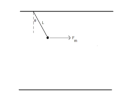 QUESTION 12
QUESTION 11
A magnet of mass 7.98 kg is suspended from the ceiling by a cord
as shown. A large magnet is somewhere off to the right, pulling on
the small hanging magnet with a constant force of F = 151.6 N. At
what angle theta ?with respect to the vertical does the magnet
hang?
QUESTION 12
Consider the same situation as in the previous problem. This
time the magnet has mass 7.51 kg and the force pulling...
QUESTION 12
QUESTION 11
A magnet of mass 7.98 kg is suspended from the ceiling by a cord
as shown. A large magnet is somewhere off to the right, pulling on
the small hanging magnet with a constant force of F = 151.6 N. At
what angle theta ?with respect to the vertical does the magnet
hang?
QUESTION 12
Consider the same situation as in the previous problem. This
time the magnet has mass 7.51 kg and the force pulling...
A ball is kicked from a location < 6, 0, -9> m (on the ground) with...
 A ball is kicked from a location < 6, 0, -9> m (on the ground) with initial velocity<-13, 17.0, -4> m/s. The ball's speed is low enough that air resistance is negligible (a) What is the velocity of the ball 0.6 s after being kicked? (Use the Momentum Principle!) 11.2 4 m/S (b) In this situation (constant force), which velocity will give the most accurate value for the location of the ball 0.6 s after it is kicked? the arithmetic...
 A gymnast of mass 62.0 kg hangs from a vertical rope attached to the ceiling. You can ignore the weight of the rope and assume that the rope does not stretch. Use the value 9.81m/s" for the acceleration of gravity. Part A Calculate the tension T in the rope if the gymnast hangs motionless on the горе. Express your answer in newtons. View Available Hint(s) V ALQ R O ? Submit Part B Calculate the tension T in the rope...
 Question 8 The nylon rope from which a mountain climber is suspended has a force constant of 1.40 x 10⁴ N/m. How much would this rope stretch to break the climber's fall if he free-falls 2.16 m before the rope runs out of slack, given his mass plus and the mass of his equipment are 91.6 kg? Hint: Use conservation of energy. You can assume the amount the rope stretches is small compared to the distance of his fall. Select...
 After rounding second base, a baseball player with a mass of 77 kg slides into third base. The coefficient of kinetic friction between the player and the ground is 0.42. What is the magnitude of the friction force acting on the player? If it takes 1.3 s for the player to come to a rest at the base, what was his velocity when he initiated his slide? Suppose you are pulling a 4.2-kg block across a rough, horizontal surface with...
 A meterstick (L-1 m) has a mass of m-0.17 kg. Initially it hangs from two short strings: one at the 25 cm mark and one at the 75 cm mark. "What is the tension in the left string? Net You currently have submissions for this question. Only 10 submission are allowed. You can make 10 more submissions for this question. 2. Now the right string is cut! What is the initial angular acceleration of the meterstick about its pivot point?...
 Sample Problems (Ch.5 Energy) 1A71.4 kg base runner begins his slide into second base when he is moving at a speed of 5-3 m/s. The coefficient of friction between his clothes and Earth is 0.78. He slides so that his speed is zero just as he reaches the base. (a) How much mechanical energy is lost due to friction acting on the runner? (b) How far does he slide? 2. A bead of mass m = 8.35 kg is released...
 QUESTION 12
QUESTION 11
A magnet of mass 7.98 kg is suspended from the ceiling by a cord
as shown. A large magnet is somewhere off to the right, pulling on
the small hanging magnet with a constant force of F = 151.6 N. At
what angle theta ?with respect to the vertical does the magnet
hang?
QUESTION 12
Consider the same situation as in the previous problem. This
time the magnet has mass 7.51 kg and the force pulling...
QUESTION 12
QUESTION 11
A magnet of mass 7.98 kg is suspended from the ceiling by a cord
as shown. A large magnet is somewhere off to the right, pulling on
the small hanging magnet with a constant force of F = 151.6 N. At
what angle theta ?with respect to the vertical does the magnet
hang?
QUESTION 12
Consider the same situation as in the previous problem. This
time the magnet has mass 7.51 kg and the force pulling...
 A ball is kicked from a location < 6, 0, -9> m (on the ground) with initial velocity<-13, 17.0, -4> m/s. The ball's speed is low enough that air resistance is negligible (a) What is the velocity of the ball 0.6 s after being kicked? (Use the Momentum Principle!) 11.2 4 m/S (b) In this situation (constant force), which velocity will give the most accurate value for the location of the ball 0.6 s after it is kicked? the arithmetic...
Most questions answered within 3 hours.
-
Where is the error in this code sequence?
String s1 = "Hello";
String s2 = "ello";...
asked 10 months ago -
Financial data for Joel de Paris, Inc., for last year
follow:
Joel de Paris, Inc.
Balance...
asked 10 months ago -
Consider this reaction:
Al2(SO4)3 (aq)+ BaCl3
(aq) Al2Cl6 (aq)- +
3BaSO4(s) . What is the...
asked 10 months ago -
Suppose that Savneet is considering increasing her
recent random sample from 20 car rentals to 40...
asked 10 months ago -
Trucks arrive at an unloading terminal at an average rate of 120
per hour.
Trucks arrive...
asked 10 months ago -
Why are methanol and ethanol completely soluble in water while
octanol is not very little soluble....
asked 10 months ago -
A facilities manager at a university reads in a research report
that the mean amount of...
asked 10 months ago -
When the CuSO4 is rehydrated by adding water to the anhydrous
compound, is this an endothermic...
asked 10 months ago -
A ray of sunlight is passing from diamond into crown glass; the
angle of incidence is...
asked 10 months ago -
A block of mass 0.249 kg is placed on top of a light, vertical
spring of...
asked 10 months ago -
how do the kidneys compensate in the presences of acidosis
a) trigger hyperventilate
b) reserve acid...
asked 10 months ago -
Question 501 pts
The rental rate of capital to the firm increases. Which of the
following...
asked 10 months ago