How to write this query in Formal Relational Query Languages? SELECT M.Name, M.Email FROM Manager AS...
How to write this query in Formal Relational Query Languages?
SELECT M.Name, M.Email
FROM Manager AS M, ManagerCertificate AS MC
WHERE M.ID = MC.ManagerID
GROUP BY M.Name
HAVING count distinct (MC.CertificateID) = 2;
Homework Answers
RESULT1 ← Manager ⨝ ID= ManagerID ManagerCertificate
RESULT2 ← π Manager.Name,
Manager.Email(Manager.Name ℑ Count
Distinct(CertificateID=2)(RESULT1))
Frist we have performed a Join operation on Manager and ManagerCertificate and stored it into a temporary table named RESULT1.
From the RESULT1 we are performing Project operation with a group by functiion which is represented by ℑ in relational algebra
<grouping attributes> ℑ <function list> (R)
Add Answer to:
How to write this query in Formal Relational Query
Languages?
SELECT M.Name, M.Email
FROM Manager AS...
Problem 3 [40 points, Formal Query Languages]| Consider the following relational schema to represent information about...
 Problem 3 [40 points, Formal Query Languages]| Consider the following relational schema to represent information about suppliers S, parts P, and projects J, S#, P#, and J# are primary keys for S, P, and J respectively. For a tuple of SPJ, a particular supplier supplies a specific part to a specific project in the specified quantity S(S#, SNAME, STATUS, CITY) P(P#, PNAME, COLOR, WEIGHT, CITY) J(J#, JNAME,CITY) SPJ(S# P# J#, QTY) Write queries for the following requests in specified languages....
Please clear and direct answer Consider the following SQL query and related relations SELECT P.Name FROM...
Please clear and direct answer Consider the following SQL query and related relations SELECT P.Name FROM Players P, Games G WHERE P.Id = G.PlayerId AND P.Game = 'Football' AND G.Season ='2019' where: Players (Id, Name, Game) Games (PlayerId, GameCode, Season) Translate the above SQL query to a relational algebra expression. Draw the Query tree for above relational algebra expression in part (a).
1 - Which of the following allows you to create subtotals in the output from a...
1 - Which of the following allows you to create subtotals in the output from a SELECT statement? Group of answer choices _ SUBTOTAL _ ORDER BY _ HAVING _ GROUP BY 2 - A query includes grouping done using the AVG, SUM, COUNT, MIN, or MAX function. Which SQL keyword is used to select rows after this grouping has been done? Group of answer choices _ WHERE _ DISTINCT _ HAVING _ LIKE 3 - Which of the following...
1- Consider the following SQL query and related relations SELECT P.Name FROM Players P, Games G...
1- Consider the following SQL query and related relations SELECT P.Name FROM Players P, Games G WHERE P.Id = G.PlayerId AND P.Game = 'Football' AND G.Season ='2019' where: Players (Id, Name, Game) Games (PlayerId, GameCode, Season) A- Translate the above SQL query to a relational algebra expression. B- Draw the Query tree for above relational algebra expression in part (a). Note: Please no screenshot
MYSQL Applied Database I just want to make sure that the syntax looks okay for my...
MYSQL Applied Database I just want to make sure that the syntax looks okay for my database SQL statements, any help would be much appreciated: 1.A query that asks for customer star review for Tony Stark on Opportunity Detail. SELECT CONCAT (employee_first_name,' ',employee_last_name) AS employee_name, review_star_count, FROM customer_reviews, JOIN e employees ON employee_id =employee_id, WHERE employee_id=4 AND opportunity_id=1; 2.A query that shows how many orders Additional Dot Twain License, in an order totaling over $900. SELECT product_name, COUNT(o.OrderID) AS...
1. For each query, there are one or more things to do. Some of these queries...
1. For each query, there are one or more things to do. Some of these queries use SQL constructs we haven't covered in class but that you should be able to figure out the meaning of. a. SELECT C.custid, C.companyname FROM Sales.Customers AS C LEFT OUTER JOIN Sales.Orders as O ON C.custid = O.custid WHERE O.orderid IS NULL Provide the result set generated by this query. One of the result rows should be (22, Customer DTDMN). What does this tell...
2. Specify the query using relational algebra Retrieve the name (first name, last name) of the...
2. Specify the query using relational algebra Retrieve the name (first name, last name) of the employee who is either a manager or a supervisor. *Don't just copy and paste from another chegg post.
Please turn this join statement into a Sub-query. Select avg(baseball.sellingprice) as AverageSellingPrice, Suppliers.SupplierName From baseball, Suppliers...
Please turn this join statement into a Sub-query. Select avg(baseball.sellingprice) as AverageSellingPrice, Suppliers.SupplierName From baseball, Suppliers where baseball.suppliercode = suppliers.suppliercode group by Suppliers.suppliername Having suppliers.suppliername = "logo goods"; Thank you
1. Select the correctly written query. SELECT ALL FROM CUSTOMERS WHERE 10243 IS CUSTOMERID PULL *...
1. Select the correctly written query. SELECT ALL FROM CUSTOMERS WHERE 10243 IS CUSTOMERID PULL * FROM CUSTOMERS WHERE CUSTOMERID = 10243 GET LIST FROM CUSTOMERS SELECT * FROM CUSTOMERS WHERE CUSTOMERID = 10243 2. The GROUP BY clause can be used in place of a JOIN clause in a SQL query? True False 3. The number of join conditions is always equal to the number of tables being joined _____ one. Plus Divided by Times Minus
How do I combine these 2 queries to produce something like this QUERY 1 SELECT hotel.country,...
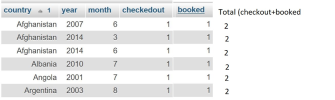 How do I combine these 2 queries to produce something like
this
QUERY 1
SELECT hotel.country, time.year, time.month,
COUNT(booking.room_id) as booked
FROM booking
LEFT JOIN room on room.room_id = booking.room_id
LEFT JOIN hotel on room.hotel_id = hotel.hotel_id
LEFT JOIN time on booking.time_id = time.time_id
GROUP BY hotel.country, time.year, time.month
ORDER by hotel.country, time.year, time.month
QUERY 2
SELECT hotel.country, time.year, time.month,
COUNT(checkout.room_id) as checkedout
FROM checkout
LEFT JOIN room on room.room_id = checkout.room_id
LEFT JOIN hotel on room.hotel_id = hotel.hotel_id
LEFT...
How do I combine these 2 queries to produce something like
this
QUERY 1
SELECT hotel.country, time.year, time.month,
COUNT(booking.room_id) as booked
FROM booking
LEFT JOIN room on room.room_id = booking.room_id
LEFT JOIN hotel on room.hotel_id = hotel.hotel_id
LEFT JOIN time on booking.time_id = time.time_id
GROUP BY hotel.country, time.year, time.month
ORDER by hotel.country, time.year, time.month
QUERY 2
SELECT hotel.country, time.year, time.month,
COUNT(checkout.room_id) as checkedout
FROM checkout
LEFT JOIN room on room.room_id = checkout.room_id
LEFT JOIN hotel on room.hotel_id = hotel.hotel_id
LEFT...
 Problem 3 [40 points, Formal Query Languages]| Consider the following relational schema to represent information about suppliers S, parts P, and projects J, S#, P#, and J# are primary keys for S, P, and J respectively. For a tuple of SPJ, a particular supplier supplies a specific part to a specific project in the specified quantity S(S#, SNAME, STATUS, CITY) P(P#, PNAME, COLOR, WEIGHT, CITY) J(J#, JNAME,CITY) SPJ(S# P# J#, QTY) Write queries for the following requests in specified languages....
 How do I combine these 2 queries to produce something like
this
QUERY 1
SELECT hotel.country, time.year, time.month,
COUNT(booking.room_id) as booked
FROM booking
LEFT JOIN room on room.room_id = booking.room_id
LEFT JOIN hotel on room.hotel_id = hotel.hotel_id
LEFT JOIN time on booking.time_id = time.time_id
GROUP BY hotel.country, time.year, time.month
ORDER by hotel.country, time.year, time.month
QUERY 2
SELECT hotel.country, time.year, time.month,
COUNT(checkout.room_id) as checkedout
FROM checkout
LEFT JOIN room on room.room_id = checkout.room_id
LEFT JOIN hotel on room.hotel_id = hotel.hotel_id
LEFT...
How do I combine these 2 queries to produce something like
this
QUERY 1
SELECT hotel.country, time.year, time.month,
COUNT(booking.room_id) as booked
FROM booking
LEFT JOIN room on room.room_id = booking.room_id
LEFT JOIN hotel on room.hotel_id = hotel.hotel_id
LEFT JOIN time on booking.time_id = time.time_id
GROUP BY hotel.country, time.year, time.month
ORDER by hotel.country, time.year, time.month
QUERY 2
SELECT hotel.country, time.year, time.month,
COUNT(checkout.room_id) as checkedout
FROM checkout
LEFT JOIN room on room.room_id = checkout.room_id
LEFT JOIN hotel on room.hotel_id = hotel.hotel_id
LEFT...
Most questions answered within 3 hours.
-
Where is the error in this code sequence?
String s1 = "Hello";
String s2 = "ello";...
asked 10 months ago -
Financial data for Joel de Paris, Inc., for last year
follow:
Joel de Paris, Inc.
Balance...
asked 10 months ago -
Consider this reaction:
Al2(SO4)3 (aq)+ BaCl3
(aq) Al2Cl6 (aq)- +
3BaSO4(s) . What is the...
asked 10 months ago -
Suppose that Savneet is considering increasing her
recent random sample from 20 car rentals to 40...
asked 10 months ago -
Trucks arrive at an unloading terminal at an average rate of 120
per hour.
Trucks arrive...
asked 10 months ago -
Why are methanol and ethanol completely soluble in water while
octanol is not very little soluble....
asked 10 months ago -
A facilities manager at a university reads in a research report
that the mean amount of...
asked 10 months ago -
When the CuSO4 is rehydrated by adding water to the anhydrous
compound, is this an endothermic...
asked 10 months ago -
A ray of sunlight is passing from diamond into crown glass; the
angle of incidence is...
asked 10 months ago -
A block of mass 0.249 kg is placed on top of a light, vertical
spring of...
asked 10 months ago -
how do the kidneys compensate in the presences of acidosis
a) trigger hyperventilate
b) reserve acid...
asked 10 months ago -
Question 501 pts
The rental rate of capital to the firm increases. Which of the
following...
asked 10 months ago