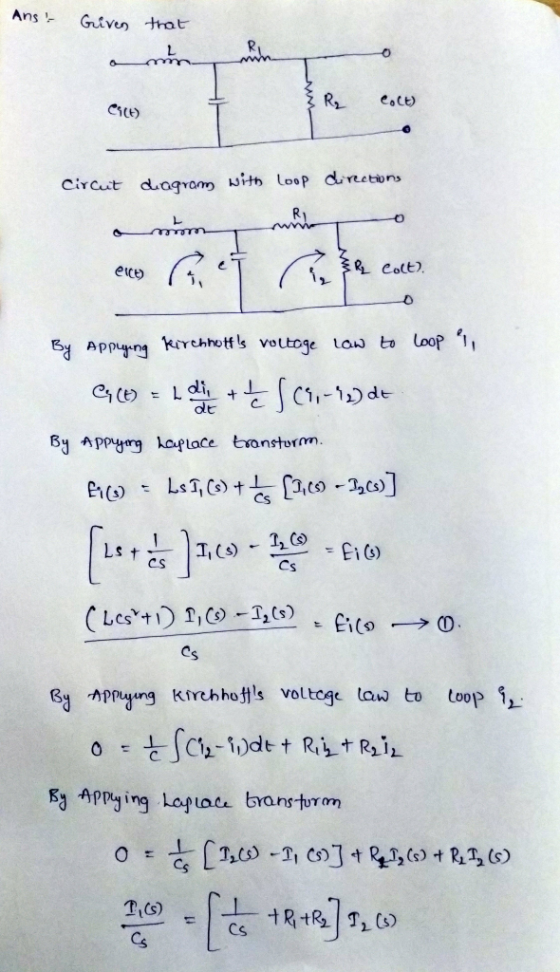
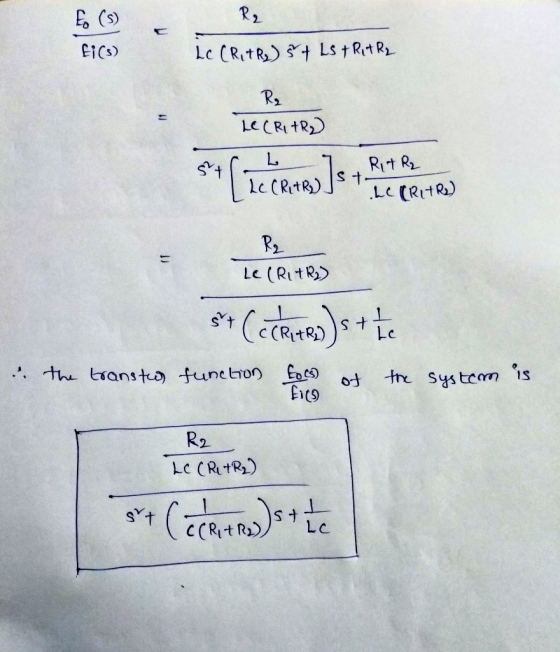
![C. (30pts]Obtain the transfer function Eo(s)/Ei(s) of the system shown below.](http://img.homeworklib.com/questions/c990a830-c1ac-11ea-add2-d5fa0188599e.png?x-oss-process=image/resize,w_560)
Homework Answers
![og = (184k] 23,00 > 1,68 = [1 +(8, +R2) Cs]5,66) Recou Equation 0 (Les + 1) 1, C5) - Iz Cs) - Fico Substitute (1+ Critre) Cs]](http://img.homeworklib.com/questions/cafe3da0-c1ac-11ea-810a-0f46e1c91be3.png?x-oss-process=image/resize,w_560)
Add Answer to:
C. (30pts]Obtain the transfer function Eo(s)/Ei(s) of the system shown below.
5) Obtain the transfer function Ee/E,of the circuit shown below. Use the complex Impedance Method. (eo...
 5) Obtain the transfer function Ee/E,of the circuit shown below. Use the complex Impedance Method. (eo and e are output and input voltages) L.
Q2 (a) Consider the control system shown in Figure Q1 (a). Obtain the closed-loop transfer function...
 Q2 (a) Consider the control system shown in Figure Q1 (a). Obtain the closed-loop transfer function of this system and by using MATLAB obtain the unit step response of this closed loop system - R(S) c(s) 36+1) (s + 1) Figure Q2 (a) (b) A sampler and a zero-order hold element were inserted into the system in Figure Q1(a) as shown in Figure Q1(b). Obtain the closed-loop pulse transfer function of this system and by using MATLAB or otherwise, obtain...
2) An electric circuit is shown below. Obtain the transfer function using a system of equations...
 2) An electric circuit is shown below. Obtain the transfer function using a system of equations and Cramer's Rule. + voll) 4 6 H 2 O (f 4 H
Q-5 Obtain the transfer functions Xi(s)/U(s) and Xa(s)/U(s) of the mechanical system shown below....
 Q-5 Obtain the transfer functions Xi(s)/U(s) and Xa(s)/U(s) of the mechanical system shown below. (35p) Lu x2 m2 bi
Q-5 Obtain the transfer functions Xi(s)/U(s) and Xa(s)/U(s) of the mechanical system shown below. (35p) Lu x2 m2 bi
Q-5 Obtain the transfer functions Xi(s)/U(s) and Xa(s)/U(s) of the mechanical system shown below. (35p) Lu x2 m2 bi
Ri 3. Obtain mathematical models for the systems shown: Ci Ri Ci R3 Ei Eo Li...
 Ri 3. Obtain mathematical models for the systems shown: Ci Ri Ci R3 Ei Eo Li (10 marks) (b) (15 marks)
C(8) for the system shown in Figure 1. R(S Find the equivalent transfer function, Geg (s)...
 C(8) for the system shown in Figure 1. R(S Find the equivalent transfer function, Geg (s) 1 Cix) Figure 1. Block diagram 2s+1 s(5s+6Ge(s) = and Figure 2 shows a closed-loop transfer function, where G(s) 2. proper H(s) K+s. Find the overall closed-loop transfer function and express is as rational function. C(s) Ea (s) Controller R(s) +/ Plant G(s) Ge (s) Feedback H(s) Figure 2. Closed loop transfer function Construct the actuation Error Transfer Function associated with the system shown...
w a. Obtain the transfer functions X1(s)/U(s) and X2(s)/U(s) of the mechanical system shown in the...
 w a. Obtain the transfer functions X1(s)/U(s) and X2(s)/U(s) of the mechanical system shown in the figure. b. Solve the transfer function to retrieve the information on the response function (as a function of time t) by assuming the m1 = m2 and ki = ki =k3 C. Plot the response function d. Show the impact of doubling the mass m2 = 2m1 on the response function - plot it to compare it with that described in case C
1. Obtain the transfer function G(s)-20 Consider the system of Figure 1. Obtain the transfer func...
 1. Obtain the transfer function G(s)-20 Consider the system of Figure 1. Obtain the transfer function G (s) - of the system in Figure 1 (clearly show the derivation of the model) Question 1.(15) Consider the system of Figure T(s) TO) J1 2 kg-m D1 1 N-m-s/rad J2-1 kg-m2 D2 2 N-m-s/rad K = 64 N-m/rad J-16 kg-m2 D3 32 N-m-s/rad Figure 1
1. Obtain the transfer function G(s)-20 Consider the system of Figure 1. Obtain the transfer function G...
1. Obtain the transfer function G(s)-20 Consider the system of Figure 1. Obtain the transfer function G (s) - of the system in Figure 1 (clearly show the derivation of the model) Question 1.(15) Consider the system of Figure T(s) TO) J1 2 kg-m D1 1 N-m-s/rad J2-1 kg-m2 D2 2 N-m-s/rad K = 64 N-m/rad J-16 kg-m2 D3 32 N-m-s/rad Figure 1
1. Obtain the transfer function G(s)-20 Consider the system of Figure 1. Obtain the transfer function G...
2. Consider the closed-loop system shown below: R(S) MS to Gs)_ G(S) H(s) A. Obtain the...
 2. Consider the closed-loop system shown below: R(S) MS to Gs)_ G(S) H(s) A. Obtain the transfer function of the closed-loop system. B. Obtain the sensitivity of the closed-loop system to the variations of G(s) (SC). How can one tune G(s) such that the sensitivity of the system to G(S) is minimized? C. Obtain the sensitivity of the closed-loop system to the variations of H(s) (S). What is the lowest possible value of this sensitivity?
A negative feedback system has a forward transfer function 1/(s+7.8) and feedback transfer function s+1.8. Obtain...
A negative feedback system has a forward transfer function 1/(s+7.8) and feedback transfer function s+1.8. Obtain the time constant (in sec) of the overall transfer function. Give the answer in 4 decimal places. (Unit is not required.)
 5) Obtain the transfer function Ee/E,of the circuit shown below. Use the complex Impedance Method. (eo and e are output and input voltages) L.
 Q2 (a) Consider the control system shown in Figure Q1 (a). Obtain the closed-loop transfer function of this system and by using MATLAB obtain the unit step response of this closed loop system - R(S) c(s) 36+1) (s + 1) Figure Q2 (a) (b) A sampler and a zero-order hold element were inserted into the system in Figure Q1(a) as shown in Figure Q1(b). Obtain the closed-loop pulse transfer function of this system and by using MATLAB or otherwise, obtain...
 2) An electric circuit is shown below. Obtain the transfer function using a system of equations and Cramer's Rule. + voll) 4 6 H 2 O (f 4 H
 Q-5 Obtain the transfer functions Xi(s)/U(s) and Xa(s)/U(s) of the mechanical system shown below. (35p) Lu x2 m2 bi
Q-5 Obtain the transfer functions Xi(s)/U(s) and Xa(s)/U(s) of the mechanical system shown below. (35p) Lu x2 m2 bi
Q-5 Obtain the transfer functions Xi(s)/U(s) and Xa(s)/U(s) of the mechanical system shown below. (35p) Lu x2 m2 bi
 Ri 3. Obtain mathematical models for the systems shown: Ci Ri Ci R3 Ei Eo Li (10 marks) (b) (15 marks)
 C(8) for the system shown in Figure 1. R(S Find the equivalent transfer function, Geg (s) 1 Cix) Figure 1. Block diagram 2s+1 s(5s+6Ge(s) = and Figure 2 shows a closed-loop transfer function, where G(s) 2. proper H(s) K+s. Find the overall closed-loop transfer function and express is as rational function. C(s) Ea (s) Controller R(s) +/ Plant G(s) Ge (s) Feedback H(s) Figure 2. Closed loop transfer function Construct the actuation Error Transfer Function associated with the system shown...
 w a. Obtain the transfer functions X1(s)/U(s) and X2(s)/U(s) of the mechanical system shown in the figure. b. Solve the transfer function to retrieve the information on the response function (as a function of time t) by assuming the m1 = m2 and ki = ki =k3 C. Plot the response function d. Show the impact of doubling the mass m2 = 2m1 on the response function - plot it to compare it with that described in case C
 1. Obtain the transfer function G(s)-20 Consider the system of Figure 1. Obtain the transfer function G (s) - of the system in Figure 1 (clearly show the derivation of the model) Question 1.(15) Consider the system of Figure T(s) TO) J1 2 kg-m D1 1 N-m-s/rad J2-1 kg-m2 D2 2 N-m-s/rad K = 64 N-m/rad J-16 kg-m2 D3 32 N-m-s/rad Figure 1
1. Obtain the transfer function G(s)-20 Consider the system of Figure 1. Obtain the transfer function G...
1. Obtain the transfer function G(s)-20 Consider the system of Figure 1. Obtain the transfer function G (s) - of the system in Figure 1 (clearly show the derivation of the model) Question 1.(15) Consider the system of Figure T(s) TO) J1 2 kg-m D1 1 N-m-s/rad J2-1 kg-m2 D2 2 N-m-s/rad K = 64 N-m/rad J-16 kg-m2 D3 32 N-m-s/rad Figure 1
1. Obtain the transfer function G(s)-20 Consider the system of Figure 1. Obtain the transfer function G...
 2. Consider the closed-loop system shown below: R(S) MS to Gs)_ G(S) H(s) A. Obtain the transfer function of the closed-loop system. B. Obtain the sensitivity of the closed-loop system to the variations of G(s) (SC). How can one tune G(s) such that the sensitivity of the system to G(S) is minimized? C. Obtain the sensitivity of the closed-loop system to the variations of H(s) (S). What is the lowest possible value of this sensitivity?
Most questions answered within 3 hours.
-
Where is the error in this code sequence?
String s1 = "Hello";
String s2 = "ello";...
asked 10 months ago -
Financial data for Joel de Paris, Inc., for last year
follow:
Joel de Paris, Inc.
Balance...
asked 10 months ago -
Consider this reaction:
Al2(SO4)3 (aq)+ BaCl3
(aq) Al2Cl6 (aq)- +
3BaSO4(s) . What is the...
asked 10 months ago -
Suppose that Savneet is considering increasing her
recent random sample from 20 car rentals to 40...
asked 10 months ago -
Trucks arrive at an unloading terminal at an average rate of 120
per hour.
Trucks arrive...
asked 10 months ago -
Why are methanol and ethanol completely soluble in water while
octanol is not very little soluble....
asked 10 months ago -
A facilities manager at a university reads in a research report
that the mean amount of...
asked 10 months ago -
When the CuSO4 is rehydrated by adding water to the anhydrous
compound, is this an endothermic...
asked 10 months ago -
A ray of sunlight is passing from diamond into crown glass; the
angle of incidence is...
asked 10 months ago -
A block of mass 0.249 kg is placed on top of a light, vertical
spring of...
asked 10 months ago -
how do the kidneys compensate in the presences of acidosis
a) trigger hyperventilate
b) reserve acid...
asked 10 months ago -
Question 501 pts
The rental rate of capital to the firm increases. Which of the
following...
asked 10 months ago