
Homework Answers
Dear student, In the second equation it will be y'=-y, otherwise
there will be no bifurcation. It would be a typo. However, I have
corrected this fault in my solution.![x = px - x² = forsy) y =-y = grzey) equilibrium point xzo y=0 Maxx=0 y=0 So points are coo) and (eo) At (oo) [J]co,0) = Tue](http://img.homeworklib.com/questions/f58c5810-c294-11ea-85b4-1bfa4b98901e.png?x-oss-process=image/resize,w_560)


Rate if you are satisfied with my answer.
sketch phase lines for: dy/dt = y(y+3)^3(y-2)^2(y-5) sketch bifurcation diagram for: dy/dt = y(y^2+ α) where...
sketch phase lines for: dy/dt = y(y+3)^3(y-2)^2(y-5) sketch bifurcation diagram for: dy/dt = y(y^2+ α) where α is a parameter
2. (2 pts) Determine the type of the critical point (0,0) for the system x' =-7x+ 5y, y' =-6x 4y. Sketch a phas...
 2. (2 pts) Determine the type of the critical point (0,0) for the system x' =-7x+ 5y, y' =-6x 4y. Sketch a phase portrait based on the eigenvectors, and the direction that the sign of the eigenvalue indicates.
2. (2 pts) Determine the type of the critical point (0,0) for the system x' =-7x+ 5y, y' =-6x 4y. Sketch a phase portrait based on the eigenvectors, and the direction that the sign of the eigenvalue indicates.
2. (2 pts) Determine the type of the critical point (0,0) for the system x' =-7x+ 5y, y' =-6x 4y. Sketch a phase portrait based on the eigenvectors, and the direction that the sign of the eigenvalue indicates.
Classify bifurcations for the system x '= a(1 − x) − xy^2 , y' = xy^2 − (a + k)y, where a > 0 ...
Classify bifurcations for the system x '= a(1 − x) − xy^2 , y' = xy^2 − (a + k)y, where a > 0 and k > 0 are parameters, and sketch the bifurcation curve in the a − k space.
Problem 2: Consider the DE y = f(y) = y® – 2y + H, where is...
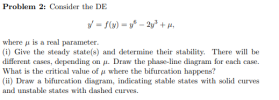 Problem 2: Consider the DE y = f(y) = y® – 2y + H, where is a real parameter. (i) Give the steady state(s) and determine their stability. There will be different cases, depending on . Draw the phase-line diagram for each case. What is the critical value of where the bifurcation happens? (ii) Draw a bifurcation diagram, indicating stable states with solid curves and unstable states with dashed curves.
Problem 5: For the following transfer functions, sketch the bode asymptotic magnitude and phase p...
 Problem 5: For the following transfer functions, sketch the bode asymptotic magnitude and phase plots, find the Gain margin and Phase margin, find the system type and the corresponding error constant for each case. G(A) (s +3)(s +5) s(s +2) (s+4) S+5 2)b).
Problem 5: For the following transfer functions, sketch the bode asymptotic magnitude and phase plots, find the Gain margin and Phase margin, find the system type and the corresponding error constant for each case. G(A) (s +3)(s...
Problem 5: For the following transfer functions, sketch the bode asymptotic magnitude and phase plots, find the Gain margin and Phase margin, find the system type and the corresponding error constant for each case. G(A) (s +3)(s +5) s(s +2) (s+4) S+5 2)b).
Problem 5: For the following transfer functions, sketch the bode asymptotic magnitude and phase plots, find the Gain margin and Phase margin, find the system type and the corresponding error constant for each case. G(A) (s +3)(s...
Converting to linear system for three different cases: ii) y 0 For each cases provide general solutions, the phase portrait and the value of gamma at which there is a bifurcation, Converting...
 Converting to linear system for three different cases: ii) y 0 For each cases provide general solutions, the phase portrait and the value of gamma at which there is a bifurcation,
Converting to linear system for three different cases: ii) y 0 For each cases provide general solutions, the phase portrait and the value of gamma at which there is a bifurcation,
Converting to linear system for three different cases: ii) y 0 For each cases provide general solutions, the phase portrait and the value of gamma at which there is a bifurcation,
Determine the phase in a system consisting of water at the following conditions and sketch P–v...
Determine the phase in a system consisting of water at the following conditions and sketch P–v and T–v diagrams showing the location of each state (show the saturation dome and the relevant constant-pressure and constant-temperature lines). Also, find the value of the internal energy and the enthalpy for each state. a) P = 15 kPa and x = 0.8. b) T = 50 C and P = 20 MPa. c) T = 600 C and P = 10 MPa. d)...
1. For each of the following systems, sketch the x- and y-nullclines and use this information to determine the nature o...
 1. For each of the following systems, sketch the x- and y-nullclines and use this information to determine the nature of the phase portrait. You may assume that these systems are defined only for x,y 20. x' = x(y + 2x-2), y' = y(y-1 ) (a)
1. For each of the following systems, sketch the x- and y-nullclines and use this information to determine the nature of the phase portrait. You may assume that these systems are defined only for...
1. For each of the following systems, sketch the x- and y-nullclines and use this information to determine the nature of the phase portrait. You may assume that these systems are defined only for x,y 20. x' = x(y + 2x-2), y' = y(y-1 ) (a)
1. For each of the following systems, sketch the x- and y-nullclines and use this information to determine the nature of the phase portrait. You may assume that these systems are defined only for...
1. For each of the following systems, sketch the x- and y-nullclines and use this information to determine the nature o...
 1. For each of the following systems, sketch the x- and y-nullclines and use this information to determine the nature of the phase portrait. You may assume that these systems are defined only for x,y 20. (b) x' = x(y + 2x-2), y' = y(y + x-3)
1. For each of the following systems, sketch the x- and y-nullclines and use this information to determine the nature of the phase portrait. You may assume that these systems are defined only...
1. For each of the following systems, sketch the x- and y-nullclines and use this information to determine the nature of the phase portrait. You may assume that these systems are defined only for x,y 20. (b) x' = x(y + 2x-2), y' = y(y + x-3)
1. For each of the following systems, sketch the x- and y-nullclines and use this information to determine the nature of the phase portrait. You may assume that these systems are defined only...
Problems 17 through 19 deal with competitive systems much like those in Examples 1 and 2 except t...
 #19 all parts
Problems 17 through 19 deal with competitive systems much like those in Examples 1 and 2 except that some coefficients depend on a parameter a. In each of these problems, assume that x, y, and a are always nonnegative. In each of Problems 17 through 19: (a) Sketch the nullclines in the first quadrant, as in Figure 9.4.5. For different ranges of a your sketch may resemble different parts of Figure 9.4.5 (b) Find the critical points...
#19 all parts
Problems 17 through 19 deal with competitive systems much like those in Examples 1 and 2 except that some coefficients depend on a parameter a. In each of these problems, assume that x, y, and a are always nonnegative. In each of Problems 17 through 19: (a) Sketch the nullclines in the first quadrant, as in Figure 9.4.5. For different ranges of a your sketch may resemble different parts of Figure 9.4.5 (b) Find the critical points...
 2. (2 pts) Determine the type of the critical point (0,0) for the system x' =-7x+ 5y, y' =-6x 4y. Sketch a phase portrait based on the eigenvectors, and the direction that the sign of the eigenvalue indicates.
2. (2 pts) Determine the type of the critical point (0,0) for the system x' =-7x+ 5y, y' =-6x 4y. Sketch a phase portrait based on the eigenvectors, and the direction that the sign of the eigenvalue indicates.
2. (2 pts) Determine the type of the critical point (0,0) for the system x' =-7x+ 5y, y' =-6x 4y. Sketch a phase portrait based on the eigenvectors, and the direction that the sign of the eigenvalue indicates.
 Problem 2: Consider the DE y = f(y) = y® – 2y + H, where is a real parameter. (i) Give the steady state(s) and determine their stability. There will be different cases, depending on . Draw the phase-line diagram for each case. What is the critical value of where the bifurcation happens? (ii) Draw a bifurcation diagram, indicating stable states with solid curves and unstable states with dashed curves.
 Problem 5: For the following transfer functions, sketch the bode asymptotic magnitude and phase plots, find the Gain margin and Phase margin, find the system type and the corresponding error constant for each case. G(A) (s +3)(s +5) s(s +2) (s+4) S+5 2)b).
Problem 5: For the following transfer functions, sketch the bode asymptotic magnitude and phase plots, find the Gain margin and Phase margin, find the system type and the corresponding error constant for each case. G(A) (s +3)(s...
Problem 5: For the following transfer functions, sketch the bode asymptotic magnitude and phase plots, find the Gain margin and Phase margin, find the system type and the corresponding error constant for each case. G(A) (s +3)(s +5) s(s +2) (s+4) S+5 2)b).
Problem 5: For the following transfer functions, sketch the bode asymptotic magnitude and phase plots, find the Gain margin and Phase margin, find the system type and the corresponding error constant for each case. G(A) (s +3)(s...
 Converting to linear system for three different cases: ii) y 0 For each cases provide general solutions, the phase portrait and the value of gamma at which there is a bifurcation,
Converting to linear system for three different cases: ii) y 0 For each cases provide general solutions, the phase portrait and the value of gamma at which there is a bifurcation,
Converting to linear system for three different cases: ii) y 0 For each cases provide general solutions, the phase portrait and the value of gamma at which there is a bifurcation,
 1. For each of the following systems, sketch the x- and y-nullclines and use this information to determine the nature of the phase portrait. You may assume that these systems are defined only for x,y 20. x' = x(y + 2x-2), y' = y(y-1 ) (a)
1. For each of the following systems, sketch the x- and y-nullclines and use this information to determine the nature of the phase portrait. You may assume that these systems are defined only for...
1. For each of the following systems, sketch the x- and y-nullclines and use this information to determine the nature of the phase portrait. You may assume that these systems are defined only for x,y 20. x' = x(y + 2x-2), y' = y(y-1 ) (a)
1. For each of the following systems, sketch the x- and y-nullclines and use this information to determine the nature of the phase portrait. You may assume that these systems are defined only for...
 1. For each of the following systems, sketch the x- and y-nullclines and use this information to determine the nature of the phase portrait. You may assume that these systems are defined only for x,y 20. (b) x' = x(y + 2x-2), y' = y(y + x-3)
1. For each of the following systems, sketch the x- and y-nullclines and use this information to determine the nature of the phase portrait. You may assume that these systems are defined only...
1. For each of the following systems, sketch the x- and y-nullclines and use this information to determine the nature of the phase portrait. You may assume that these systems are defined only for x,y 20. (b) x' = x(y + 2x-2), y' = y(y + x-3)
1. For each of the following systems, sketch the x- and y-nullclines and use this information to determine the nature of the phase portrait. You may assume that these systems are defined only...
 #19 all parts
Problems 17 through 19 deal with competitive systems much like those in Examples 1 and 2 except that some coefficients depend on a parameter a. In each of these problems, assume that x, y, and a are always nonnegative. In each of Problems 17 through 19: (a) Sketch the nullclines in the first quadrant, as in Figure 9.4.5. For different ranges of a your sketch may resemble different parts of Figure 9.4.5 (b) Find the critical points...
#19 all parts
Problems 17 through 19 deal with competitive systems much like those in Examples 1 and 2 except that some coefficients depend on a parameter a. In each of these problems, assume that x, y, and a are always nonnegative. In each of Problems 17 through 19: (a) Sketch the nullclines in the first quadrant, as in Figure 9.4.5. For different ranges of a your sketch may resemble different parts of Figure 9.4.5 (b) Find the critical points...
Most questions answered within 3 hours.
-
Where is the error in this code sequence?
String s1 = "Hello";
String s2 = "ello";...
asked 10 months ago -
Financial data for Joel de Paris, Inc., for last year
follow:
Joel de Paris, Inc.
Balance...
asked 10 months ago -
Consider this reaction:
Al2(SO4)3 (aq)+ BaCl3
(aq) Al2Cl6 (aq)- +
3BaSO4(s) . What is the...
asked 10 months ago -
Suppose that Savneet is considering increasing her
recent random sample from 20 car rentals to 40...
asked 10 months ago -
Trucks arrive at an unloading terminal at an average rate of 120
per hour.
Trucks arrive...
asked 10 months ago -
Why are methanol and ethanol completely soluble in water while
octanol is not very little soluble....
asked 10 months ago -
A facilities manager at a university reads in a research report
that the mean amount of...
asked 10 months ago -
When the CuSO4 is rehydrated by adding water to the anhydrous
compound, is this an endothermic...
asked 10 months ago -
A ray of sunlight is passing from diamond into crown glass; the
angle of incidence is...
asked 10 months ago -
A block of mass 0.249 kg is placed on top of a light, vertical
spring of...
asked 10 months ago -
how do the kidneys compensate in the presences of acidosis
a) trigger hyperventilate
b) reserve acid...
asked 10 months ago -
Question 501 pts
The rental rate of capital to the firm increases. Which of the
following...
asked 10 months ago