
Homework Answers

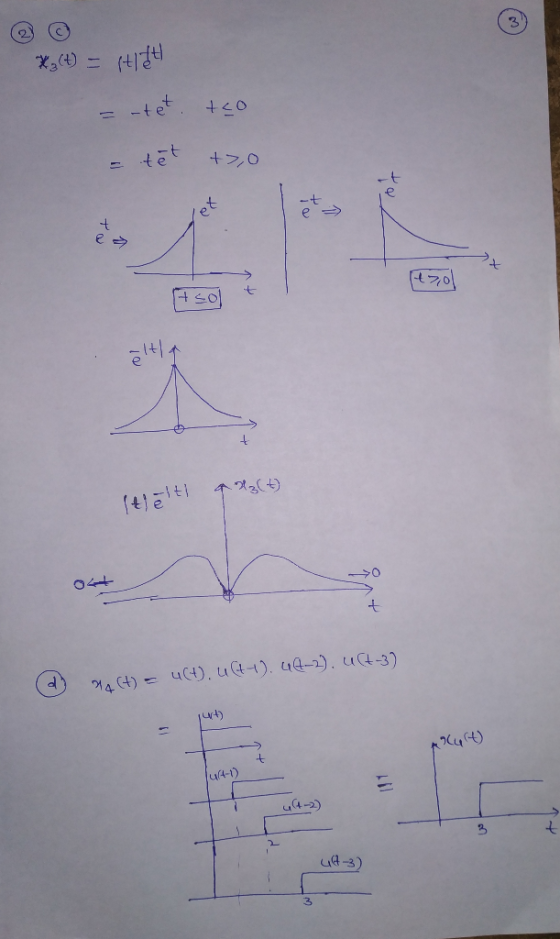
![*4)=+. (44+2) 42-)] u(++2) = t3,-2 + u A-1)= uct+2) - (t-1) 9 + [u (t +2) – u(t-1)] (t) 2061)= telt! - 1 tl](http://img.homeworklib.com/questions/3ceeaee0-c28f-11ea-bc6c-930e13a39213.png?x-oss-process=image/resize,w_560)
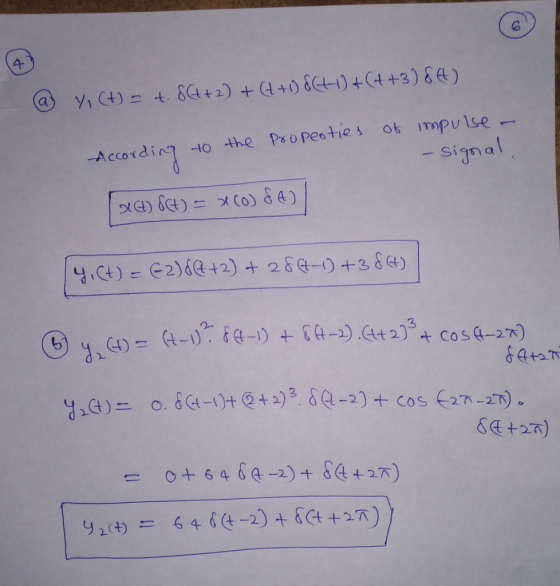
![@ g (t) = x (34) Linear day, 4) + by El) = an, (4) + bx, (t) | 44) = T[X] y (t) = x(34) is a linear system Tim Invarient YET)](http://img.homeworklib.com/questions/3e2708a0-c28f-11ea-bbd6-5545b1711d96.png?x-oss-process=image/resize,w_560)

Add Answer to:
1. Use combinations of STEP FUNCTIONS to describe each continuous-time signal shown below. f(t) 0 2...
Consider the following continuous-time signal. x(t) = 1 for m < t < m + 1...
Consider the following continuous-time signal. x(t) = 1 for m < t < m + 1 −1 for m + 1 < t < m + 2 for m = − 4,−2, 0, 2, 4, · · · Sketch the following signals. (a) x(t) (b) y(t) = 2x(2t − 1) + 1
(a) Let x(t) be a continuous-time signal known to have a first derivative ct) that is...
 (a) Let x(t) be a continuous-time signal known to have a first derivative ct) that is a smooth, continuous function over all t in (-00,00). Then the integral [ [x(t) – e(t – 7)][8(t – 3) + 6(t – 10)] dt evaluates to which of the following expressions: 1. x(t)8(t – 3) 2. x(3) 3. x(3) – č(-4) + x(10) – č(3) 4. x(3) – 3(-4) (b) A continuous-time dynamic system is described by the differential equation dyſt) + 4y(t)...
HW 1_Chi 1) Find the energies of the following signals below. 2) Find the power and...
 HW 1_Chi 1) Find the energies of the following signals below. 2) Find the power and the rms value of the signal belo a) x(-4) b)x(-t) c) x(2-4) 3) for the signal x(t) shown below, sketch the signals b) (-4)[u(t-2)-(-4)] 4) sketch the following signals a) uſt-5) - ult-7) 5) Simplify the following expressions: (a) (2+2) (1) (+3)sw) (c) le='cos (31 – 60°)80) () (sin ka ) s() 6) Evaluate the following integrals: (a) , 8(7)x(1 – t)dt (b) *()8(1-1)dt...
QUESTION 2 (20 MARKS) (a) A continuous time signal x(t) = 3e2tu(-t) is an input to...
 QUESTION 2 (20 MARKS) (a) A continuous time signal x(t) = 3e2tu(-t) is an input to a Linear Time Invariant system of which the impulse response h(t) is shown as h(t) = { .. 12, -osts-2 elsewhere Compute the output y(t) of the system above using convolution in time domain for all values of time t. [8 marks) (b) The impulse response h[n] of an LTI system is given as a[n] = 4(0.6)”u[n] Determine if the system is stable. [3...
Question #5: Consider the continuous-time signal shown below. x(t) -6 -4 -2 4 -2 (a) Sketch...
 Question #5: Consider the continuous-time signal shown below. x(t) -6 -4 -2 4 -2 (a) Sketch y(t) x1) (b) Sketch y(t) 2x[t- 2) (c) Sketch y(t) - 5x(t/3) (d) Sketch y(t) x(t) -x(-t)
(a) The continuous-time signal x(t) with FT as depicted in the figure shown below is sampled....
 (a) The continuous-time signal x(t) with FT as depicted in the figure shown below is sampled. Sketch the FT of the sampled signal for the following sampling intervals: identify whether aliasing occurs, Ts = 1/12 X(jw) -117 107 W -10 0 117 97 97T (b) Determine the z-transform and ROC for the following time signals: x[n] = (4)"u[n] + (1)"u[ -– 1] Sketch the ROC, poles, and zeros in the z-plane.
For the continuous time signal() shown in the Figure 1
 For the continuous time signal() shown in the Figure 1, sketch each of the following signals: (a) x(t-3)-3 points(b) x(2-t)-5 points(c) x(2 t+2)-5 points(d) x(2-t/3)-4 points(e) x(t)(σ(t+3/2)-σ(t-3/2))-2 points(f) (x(t)+x(2-t)) u(1-t)-6 points(g) x(t/2-3)+x(t/3-2)-6 points(h) x(t-1) u(t-1)-4 pointsσ(t) is the impulse function and u(t) is the unit step function.
Question 2 (50 points]: Continuous-Time Signals Given the following continuous-time signal (t). (t) 5t (a) [4%]...
 Question 2 (50 points]: Continuous-Time Signals Given the following continuous-time signal (t). (t) 5t (a) [4%] What is the fundamental period (i.e., T) and fundamental frequency (ie, wo) of (+)? (b) [8%] Calculate the time average, average power and total energy of x(t). Is x(t) an energy signal? Explain. (c) [8%] Calculate the Fourier series coefficients of (t), i.e., {x}. [Hint: You can make use of the result in Q1(a).] (d) [8%] What is the percentage of power loss if...
answer a and b only Suppose that two continuous time signal are given by x(t) and...
 answer a and b only
Suppose that two continuous time signal are given by x(t) and v(t) as: x(t) = u(t) - 2u(t - 1) + u(t - 2) v(t) = u(t)- uſt - 1) Answer the following questions: (a) Plot signals x(t) and v(t). (b) Find the convolution of y(t) = x(t-3) = v(t) (c) Plot for y(t).
answer a and b only
Suppose that two continuous time signal are given by x(t) and v(t) as: x(t) = u(t) - 2u(t - 1) + u(t - 2) v(t) = u(t)- uſt - 1) Answer the following questions: (a) Plot signals x(t) and v(t). (b) Find the convolution of y(t) = x(t-3) = v(t) (c) Plot for y(t).
(a) Determine the Fourier transform of x(t) 26(t-1)-6(t-3) (b) Compute the convolution sum of the following signals, (6%) [696] (c) The Fourier transform of a continuous-time signal a(t) is given bel...
 (a) Determine the Fourier transform of x(t) 26(t-1)-6(t-3) (b) Compute the convolution sum of the following signals, (6%) [696] (c) The Fourier transform of a continuous-time signal a(t) is given below. Determine the [696] total energy of (t) 4 sin w (d) Determine the DC value and the average power of the following periodic signal. (6%) 0.5 0.5 (e) Determine the Nyquist rate for the following signal. (6%) x(t) = [1-0.78 cos(50nt + π/4)]2. (f) Sketch the frequency spectrum of...
 (a) Let x(t) be a continuous-time signal known to have a first derivative ct) that is a smooth, continuous function over all t in (-00,00). Then the integral [ [x(t) – e(t – 7)][8(t – 3) + 6(t – 10)] dt evaluates to which of the following expressions: 1. x(t)8(t – 3) 2. x(3) 3. x(3) – č(-4) + x(10) – č(3) 4. x(3) – 3(-4) (b) A continuous-time dynamic system is described by the differential equation dyſt) + 4y(t)...
 HW 1_Chi 1) Find the energies of the following signals below. 2) Find the power and the rms value of the signal belo a) x(-4) b)x(-t) c) x(2-4) 3) for the signal x(t) shown below, sketch the signals b) (-4)[u(t-2)-(-4)] 4) sketch the following signals a) uſt-5) - ult-7) 5) Simplify the following expressions: (a) (2+2) (1) (+3)sw) (c) le='cos (31 – 60°)80) () (sin ka ) s() 6) Evaluate the following integrals: (a) , 8(7)x(1 – t)dt (b) *()8(1-1)dt...
 QUESTION 2 (20 MARKS) (a) A continuous time signal x(t) = 3e2tu(-t) is an input to a Linear Time Invariant system of which the impulse response h(t) is shown as h(t) = { .. 12, -osts-2 elsewhere Compute the output y(t) of the system above using convolution in time domain for all values of time t. [8 marks) (b) The impulse response h[n] of an LTI system is given as a[n] = 4(0.6)”u[n] Determine if the system is stable. [3...
 Question #5: Consider the continuous-time signal shown below. x(t) -6 -4 -2 4 -2 (a) Sketch y(t) x1) (b) Sketch y(t) 2x[t- 2) (c) Sketch y(t) - 5x(t/3) (d) Sketch y(t) x(t) -x(-t)
 (a) The continuous-time signal x(t) with FT as depicted in the figure shown below is sampled. Sketch the FT of the sampled signal for the following sampling intervals: identify whether aliasing occurs, Ts = 1/12 X(jw) -117 107 W -10 0 117 97 97T (b) Determine the z-transform and ROC for the following time signals: x[n] = (4)"u[n] + (1)"u[ -– 1] Sketch the ROC, poles, and zeros in the z-plane.
 Question 2 (50 points]: Continuous-Time Signals Given the following continuous-time signal (t). (t) 5t (a) [4%] What is the fundamental period (i.e., T) and fundamental frequency (ie, wo) of (+)? (b) [8%] Calculate the time average, average power and total energy of x(t). Is x(t) an energy signal? Explain. (c) [8%] Calculate the Fourier series coefficients of (t), i.e., {x}. [Hint: You can make use of the result in Q1(a).] (d) [8%] What is the percentage of power loss if...
 answer a and b only
Suppose that two continuous time signal are given by x(t) and v(t) as: x(t) = u(t) - 2u(t - 1) + u(t - 2) v(t) = u(t)- uſt - 1) Answer the following questions: (a) Plot signals x(t) and v(t). (b) Find the convolution of y(t) = x(t-3) = v(t) (c) Plot for y(t).
answer a and b only
Suppose that two continuous time signal are given by x(t) and v(t) as: x(t) = u(t) - 2u(t - 1) + u(t - 2) v(t) = u(t)- uſt - 1) Answer the following questions: (a) Plot signals x(t) and v(t). (b) Find the convolution of y(t) = x(t-3) = v(t) (c) Plot for y(t).
 (a) Determine the Fourier transform of x(t) 26(t-1)-6(t-3) (b) Compute the convolution sum of the following signals, (6%) [696] (c) The Fourier transform of a continuous-time signal a(t) is given below. Determine the [696] total energy of (t) 4 sin w (d) Determine the DC value and the average power of the following periodic signal. (6%) 0.5 0.5 (e) Determine the Nyquist rate for the following signal. (6%) x(t) = [1-0.78 cos(50nt + π/4)]2. (f) Sketch the frequency spectrum of...
Most questions answered within 3 hours.
-
Where is the error in this code sequence?
String s1 = "Hello";
String s2 = "ello";...
asked 10 months ago -
Financial data for Joel de Paris, Inc., for last year
follow:
Joel de Paris, Inc.
Balance...
asked 10 months ago -
Consider this reaction:
Al2(SO4)3 (aq)+ BaCl3
(aq) Al2Cl6 (aq)- +
3BaSO4(s) . What is the...
asked 10 months ago -
Suppose that Savneet is considering increasing her
recent random sample from 20 car rentals to 40...
asked 10 months ago -
Trucks arrive at an unloading terminal at an average rate of 120
per hour.
Trucks arrive...
asked 10 months ago -
Why are methanol and ethanol completely soluble in water while
octanol is not very little soluble....
asked 10 months ago -
A facilities manager at a university reads in a research report
that the mean amount of...
asked 10 months ago -
When the CuSO4 is rehydrated by adding water to the anhydrous
compound, is this an endothermic...
asked 10 months ago -
A ray of sunlight is passing from diamond into crown glass; the
angle of incidence is...
asked 10 months ago -
A block of mass 0.249 kg is placed on top of a light, vertical
spring of...
asked 10 months ago -
how do the kidneys compensate in the presences of acidosis
a) trigger hyperventilate
b) reserve acid...
asked 10 months ago -
Question 501 pts
The rental rate of capital to the firm increases. Which of the
following...
asked 10 months ago