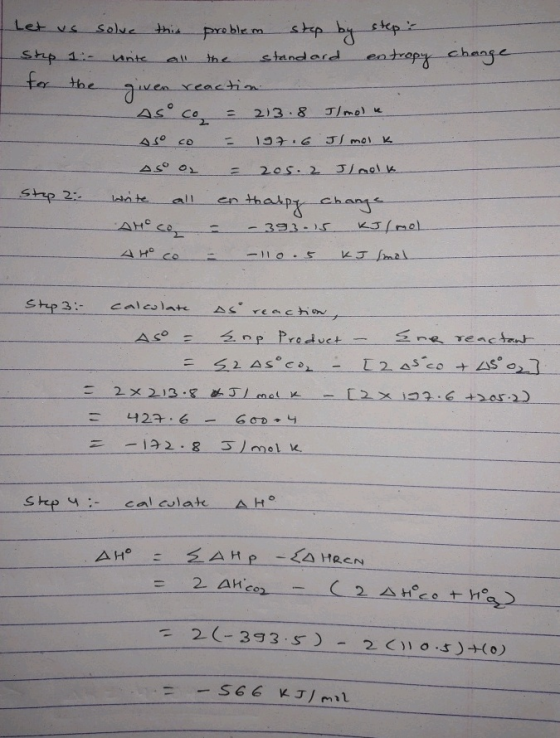
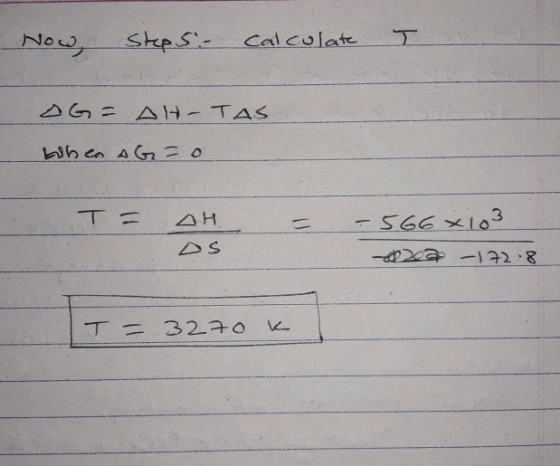
Using Appendix 2 in your textbook, at what temperature (in K) will the reaction, 2CO(g) +...
Using Appendix 2 in your textbook, at what temperature (in K) will the reaction, 2CO(g) + O2(g) --> 2CO2(g), change in spontaneity?
Homework Answers
Add Answer to:
Using Appendix 2 in your textbook, at what temperature (in K)
will the reaction, 2CO(g) +...
For the reaction 2CO(g)+O2(g)⇌2CO2(g), the value of K at a certain temperature is 1300. Calculate [CO2]...
For the reaction 2CO(g)+O2(g)⇌2CO2(g), the value of K at a certain temperature is 1300. Calculate [CO2] at equilibrium when [CO] = 9.0×10⁻² mol/L and [O2] = 0.527 mol/L
for the reaction 2CO + O2 = 2CO2 it is found that at a certain temperature...
for the reaction 2CO + O2 = 2CO2 it is found that at a certain temperature the concentration are [CO] = 7.2 x 10^-4 M, [O2] = 8.1 x 10^-3 M, and [CO2] = 2.3 x 10⁻² M. write out the equilibrium expression and calculate K for the reaction at this temperature? How would the equilibrium position change if CO2 was added?
What is KP at 1269°C for the reaction 2CO(g) + O2(g) ⇌ 2CO2(g) if Kc is...
What is KP at 1269°C for the reaction 2CO(g) + O2(g) ⇌ 2CO2(g) if Kc is 2.6 × 10¹⁴ at the same temperature? × 10 (Enter your answer in scientific notation.)
Assuming that Ac is independent of temperature, calculate AH1200 for the reaction: 2CO(g) + O2(g) →...
 Assuming that Ac is independent of temperature, calculate AH1200 for the reaction: 2CO(g) + O2(g) → 2CO2(g) AH co Chemical KkJ mol-?) U moll) -398.029 39.277 CO2(g) o2g) CO(g) n/a 28.34 -111.42 27.247 -577078.56
Using Appendix 2 in your textbook, what is the value for the standard change in Gibbs...
Using Appendix 2 in your textbook, what is the value for the standard change in Gibbs free energy (in kJ) at 25oC of the reaction: C2H4(g) + H2(g) --> C2H6(g)?
4. Calculate AG°(375 K) for the reaction 2CO(g) + O2(g) → 2CO2(g) from the values of AG°(298 K) and AH°(298 K) (found i...
 4. Calculate AG°(375 K) for the reaction 2CO(g) + O2(g) → 2CO2(g) from the values of AG°(298 K) and AH°(298 K) (found in tables) and the Gibbs-Helmholtz equation.
a) Complete the table below using data given in the Appendix of your textbook. 2 CH18...
 a) Complete the table below using data given in the Appendix of your textbook. 2 CH18 (1) + 25 O2 (g) → 16 CO2 (g) +18 H20 (1) O2(g) CO2 (g) H20 (1) C4H8 (1) -208.4 kJ/mol AH® (kJ/mol) sº (J/molK) 463.7 JK 'mol b) Calculate AG° combustion at 25°C for octane, CsH18 (1). Give your answer in kJ/mol of CH18 (1). c) Consider the reaction, 3 Fe203 (s) + 3 C(s) + 4 Fe (s) + 3 CO2 (g)...
Using values from Appendix C of your textbook, calculate the value of Keq at 298 K...
 Using values from Appendix C of your textbook, calculate the
value of Keq at 298 K for each of the following
reactions:
Using values from Appendix C of your textbook, calculate the value of Keg at 298 K for each of the following reactions: (a) Fe3O4(s) + 4 CO(g) = 3 Fe(s) + 4 CO2(g) Keq = (b) Fe2O3(s) + 6 HCI(g) = 2 FeCl3(s) + 3 H2O(g) Keq = D . (c) 4 NH3(g) + O2(g) = 2 N2H4(9)...
Using values from Appendix C of your textbook, calculate the
value of Keq at 298 K for each of the following
reactions:
Using values from Appendix C of your textbook, calculate the value of Keg at 298 K for each of the following reactions: (a) Fe3O4(s) + 4 CO(g) = 3 Fe(s) + 4 CO2(g) Keq = (b) Fe2O3(s) + 6 HCI(g) = 2 FeCl3(s) + 3 H2O(g) Keq = D . (c) 4 NH3(g) + O2(g) = 2 N2H4(9)...
Using values from Appendix C of your textbook, calculate the value of Kea at 298 K...
 Using values from Appendix C of your textbook, calculate the value of Kea at 298 K for each of the following reactions: (a) 2 SO3(g) 2 SO2(g) O2(g) Кeg (b) 2 NO(g) N2(g)02(g) Кeg (c) 2 NH3(g) N2(g) +3 H2(g) Кeg
Using values from Appendix C of your textbook, calculate the value of Keq at 298 K...
 Using values from Appendix C of your textbook, calculate the
value of Keq at 298 K for each of the following
reactions:
(a) 4 NH3(g) + O2(g) 2 N2H4(g) + 2
H2O(l)
Keq = .
(b) CH4(g) + 4 Cl2(g) CCl4(l) + 4 HCl(g)
Keq = .
(c) 6 C(graphite) + 6 H2O(l)
C6H12O6(s)
Keq = .
Using values from Appendix C of your textbook, calculate the
value of Keq at 298 K for each of the following
reactions:
(a) 4 NH3(g) + O2(g) 2 N2H4(g) + 2
H2O(l)
Keq = .
(b) CH4(g) + 4 Cl2(g) CCl4(l) + 4 HCl(g)
Keq = .
(c) 6 C(graphite) + 6 H2O(l)
C6H12O6(s)
Keq = .
 Assuming that Ac is independent of temperature, calculate AH1200 for the reaction: 2CO(g) + O2(g) → 2CO2(g) AH co Chemical KkJ mol-?) U moll) -398.029 39.277 CO2(g) o2g) CO(g) n/a 28.34 -111.42 27.247 -577078.56
 4. Calculate AG°(375 K) for the reaction 2CO(g) + O2(g) → 2CO2(g) from the values of AG°(298 K) and AH°(298 K) (found in tables) and the Gibbs-Helmholtz equation.
 a) Complete the table below using data given in the Appendix of your textbook. 2 CH18 (1) + 25 O2 (g) → 16 CO2 (g) +18 H20 (1) O2(g) CO2 (g) H20 (1) C4H8 (1) -208.4 kJ/mol AH® (kJ/mol) sº (J/molK) 463.7 JK 'mol b) Calculate AG° combustion at 25°C for octane, CsH18 (1). Give your answer in kJ/mol of CH18 (1). c) Consider the reaction, 3 Fe203 (s) + 3 C(s) + 4 Fe (s) + 3 CO2 (g)...
 Using values from Appendix C of your textbook, calculate the
value of Keq at 298 K for each of the following
reactions:
Using values from Appendix C of your textbook, calculate the value of Keg at 298 K for each of the following reactions: (a) Fe3O4(s) + 4 CO(g) = 3 Fe(s) + 4 CO2(g) Keq = (b) Fe2O3(s) + 6 HCI(g) = 2 FeCl3(s) + 3 H2O(g) Keq = D . (c) 4 NH3(g) + O2(g) = 2 N2H4(9)...
Using values from Appendix C of your textbook, calculate the
value of Keq at 298 K for each of the following
reactions:
Using values from Appendix C of your textbook, calculate the value of Keg at 298 K for each of the following reactions: (a) Fe3O4(s) + 4 CO(g) = 3 Fe(s) + 4 CO2(g) Keq = (b) Fe2O3(s) + 6 HCI(g) = 2 FeCl3(s) + 3 H2O(g) Keq = D . (c) 4 NH3(g) + O2(g) = 2 N2H4(9)...
 Using values from Appendix C of your textbook, calculate the value of Kea at 298 K for each of the following reactions: (a) 2 SO3(g) 2 SO2(g) O2(g) Кeg (b) 2 NO(g) N2(g)02(g) Кeg (c) 2 NH3(g) N2(g) +3 H2(g) Кeg
 Using values from Appendix C of your textbook, calculate the
value of Keq at 298 K for each of the following
reactions:
(a) 4 NH3(g) + O2(g) 2 N2H4(g) + 2
H2O(l)
Keq = .
(b) CH4(g) + 4 Cl2(g) CCl4(l) + 4 HCl(g)
Keq = .
(c) 6 C(graphite) + 6 H2O(l)
C6H12O6(s)
Keq = .
Using values from Appendix C of your textbook, calculate the
value of Keq at 298 K for each of the following
reactions:
(a) 4 NH3(g) + O2(g) 2 N2H4(g) + 2
H2O(l)
Keq = .
(b) CH4(g) + 4 Cl2(g) CCl4(l) + 4 HCl(g)
Keq = .
(c) 6 C(graphite) + 6 H2O(l)
C6H12O6(s)
Keq = .
Most questions answered within 3 hours.
-
Where is the error in this code sequence?
String s1 = "Hello";
String s2 = "ello";...
asked 10 months ago -
Financial data for Joel de Paris, Inc., for last year
follow:
Joel de Paris, Inc.
Balance...
asked 10 months ago -
Consider this reaction:
Al2(SO4)3 (aq)+ BaCl3
(aq) Al2Cl6 (aq)- +
3BaSO4(s) . What is the...
asked 10 months ago -
Suppose that Savneet is considering increasing her
recent random sample from 20 car rentals to 40...
asked 10 months ago -
Trucks arrive at an unloading terminal at an average rate of 120
per hour.
Trucks arrive...
asked 10 months ago -
Why are methanol and ethanol completely soluble in water while
octanol is not very little soluble....
asked 10 months ago -
A facilities manager at a university reads in a research report
that the mean amount of...
asked 10 months ago -
When the CuSO4 is rehydrated by adding water to the anhydrous
compound, is this an endothermic...
asked 10 months ago -
A ray of sunlight is passing from diamond into crown glass; the
angle of incidence is...
asked 10 months ago -
A block of mass 0.249 kg is placed on top of a light, vertical
spring of...
asked 10 months ago -
how do the kidneys compensate in the presences of acidosis
a) trigger hyperventilate
b) reserve acid...
asked 10 months ago -
Question 501 pts
The rental rate of capital to the firm increases. Which of the
following...
asked 10 months ago