Using values from Appendix C of your textbook, calculate the
value of Keq at 298 K for each of the following
reactions: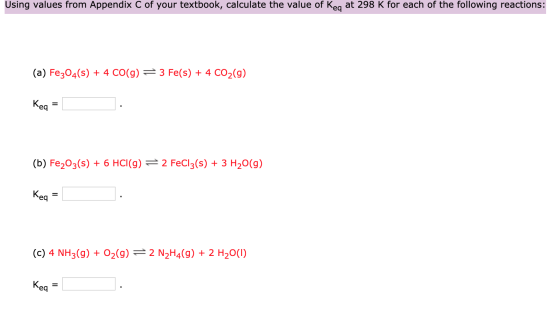
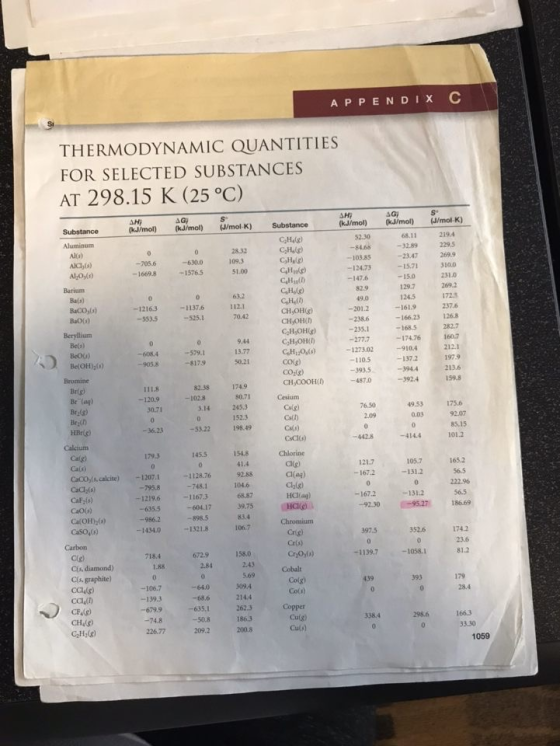
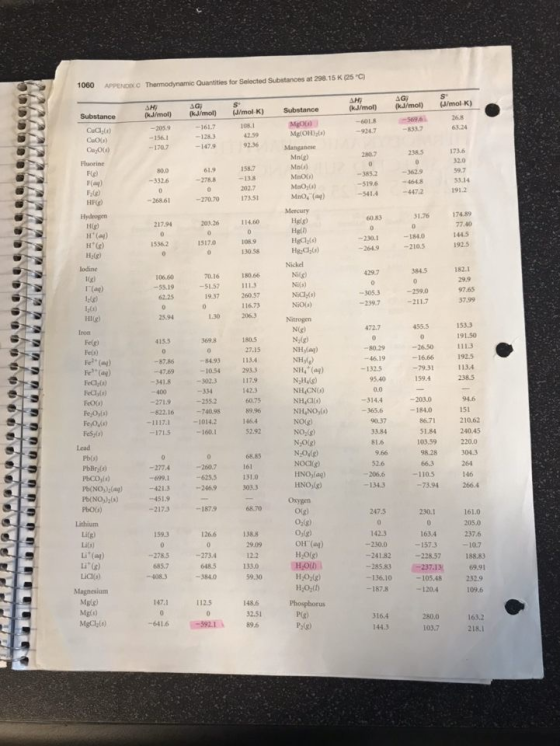
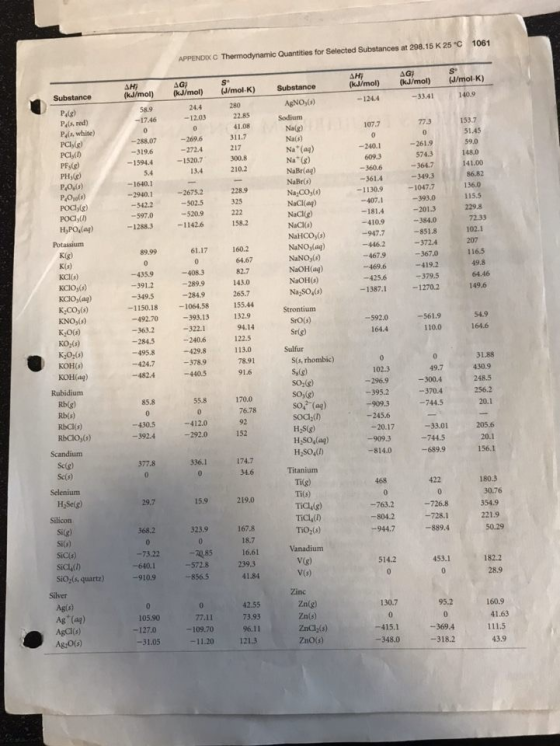
Homework Answers
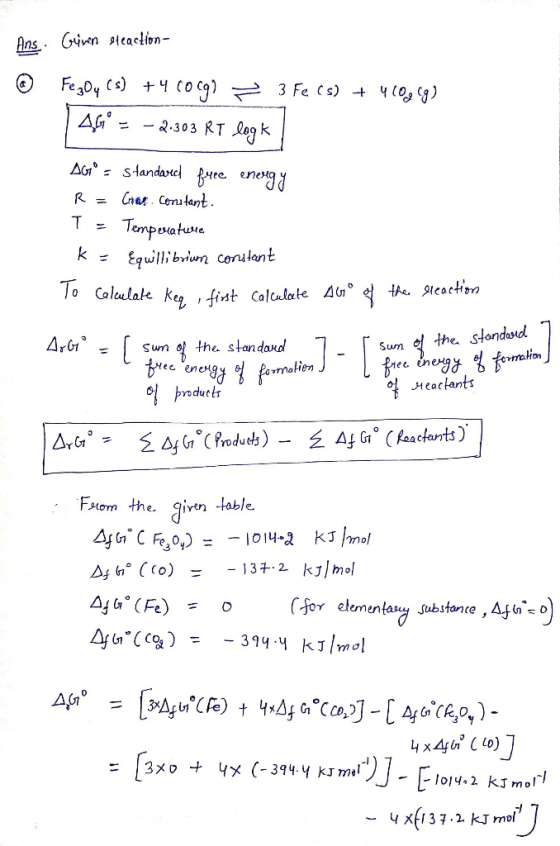
![= [1547.6 kJ molt ] - [1019.2 ks mort+(-548-8 k smi] = -1577.6 - [ - 1563] = (1577.6 + 1563) K J molt = -14.6 kJ mort AG° = -](http://img.homeworklib.com/questions/65121de0-704b-11ea-8692-3b4da4acac1f.png?x-oss-process=image/resize,w_560)
![46° = [ax 6334 kImalt) + 2 * (-228-57 Kumar)] - [-740.98 kJ molt + 6x-95-27 ks mi] = [668 - 457.14] - [ -740 – 571.62] = (-1](http://img.homeworklib.com/questions/65950310-704b-11ea-8db7-7f2a5e72cf23.png?x-oss-process=image/resize,w_560)
![461 = [2 x 444°C HgHq) + 2x 446°C4206)] - [ 4x Asci°C NH3] + Af6° 003] = (2x159.4 kJmort + 2x(-237.13 kJmort] - [4X (-16.6 ks](http://img.homeworklib.com/questions/6613a080-704b-11ea-83ce-1588ab0afa26.png?x-oss-process=image/resize,w_560)
Add Answer to:
Using values from Appendix C of your textbook, calculate the
value of Keq at 298 K...
Using values from Appendix C of your textbook, calculate the value of Keq at 298 K...
 Using values from Appendix C of your textbook, calculate the
value of Keq at 298 K for each of the following
reactions:
(a) 4 NH3(g) + O2(g) 2 N2H4(g) + 2
H2O(l)
Keq = .
(b) CH4(g) + 4 Cl2(g) CCl4(l) + 4 HCl(g)
Keq = .
(c) 6 C(graphite) + 6 H2O(l)
C6H12O6(s)
Keq = .
Using values from Appendix C of your textbook, calculate the
value of Keq at 298 K for each of the following
reactions:
(a) 4 NH3(g) + O2(g) 2 N2H4(g) + 2
H2O(l)
Keq = .
(b) CH4(g) + 4 Cl2(g) CCl4(l) + 4 HCl(g)
Keq = .
(c) 6 C(graphite) + 6 H2O(l)
C6H12O6(s)
Keq = .
Using values from Appendix C of your textbook, calculate the value of Kea at 298 K...
 Using values from Appendix C of your textbook, calculate the value of Kea at 298 K for each of the following reactions: (a) 2 SO3(g) 2 SO2(g) O2(g) Кeg (b) 2 NO(g) N2(g)02(g) Кeg (c) 2 NH3(g) N2(g) +3 H2(g) Кeg
Using values from Appendix C in the textbook, calculate the standard enthalpy change for each of...
Using values from Appendix C in the textbook, calculate the standard enthalpy change for each of the following reactions. Link to Appendix C: https://media.pearsoncmg.com/ph/esm/esm_brown_chemistry_14/appendices/appendix-c.pdf 1. 2SO2(g)+O2(g)→2SO3(g) 2. Mg(OH)2(s)→MgO(s)+H2O(l) 3. N2O4(g)+4H2(g)→N2(g)+4H2O(g)N2O4(g)+4H2(g)→N2(g)+4H2O(g) 4. SiCl4(l)+2H2O(l)→SiO2(s)+4HCl(g)
Using data from Appendix C in the textbook, write the equilibrium-constant expression and calculate the value...
Using data from Appendix C in the textbook, write the equilibrium-constant expression and calculate the value of the equilibrium constant and the free-energy change for these reactions at 298 K . A) NaHCO3(s) ⇌ NaOH(s)+CO2(g) What is the free-energy change for this reaction at 298 K? Express the free energy in kilojoules to one decimal place. B) 2HBr(g)+Cl2(g) ⇌ 2HCl(g)+Br2(g) Which is the equilibrium-constant expression for this reaction? K=P2HClPBr2P2HBrPCl2 K=P2HBrPCl2 K=P2HBrPCl2P2HClPBr2 K=PHClPBr2PHBrPCl2 C) 2SO2(g)+O2(g) ⇌ 2SO3(g) Which is the equilibrium-constant...
Using data found in Appendix E of your textbook calculate the nonstandard emf for each of...
 Using data found in Appendix E of your textbook calculate the
nonstandard emf for each of the following reactions if the
concentration of each of the ions in these reactions is 0.0003
molar and everything else is standard (use 298 K for the
temperature, R = 8.314 J/mol-K, and F = 96,485 C/mol):
33. 0/0.1 points Previous Answers 1/4 Submissions Used My Notes Using data found in Appendix E of your textbook calculate the nonstandard emf for each of the...
Using data found in Appendix E of your textbook calculate the
nonstandard emf for each of the following reactions if the
concentration of each of the ions in these reactions is 0.0003
molar and everything else is standard (use 298 K for the
temperature, R = 8.314 J/mol-K, and F = 96,485 C/mol):
33. 0/0.1 points Previous Answers 1/4 Submissions Used My Notes Using data found in Appendix E of your textbook calculate the nonstandard emf for each of the...
Use the S∘ values in Appendix B in the textbook to calculate ΔS∘ at 25 ∘C...
Use the S∘ values in Appendix B in the textbook to calculate ΔS∘ at 25 ∘C for each of the following reactions. Suggest a reason for the sign of ΔS∘ in each case. A. 2S(s)+3O2(g)→2SO3(g) (suggest a reason for the sign of S in this case) B. SO3(g)+H2O(l)→H2SO4(aq) (suggest a reason for the sign of S in this case) C. AgCl(s)→Ag+(aq)+Cl−(aq) (suggest a reason for the sign of S in this case) D. NH4NO3(s)→N2O(g)+2H2O(g) (suggest a reason for the sign...
Using heat of formation values from Appendix C of the textbook, calculate the standard enthalpy change...
Using heat of formation values from Appendix C of the textbook, calculate the standard enthalpy change for the following reaction: 2 C3H8 (g) + 9 O2 (g) ----> 2 CO2 (g) + 8 H2O (l) + 4 CO2 (g) Enthalpies of formation values C3H8 (g) = -103.85 kJ/ mol , O2 (g) = 0 , CO (g) = -110.5 kJ/ mol , H20 (l) = -285.83 kJ/ mol , CO2 (g) = -393.5 kJ/ mol
7. Using the values in the appendix at the end of your textbook, calculate the value...
 7. Using the values in the appendix at the end of your textbook, calculate the value of ASo for the catalytic hydrogenation of acetylene to ethane is which of the following? a, +18.6 b, +550.8 c. +1 12.0 (a-112.0 e.-18.6 C2H2(g) + H2(g) → C2H4e)
Calculate AS values for the following reactions using the tabulated values in Appendix C. In each...
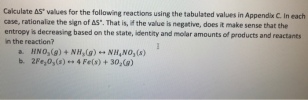 Calculate AS values for the following reactions using the tabulated values in Appendix C. In each case, rationalize the sign of AS°. That is, if the value is negative, does it make sense that the entropy is decreasing based on the state, identity and molar amounts of products and reactants in the reaction? a. HNO3 (g) + NH3(g) NH,NO3 (s) b. 2Fe203 (s)4 Fe(s) +302(g)
Part 1.) Calculate the pH of each of the following strong acid solutions. (a) 0.00555 M...
 Part 1.)
Calculate the pH of each of the following strong acid
solutions.
(a) 0.00555 M HClO4
pH =
(b) 0.314 g of HBrO4 in 21.0 L of solution
pH =
(c) 39.0 mL of 3.50 M HClO4 diluted to 1.90 L
pH =
(d) a mixture formed by adding 59.0 mL of 0.00582 M
HClO4 to 16.0 mL of 0.00676 M HBrO4
pH =
Part 2.)
Using values from Appendix C of your textbook, calculate the
value of Keq...
Part 1.)
Calculate the pH of each of the following strong acid
solutions.
(a) 0.00555 M HClO4
pH =
(b) 0.314 g of HBrO4 in 21.0 L of solution
pH =
(c) 39.0 mL of 3.50 M HClO4 diluted to 1.90 L
pH =
(d) a mixture formed by adding 59.0 mL of 0.00582 M
HClO4 to 16.0 mL of 0.00676 M HBrO4
pH =
Part 2.)
Using values from Appendix C of your textbook, calculate the
value of Keq...
 Using values from Appendix C of your textbook, calculate the
value of Keq at 298 K for each of the following
reactions:
(a) 4 NH3(g) + O2(g) 2 N2H4(g) + 2
H2O(l)
Keq = .
(b) CH4(g) + 4 Cl2(g) CCl4(l) + 4 HCl(g)
Keq = .
(c) 6 C(graphite) + 6 H2O(l)
C6H12O6(s)
Keq = .
Using values from Appendix C of your textbook, calculate the
value of Keq at 298 K for each of the following
reactions:
(a) 4 NH3(g) + O2(g) 2 N2H4(g) + 2
H2O(l)
Keq = .
(b) CH4(g) + 4 Cl2(g) CCl4(l) + 4 HCl(g)
Keq = .
(c) 6 C(graphite) + 6 H2O(l)
C6H12O6(s)
Keq = .
 Using values from Appendix C of your textbook, calculate the value of Kea at 298 K for each of the following reactions: (a) 2 SO3(g) 2 SO2(g) O2(g) Кeg (b) 2 NO(g) N2(g)02(g) Кeg (c) 2 NH3(g) N2(g) +3 H2(g) Кeg
 Using data found in Appendix E of your textbook calculate the
nonstandard emf for each of the following reactions if the
concentration of each of the ions in these reactions is 0.0003
molar and everything else is standard (use 298 K for the
temperature, R = 8.314 J/mol-K, and F = 96,485 C/mol):
33. 0/0.1 points Previous Answers 1/4 Submissions Used My Notes Using data found in Appendix E of your textbook calculate the nonstandard emf for each of the...
Using data found in Appendix E of your textbook calculate the
nonstandard emf for each of the following reactions if the
concentration of each of the ions in these reactions is 0.0003
molar and everything else is standard (use 298 K for the
temperature, R = 8.314 J/mol-K, and F = 96,485 C/mol):
33. 0/0.1 points Previous Answers 1/4 Submissions Used My Notes Using data found in Appendix E of your textbook calculate the nonstandard emf for each of the...
 7. Using the values in the appendix at the end of your textbook, calculate the value of ASo for the catalytic hydrogenation of acetylene to ethane is which of the following? a, +18.6 b, +550.8 c. +1 12.0 (a-112.0 e.-18.6 C2H2(g) + H2(g) → C2H4e)
 Calculate AS values for the following reactions using the tabulated values in Appendix C. In each case, rationalize the sign of AS°. That is, if the value is negative, does it make sense that the entropy is decreasing based on the state, identity and molar amounts of products and reactants in the reaction? a. HNO3 (g) + NH3(g) NH,NO3 (s) b. 2Fe203 (s)4 Fe(s) +302(g)
 Part 1.)
Calculate the pH of each of the following strong acid
solutions.
(a) 0.00555 M HClO4
pH =
(b) 0.314 g of HBrO4 in 21.0 L of solution
pH =
(c) 39.0 mL of 3.50 M HClO4 diluted to 1.90 L
pH =
(d) a mixture formed by adding 59.0 mL of 0.00582 M
HClO4 to 16.0 mL of 0.00676 M HBrO4
pH =
Part 2.)
Using values from Appendix C of your textbook, calculate the
value of Keq...
Part 1.)
Calculate the pH of each of the following strong acid
solutions.
(a) 0.00555 M HClO4
pH =
(b) 0.314 g of HBrO4 in 21.0 L of solution
pH =
(c) 39.0 mL of 3.50 M HClO4 diluted to 1.90 L
pH =
(d) a mixture formed by adding 59.0 mL of 0.00582 M
HClO4 to 16.0 mL of 0.00676 M HBrO4
pH =
Part 2.)
Using values from Appendix C of your textbook, calculate the
value of Keq...
Most questions answered within 3 hours.
-
Where is the error in this code sequence?
String s1 = "Hello";
String s2 = "ello";...
asked 11 months ago -
Financial data for Joel de Paris, Inc., for last year
follow:
Joel de Paris, Inc.
Balance...
asked 11 months ago -
Consider this reaction:
Al2(SO4)3 (aq)+ BaCl3
(aq) Al2Cl6 (aq)- +
3BaSO4(s) . What is the...
asked 11 months ago -
Suppose that Savneet is considering increasing her
recent random sample from 20 car rentals to 40...
asked 11 months ago -
Trucks arrive at an unloading terminal at an average rate of 120
per hour.
Trucks arrive...
asked 11 months ago -
Why are methanol and ethanol completely soluble in water while
octanol is not very little soluble....
asked 11 months ago -
A facilities manager at a university reads in a research report
that the mean amount of...
asked 11 months ago -
When the CuSO4 is rehydrated by adding water to the anhydrous
compound, is this an endothermic...
asked 11 months ago -
A ray of sunlight is passing from diamond into crown glass; the
angle of incidence is...
asked 11 months ago -
A block of mass 0.249 kg is placed on top of a light, vertical
spring of...
asked 11 months ago -
how do the kidneys compensate in the presences of acidosis
a) trigger hyperventilate
b) reserve acid...
asked 11 months ago -
Question 501 pts
The rental rate of capital to the firm increases. Which of the
following...
asked 11 months ago