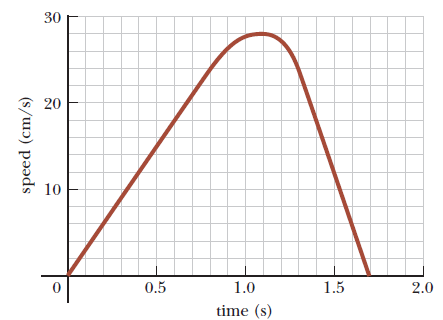
The figure below shows the speed of a person's body as he does a chin-up. Assume the motion is vertical and the mass of the person's body is 57.4 kg. Determine the force exerted by the chin-up bar on his body at the following times.
(a) t = 0
N
(b) t = 0.5 s
N
(c) t = 1.1 s
N
(d) t = 1.6 s.
N
Homework Answers
a) v=0 hence a=0 and F= 0
b) slope ,a= 14/0.5 = 28 cm/s2
a= .28 m/s2
F=ma=16.072 N
c) v is const, a=0 hence F =0
d) a= 0 .0667 m/s2
F= ma = 3.826 N
Add Answer to:
The figure below shows the speed of a person's body as he does a
chin-up. Assume...
As pdlt ol an exercise ruutirie, dn athlete does a set 이 dim ups shown IS...
 As pdlt ol an exercise ruutirie, dn athlete does a set 이 dim ups shown IS d ur dph ut the d thlete s vertical speed ds she perilms a chin-up. If her mass is 75.3 kg calculate he torce exerted by the chin-up bar her hands for the given times. (nter the magnitudes in N.) 30 0 0.5 2.0 time (s) (a) 4-t0 (b) r = 0.55 (c) r= 1.1 s (d) t 1.6 s
The figure below shows a top view of a bar that can slide on two frictionless...
The figure below shows a top view of a bar that can slide on two frictionless rails. The resistor is R = 5.00 Ω, and a 2.50-T magnetic field is directed perpendicularly downward, into the page. Let ℓ = 1.20 m. A vertical bar and two parallel horizontal rails lie in the plane of the page, in a region of uniform magnetic field, vector Bin, pointing into the page. The parallel rails run from left to right, with one a...
The plot ofan airplane executes constant-speed loop-the-loop maneuver in vertical circle as in the figure below....
 The plot ofan airplane executes constant-speed loop-the-loop maneuver in vertical circle as in the figure below. The speed of the airplane is 2.40 × 10² m/s, and the radius of the circle s 3.05 × 10³ m. (a) What is the pilot's apparent weight at the lowest point of the circle if his true weight is 740 N? (b) What is his apparent weight at the highest point of the circle? (c) Describe how the pilot could experience weightlessness if...
The figure below shows a ball of mass m=1.6 kg which is connected to a string...
 The figure below shows a ball of mass m=1.6 kg which is
connected to a string of length L=2.0 m and moves in a vertical
circle. Only gravity and the tension in the string act on the ball.
If the velocity of the ball at point A is v0=10.7 m/s,
what is the tension T in the string when the ball reaches the point
D?
A m n 1 •C B
The figure below shows a ball of mass m=1.6 kg which is
connected to a string of length L=2.0 m and moves in a vertical
circle. Only gravity and the tension in the string act on the ball.
If the velocity of the ball at point A is v0=10.7 m/s,
what is the tension T in the string when the ball reaches the point
D?
A m n 1 •C B
HYS 121-In-Class Problem Graphing with Velocity he motion of obj The figure below shows a posit...
 HYS 121-In-Class Problem Graphing with Velocity he motion of obj The figure below shows a posit along the same axis. a position vs time graph for the motion of objects A and B that are tion vs. time graph for 2. 2.5 0.5 Time (s) a. At the instantに1s, is the speed of A greater than, less than or equal to the speed of B? Tre pet Explain. b. Do objects ever have the same spcod? If so, at what...
solve using kinetic energy equations. ( Theorem of change in kinetic enegery) KE20. Figure shows a mechanism. Body 5...
 solve using kinetic energy equations. ( Theorem of
change in kinetic enegery)
KE20. Figure shows a mechanism. Body 5 is assumed to be homogeneous circular cylinder, and mass of the pulley 4 is uniformly distributed over its rim. The coefficient of sliding friction between bodies and the plane is f 0.1 The coefficient of stiffness of a spring is c. A force F applied to the mechanism depends on the displacement s of the body 1. The mechanism starts motion...
solve using kinetic energy equations. ( Theorem of
change in kinetic enegery)
KE20. Figure shows a mechanism. Body 5 is assumed to be homogeneous circular cylinder, and mass of the pulley 4 is uniformly distributed over its rim. The coefficient of sliding friction between bodies and the plane is f 0.1 The coefficient of stiffness of a spring is c. A force F applied to the mechanism depends on the displacement s of the body 1. The mechanism starts motion...
The figure below shows a top view of a bar that can slide on two frictionless...
 The figure below shows a top view of a bar that can slide on two frictionless rails. The resistor is R - 6.80 O, and a 2.50-T magnetic field is directed perpendicularly downward, into the page. Let ! - 1.20 m. XX XX R (a) Calculate the applied force required to move the bar to the right at a constant speed of 1.90 m/s. N (to the right) (6) At what rate is energy delivered to the resistor? w
KE7. Figure shows a mechanism. Body 5 is assumed to be homogeneous circular cylinder, and mass of the pulley 4 is uniformly distributed over its rim. The coefficient of sliding friction between bo...
 KE7. Figure shows a mechanism. Body 5 is assumed to be homogeneous circular cylinder, and mass of the pulley 4 is uniformly distributed over its rim. The coefficient of sliding friction between bodies and the plane is f 0.1. The coefficient of stiffness of a spring is c. A force F applied to the mechanism depends on the displacement s of the body 1. The mechanism starts motion from rest, and F at the beginning of the motion the spring...
Can someone solve these? ill award a thumbs up Force Balance and Free body Diagrams 9....
 Can someone solve these? ill award a thumbs up
Force Balance and Free body Diagrams 9. (2) True or false: Dynamic equilibrium involves a net force equal to zero and the object at rest 10. (2) True or false: A hockey puck sliding on a frictionless Ice rink at constant velocity is in dynamic equilibrium. 11. (2) True or False: A stoplight hanging motionless from a wire is in dynamic equilibrium For questions 12, 13 and 14 draw and label...
Can someone solve these? ill award a thumbs up
Force Balance and Free body Diagrams 9. (2) True or false: Dynamic equilibrium involves a net force equal to zero and the object at rest 10. (2) True or false: A hockey puck sliding on a frictionless Ice rink at constant velocity is in dynamic equilibrium. 11. (2) True or False: A stoplight hanging motionless from a wire is in dynamic equilibrium For questions 12, 13 and 14 draw and label...
The figure below shows a proton entering a parallel-plate capacitor with a speed of 2.10 times...
 The figure below shows a proton entering a parallel-plate capacitor with a speed of 2.10 times 10^5 m/s. The proton travels a horizontal distance x = 5.20 cm through the essentially uniform electric field. The electric field of the capacitor has deflected the proton downward by a distance of d = 0.720 cm at the point where the proton exits the capacitor. (You can neglect the effects of gravity.) Using kinematics, find the vertical acceleration (including sign) of the proton...
 As pdlt ol an exercise ruutirie, dn athlete does a set 이 dim ups shown IS d ur dph ut the d thlete s vertical speed ds she perilms a chin-up. If her mass is 75.3 kg calculate he torce exerted by the chin-up bar her hands for the given times. (nter the magnitudes in N.) 30 0 0.5 2.0 time (s) (a) 4-t0 (b) r = 0.55 (c) r= 1.1 s (d) t 1.6 s
 The plot ofan airplane executes constant-speed loop-the-loop maneuver in vertical circle as in the figure below. The speed of the airplane is 2.40 × 10² m/s, and the radius of the circle s 3.05 × 10³ m. (a) What is the pilot's apparent weight at the lowest point of the circle if his true weight is 740 N? (b) What is his apparent weight at the highest point of the circle? (c) Describe how the pilot could experience weightlessness if...
 The figure below shows a ball of mass m=1.6 kg which is
connected to a string of length L=2.0 m and moves in a vertical
circle. Only gravity and the tension in the string act on the ball.
If the velocity of the ball at point A is v0=10.7 m/s,
what is the tension T in the string when the ball reaches the point
D?
A m n 1 •C B
The figure below shows a ball of mass m=1.6 kg which is
connected to a string of length L=2.0 m and moves in a vertical
circle. Only gravity and the tension in the string act on the ball.
If the velocity of the ball at point A is v0=10.7 m/s,
what is the tension T in the string when the ball reaches the point
D?
A m n 1 •C B
 HYS 121-In-Class Problem Graphing with Velocity he motion of obj The figure below shows a posit along the same axis. a position vs time graph for the motion of objects A and B that are tion vs. time graph for 2. 2.5 0.5 Time (s) a. At the instantに1s, is the speed of A greater than, less than or equal to the speed of B? Tre pet Explain. b. Do objects ever have the same spcod? If so, at what...
 solve using kinetic energy equations. ( Theorem of
change in kinetic enegery)
KE20. Figure shows a mechanism. Body 5 is assumed to be homogeneous circular cylinder, and mass of the pulley 4 is uniformly distributed over its rim. The coefficient of sliding friction between bodies and the plane is f 0.1 The coefficient of stiffness of a spring is c. A force F applied to the mechanism depends on the displacement s of the body 1. The mechanism starts motion...
solve using kinetic energy equations. ( Theorem of
change in kinetic enegery)
KE20. Figure shows a mechanism. Body 5 is assumed to be homogeneous circular cylinder, and mass of the pulley 4 is uniformly distributed over its rim. The coefficient of sliding friction between bodies and the plane is f 0.1 The coefficient of stiffness of a spring is c. A force F applied to the mechanism depends on the displacement s of the body 1. The mechanism starts motion...
 The figure below shows a top view of a bar that can slide on two frictionless rails. The resistor is R - 6.80 O, and a 2.50-T magnetic field is directed perpendicularly downward, into the page. Let ! - 1.20 m. XX XX R (a) Calculate the applied force required to move the bar to the right at a constant speed of 1.90 m/s. N (to the right) (6) At what rate is energy delivered to the resistor? w
 KE7. Figure shows a mechanism. Body 5 is assumed to be homogeneous circular cylinder, and mass of the pulley 4 is uniformly distributed over its rim. The coefficient of sliding friction between bodies and the plane is f 0.1. The coefficient of stiffness of a spring is c. A force F applied to the mechanism depends on the displacement s of the body 1. The mechanism starts motion from rest, and F at the beginning of the motion the spring...
 Can someone solve these? ill award a thumbs up
Force Balance and Free body Diagrams 9. (2) True or false: Dynamic equilibrium involves a net force equal to zero and the object at rest 10. (2) True or false: A hockey puck sliding on a frictionless Ice rink at constant velocity is in dynamic equilibrium. 11. (2) True or False: A stoplight hanging motionless from a wire is in dynamic equilibrium For questions 12, 13 and 14 draw and label...
Can someone solve these? ill award a thumbs up
Force Balance and Free body Diagrams 9. (2) True or false: Dynamic equilibrium involves a net force equal to zero and the object at rest 10. (2) True or false: A hockey puck sliding on a frictionless Ice rink at constant velocity is in dynamic equilibrium. 11. (2) True or False: A stoplight hanging motionless from a wire is in dynamic equilibrium For questions 12, 13 and 14 draw and label...
 The figure below shows a proton entering a parallel-plate capacitor with a speed of 2.10 times 10^5 m/s. The proton travels a horizontal distance x = 5.20 cm through the essentially uniform electric field. The electric field of the capacitor has deflected the proton downward by a distance of d = 0.720 cm at the point where the proton exits the capacitor. (You can neglect the effects of gravity.) Using kinematics, find the vertical acceleration (including sign) of the proton...
Most questions answered within 3 hours.
-
Where is the error in this code sequence?
String s1 = "Hello";
String s2 = "ello";...
asked 11 months ago -
Financial data for Joel de Paris, Inc., for last year
follow:
Joel de Paris, Inc.
Balance...
asked 11 months ago -
Consider this reaction:
Al2(SO4)3 (aq)+ BaCl3
(aq) Al2Cl6 (aq)- +
3BaSO4(s) . What is the...
asked 11 months ago -
Suppose that Savneet is considering increasing her
recent random sample from 20 car rentals to 40...
asked 11 months ago -
Trucks arrive at an unloading terminal at an average rate of 120
per hour.
Trucks arrive...
asked 11 months ago -
Why are methanol and ethanol completely soluble in water while
octanol is not very little soluble....
asked 11 months ago -
A facilities manager at a university reads in a research report
that the mean amount of...
asked 11 months ago -
When the CuSO4 is rehydrated by adding water to the anhydrous
compound, is this an endothermic...
asked 11 months ago -
A ray of sunlight is passing from diamond into crown glass; the
angle of incidence is...
asked 11 months ago -
A block of mass 0.249 kg is placed on top of a light, vertical
spring of...
asked 11 months ago -
how do the kidneys compensate in the presences of acidosis
a) trigger hyperventilate
b) reserve acid...
asked 11 months ago -
Question 501 pts
The rental rate of capital to the firm increases. Which of the
following...
asked 11 months ago