
Homework Answers


Add Answer to:
1. A styrofoam cooler is a perfect cube (i.c. normal box shape) that is 0.35 m...
The Styrofoam™ box in is used to keep drinks cold at a picnic. The total wall...
The Styrofoam™ box in is used to keep drinks cold at a picnic. The total wall area (including the lid) is 0.80 m^2, and the wall thickness is 2.0 cm. The box is filled with ice and cans of cola, keeping the inner surface at 0 ∘C. What is the rate of heat flow into the box if the temperature of the outside surface is 30 ∘C? How much ice melts in one day (24 h)? This same Styrofoam™ cooler...
A cooler is a closed container in the shape of a cube, each side 0.5 m...
A cooler is a closed container in the shape of a cube, each side 0.5 m in length, and made of polystyrene foam with a thermal conductivity k = 0.010 W /m K. The foam is 5 millimeters thick on all sides. The cooler contains 40 kg of ice and the inside temperature is a constant 0◦C. If the temperature outside the cooler is a constant 25◦C, calculate the power P and the total energy Q conducted through the cooler...
A Styrofoam cooler with a thermal conductivity of 0.042W/(m°C) has a surface area of 1.0m2 and...
A Styrofoam cooler with a thermal conductivity of 0.042W/(m°C) has a surface area of 1.0m2 and a thickness of 2.5cm. 5.0kg of ice at 0°C is stored inside and the outside temperature is 35°C. If heat transfer occurs only through conduction, how long does it take for all the ice to melt?
A Styrofoam cooler has a surface area of 2,700 cm2 and a wall thickness of 3.00...
A Styrofoam cooler has a surface area of 2,700 cm2 and a wall thickness of 3.00 cm. Styrofoam has a coefficient of thermal conductivity of 0.010 W/m °C. A 2.00 kg block of ice is placed inside the cooler that has a temperature inside of 2°C. When the temperature outside is 30.0°C, the ice lasts for 8.00 hours. If the temperature outside becomes 20.0°C, then how long will the ice last?
Main Menu Contents Course Content - Styrofoam Cooler • T otes verdade Print Info A styrofoam...
 Main Menu Contents Course Content - Styrofoam Cooler • T otes verdade Print Info A styrofoam cooler (K = .030 W/m° C) has outside dimensions of 0.170 m x 0.210 mx 0.340 m, and an average thickness of 3.0 cm. About how long will it take for 2.60 kg of ice at 0° to melt in the cooler if the outside temperature is 24.0°? Som A Thes 0/20 e Post Discussion Send Feedback
After an afternoon party, a small cooler full of ice is dumped onto the hot ground...
After an afternoon party, a small cooler full of ice is dumped onto the hot ground and melts. If the cooler contained 7.30 kg of ice and the temperature of the ground was 42.5°C, calculate the energy that is required to melt all the ice at 0°C. The heat of fusion for water is 80.0 cal/g.
After an afternoon party, a small cooler full of ice is dumped onto the hot ground...
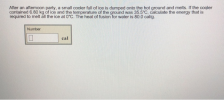 After an afternoon party, a small cooler full of ice is dumped onto the hot ground and melts. If the cooler contained 6.80 kg of ice and the temperature of the ground was 35.5℃, calculate the energy that is required to melt all the ice at 0°C. The heat of fusion for water is 80.0 cal/lg Number cal
Question 5 of 14 After an afternoon party, a small cooler full of ice is dumped...
 Question 5 of 14 After an afternoon party, a small cooler full of ice is dumped onto the hot ground and melts. If the cooler contained 4.50 kg of ice and the temperature of the ground was 36.5 °C, calculate the energy that is required to melt all the ice at 0 °C. The heat of fusion for water is 80.0 cal/g. energy required:
Solid ice melts at 0 °C and has a latent heat of fusion of 333 kJ/kg....
 Solid ice melts at 0 °C and has a latent heat of fusion of 333 kJ/kg. How much heat is required to first melt 0.02 kg of ice into water at 0 °C, and then increasing the temperature of the water from 0 °C to 16.6 °C? (C=4186 J/kg.Cº] Heat of fusion Le Water (all liquid) Water and ice Ice at 0 °C water at 0 °C Answer: J kJ Next page Online Quizlenlaces the crada oficinss. Send message
4:162 4:16 latencom login.physicscurriculum.com Calorimetry ** A 53.0 g ice cube, initially at 0.00 °C, is...
 4:162 4:16 latencom login.physicscurriculum.com Calorimetry ** A 53.0 g ice cube, initially at 0.00 °C, is dropped into a Styrofoam cup containing 373 g of water, initially at 29.0 °C. What is the final temperature of the water, if no heat is transferred to the Styrofoam or the surroundings? The latent heat of melting for ice is 79.7 cal/g. Part 1 + Give the equation used for finding the heat required to melt an object of mass m and with...
 Main Menu Contents Course Content - Styrofoam Cooler • T otes verdade Print Info A styrofoam cooler (K = .030 W/m° C) has outside dimensions of 0.170 m x 0.210 mx 0.340 m, and an average thickness of 3.0 cm. About how long will it take for 2.60 kg of ice at 0° to melt in the cooler if the outside temperature is 24.0°? Som A Thes 0/20 e Post Discussion Send Feedback
 After an afternoon party, a small cooler full of ice is dumped onto the hot ground and melts. If the cooler contained 6.80 kg of ice and the temperature of the ground was 35.5℃, calculate the energy that is required to melt all the ice at 0°C. The heat of fusion for water is 80.0 cal/lg Number cal
 Question 5 of 14 After an afternoon party, a small cooler full of ice is dumped onto the hot ground and melts. If the cooler contained 4.50 kg of ice and the temperature of the ground was 36.5 °C, calculate the energy that is required to melt all the ice at 0 °C. The heat of fusion for water is 80.0 cal/g. energy required:
 Solid ice melts at 0 °C and has a latent heat of fusion of 333 kJ/kg. How much heat is required to first melt 0.02 kg of ice into water at 0 °C, and then increasing the temperature of the water from 0 °C to 16.6 °C? (C=4186 J/kg.Cº] Heat of fusion Le Water (all liquid) Water and ice Ice at 0 °C water at 0 °C Answer: J kJ Next page Online Quizlenlaces the crada oficinss. Send message
 4:162 4:16 latencom login.physicscurriculum.com Calorimetry ** A 53.0 g ice cube, initially at 0.00 °C, is dropped into a Styrofoam cup containing 373 g of water, initially at 29.0 °C. What is the final temperature of the water, if no heat is transferred to the Styrofoam or the surroundings? The latent heat of melting for ice is 79.7 cal/g. Part 1 + Give the equation used for finding the heat required to melt an object of mass m and with...
Most questions answered within 3 hours.
-
Where is the error in this code sequence?
String s1 = "Hello";
String s2 = "ello";...
asked 10 months ago -
Financial data for Joel de Paris, Inc., for last year
follow:
Joel de Paris, Inc.
Balance...
asked 10 months ago -
Consider this reaction:
Al2(SO4)3 (aq)+ BaCl3
(aq) Al2Cl6 (aq)- +
3BaSO4(s) . What is the...
asked 10 months ago -
Suppose that Savneet is considering increasing her
recent random sample from 20 car rentals to 40...
asked 10 months ago -
Trucks arrive at an unloading terminal at an average rate of 120
per hour.
Trucks arrive...
asked 10 months ago -
Why are methanol and ethanol completely soluble in water while
octanol is not very little soluble....
asked 10 months ago -
A facilities manager at a university reads in a research report
that the mean amount of...
asked 10 months ago -
When the CuSO4 is rehydrated by adding water to the anhydrous
compound, is this an endothermic...
asked 10 months ago -
A ray of sunlight is passing from diamond into crown glass; the
angle of incidence is...
asked 10 months ago -
A block of mass 0.249 kg is placed on top of a light, vertical
spring of...
asked 10 months ago -
how do the kidneys compensate in the presences of acidosis
a) trigger hyperventilate
b) reserve acid...
asked 10 months ago -
Question 501 pts
The rental rate of capital to the firm increases. Which of the
following...
asked 10 months ago