Refer to the
normal-form game of price competition shown below.
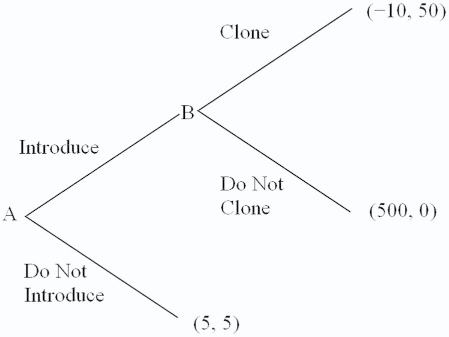
Firm A must decide whether or not to introduce a new product. If
firm A introduces a new product, firm B must decide whether or not
to clone the product. The payoff structure of the game is depicted
in Figure 10-12. The subgame perfect Nash equilibrium to this game
is:
Multiple Choice
-
A. Firm A plays "Introduce"; firm B plays "Clone" if firm A plays "Introduce."
-
B. Firm A plays "Do Not Introduce"; firm B plays "Clone" if firm A plays "Introduce."
-
C. Firm A plays "Introduce"; firm B plays "Do Not Clone" if firm A plays "Introduce."
-
D. Firm A plays "Do Not Introduce"; firm B plays "Do Not Clone" if firm A plays "Introduce."
Homework Answers
Sequential game are solved by backward induction
Thus we know player B will play Clone on its turn
knowing this player 1 will play Donot introduce
Thus ans is B
Add Answer to:
Refer to the
normal-form game of price competition shown below.
Firm A must decide whether or...
2. Your firm must decide whether or not to introduce a new product. If you introduce the new prod...
 Please answer all the questions and show work for the
first one. Thank you
2. Your firm must decide whether or not to introduce a new product. If you introduce the new product, your rival will have to decide where to copy (clone), the new product or not. If you don't introduce the new product, you and your rival earn $10 million each. If you introduce the new product, and your rival clones it, you will lose $5 million and...
Please answer all the questions and show work for the
first one. Thank you
2. Your firm must decide whether or not to introduce a new product. If you introduce the new product, your rival will have to decide where to copy (clone), the new product or not. If you don't introduce the new product, you and your rival earn $10 million each. If you introduce the new product, and your rival clones it, you will lose $5 million and...
Game: Extensive Form. Suppose player 1 chooses G or H, and player 2 observes this choice....
Game: Extensive Form. Suppose player 1 chooses G or H, and player 2 observes this choice. If player 1 chooses H, then player 2 must choose A or B. Player 1 does not get to observe this choice by player 2, and must then choose X or Y. If A and X are played, the payoff for player 1 is 1 and for player 2 it's 5. If A and Y are played, the payoff for player 1 is 6...
Consider the following normal form game: U D LR 7,7 4,8 8,4 5,5 a. Are there...
 Consider the following normal form game: U D LR 7,7 4,8 8,4 5,5 a. Are there dominant actions for any of the players? b. Find all Nash equilibria of this game. c. Suppose we repeat this game 10 times, specify a subgame perfect equi- librium of this finitely repeated game. d. Suppose this game is repeated infinitely: Identify a subgame perfect equilibrium of this game which gives an average (normalized) dis- counted payoff of 7 to both players. Clearly identify...
1. Consider the following normal form game: 112 L CR T 10 102 12 0 13...
 1. Consider the following normal form game: 112 L CR T 10 102 12 0 13 M 12 25 5 0 0 B|13 010 011 a) (Level A) First suppose this game is played only once. What are the pure strategy Nash equilibria? (b) (Level B) Now suppose this game is played twice. Players observe the actions chosen in the first period prior to the second period. Each player's total payoff is the sum of his/her payoff in the two...
1. Consider the following normal form game 112 L CR T|10 1012 1210 13 M 12...
 1. Consider the following normal form game 112 L CR T|10 1012 1210 13 M 12 25 5 0 (0 B113 0100 (a) (Level A) First suppose this game is played only once. What are the pure strategy Nash equilibria? (b) (Level B) Now suppose this game is played twice. Players observe the actions chosen in the first period prior to the second period. Each player's total payoff is the sum of his/her payoff in the two periods. Consider the...
Nsider the Game of Chicken depicted in the figure below, in which t each other must decide whethe...
 need d, e and f answered. first picture is just for reference to
the questions.
nsider the Game of Chicken depicted in the figure below, in which t each other must decide whether or not to swerve. Player 2 Straight Swerve Player 1 Straight 0, 0 Swerve1,3 3, 1 2, 2 have a strictly dominant strategy? What about Player 2? best responses for Player 1? And for Player 2? any pure strategy Nash Equilibrium (psNE) in this game? d. Find...
need d, e and f answered. first picture is just for reference to
the questions.
nsider the Game of Chicken depicted in the figure below, in which t each other must decide whether or not to swerve. Player 2 Straight Swerve Player 1 Straight 0, 0 Swerve1,3 3, 1 2, 2 have a strictly dominant strategy? What about Player 2? best responses for Player 1? And for Player 2? any pure strategy Nash Equilibrium (psNE) in this game? d. Find...
Refer to the normal-form game of advertising shown below. Firm A Firm B Advertise Do Not Advertise Advertise...
Refer to the normal-form game of advertising shown below. Firm A Firm B Advertise Do Not Advertise Advertise $0,$0 $175,$10 Do Not Advertise $10,$175 $125,$125 Consider the advertising game in Figure 10-17. Firms A and B know the game will be played for exactly five periods. What is a Nash equilibrium to this game? {advertise, do not advertise} {advertise, advertise} {do not advertise, do not advertise} provided the interest rate is less than 0.10 percent {advertise, advertise} provided the interest...
Refer to the following normal form game of price competition. Firm B Low Price Low Price...
 Refer to the following normal form game of price competition. Firm B Low Price Low Price 0,0 Firm A High Price -2, 17 High Price 17,-2 9,9 Suppose the game is infinitely repeated, and the interest rate is 10%. Both firms agree to charge a high price, provided no player has charged a low price in the past. If both firms stick to this agreement, then the present value of Firm A's payoffs are: $0.82 $9 $99 $187
Refer to the following normal form game of price competition. Firm B Low Price High Price...
 Refer to the following normal form game of price competition. Firm B Low Price High Price 17,-2 Firm A Low Price High Price 0,0 -2, 17 9,9 What is the maximum interest rate than can sustain collusion? 24.3% 12.5% 78.5% 112.5%
5. Suppose two firms A and B must decide whether to charge low or high price...
5. Suppose two firms A and B must decide whether to charge low or high price for a product. If both firms charge high price each firm earns a profit of 10. If both firms charge a low price, each firm earns zero profit. If firm A charges a low price while firm B charges a high price, firm A earns a profit of 50 while firm B has a loss of 10. If firm B charges a low price...
 Please answer all the questions and show work for the
first one. Thank you
2. Your firm must decide whether or not to introduce a new product. If you introduce the new product, your rival will have to decide where to copy (clone), the new product or not. If you don't introduce the new product, you and your rival earn $10 million each. If you introduce the new product, and your rival clones it, you will lose $5 million and...
Please answer all the questions and show work for the
first one. Thank you
2. Your firm must decide whether or not to introduce a new product. If you introduce the new product, your rival will have to decide where to copy (clone), the new product or not. If you don't introduce the new product, you and your rival earn $10 million each. If you introduce the new product, and your rival clones it, you will lose $5 million and...
 Consider the following normal form game: U D LR 7,7 4,8 8,4 5,5 a. Are there dominant actions for any of the players? b. Find all Nash equilibria of this game. c. Suppose we repeat this game 10 times, specify a subgame perfect equi- librium of this finitely repeated game. d. Suppose this game is repeated infinitely: Identify a subgame perfect equilibrium of this game which gives an average (normalized) dis- counted payoff of 7 to both players. Clearly identify...
 1. Consider the following normal form game: 112 L CR T 10 102 12 0 13 M 12 25 5 0 0 B|13 010 011 a) (Level A) First suppose this game is played only once. What are the pure strategy Nash equilibria? (b) (Level B) Now suppose this game is played twice. Players observe the actions chosen in the first period prior to the second period. Each player's total payoff is the sum of his/her payoff in the two...
 1. Consider the following normal form game 112 L CR T|10 1012 1210 13 M 12 25 5 0 (0 B113 0100 (a) (Level A) First suppose this game is played only once. What are the pure strategy Nash equilibria? (b) (Level B) Now suppose this game is played twice. Players observe the actions chosen in the first period prior to the second period. Each player's total payoff is the sum of his/her payoff in the two periods. Consider the...
 need d, e and f answered. first picture is just for reference to
the questions.
nsider the Game of Chicken depicted in the figure below, in which t each other must decide whether or not to swerve. Player 2 Straight Swerve Player 1 Straight 0, 0 Swerve1,3 3, 1 2, 2 have a strictly dominant strategy? What about Player 2? best responses for Player 1? And for Player 2? any pure strategy Nash Equilibrium (psNE) in this game? d. Find...
need d, e and f answered. first picture is just for reference to
the questions.
nsider the Game of Chicken depicted in the figure below, in which t each other must decide whether or not to swerve. Player 2 Straight Swerve Player 1 Straight 0, 0 Swerve1,3 3, 1 2, 2 have a strictly dominant strategy? What about Player 2? best responses for Player 1? And for Player 2? any pure strategy Nash Equilibrium (psNE) in this game? d. Find...
 Refer to the following normal form game of price competition. Firm B Low Price Low Price 0,0 Firm A High Price -2, 17 High Price 17,-2 9,9 Suppose the game is infinitely repeated, and the interest rate is 10%. Both firms agree to charge a high price, provided no player has charged a low price in the past. If both firms stick to this agreement, then the present value of Firm A's payoffs are: $0.82 $9 $99 $187
 Refer to the following normal form game of price competition. Firm B Low Price High Price 17,-2 Firm A Low Price High Price 0,0 -2, 17 9,9 What is the maximum interest rate than can sustain collusion? 24.3% 12.5% 78.5% 112.5%
Most questions answered within 3 hours.
-
Where is the error in this code sequence?
String s1 = "Hello";
String s2 = "ello";...
asked 11 months ago -
Financial data for Joel de Paris, Inc., for last year
follow:
Joel de Paris, Inc.
Balance...
asked 11 months ago -
Consider this reaction:
Al2(SO4)3 (aq)+ BaCl3
(aq) Al2Cl6 (aq)- +
3BaSO4(s) . What is the...
asked 11 months ago -
Suppose that Savneet is considering increasing her
recent random sample from 20 car rentals to 40...
asked 11 months ago -
Trucks arrive at an unloading terminal at an average rate of 120
per hour.
Trucks arrive...
asked 11 months ago -
Why are methanol and ethanol completely soluble in water while
octanol is not very little soluble....
asked 11 months ago -
A facilities manager at a university reads in a research report
that the mean amount of...
asked 11 months ago -
When the CuSO4 is rehydrated by adding water to the anhydrous
compound, is this an endothermic...
asked 11 months ago -
A ray of sunlight is passing from diamond into crown glass; the
angle of incidence is...
asked 11 months ago -
A block of mass 0.249 kg is placed on top of a light, vertical
spring of...
asked 11 months ago -
how do the kidneys compensate in the presences of acidosis
a) trigger hyperventilate
b) reserve acid...
asked 11 months ago -
Question 501 pts
The rental rate of capital to the firm increases. Which of the
following...
asked 11 months ago