
Homework Answers
Question 10
The substrate that yeast use for alcoholic fermentation is glucose which is oxidized to produce ethanol and carbon dioxide.

Question 12
The carbon dioxide gas is the product of alcholic fermentation that we measure in the experiment. The carbon dioxide is the by product of alcholic fermentation by yeast.
Question 13
I. Metaphase
II. Anaphase
III. Prophase
Add Answer to:
10. Describe the substrate that yeasts use for alcoholic fermentation. (3 points) 11. Which product of...
EXERCISE 5B CELLULAR RESPIRATION Alcoholic Fermentation by Yeast OBJECTIVES the completion of thi...
 EXERCISE 5B CELLULAR RESPIRATION Alcoholic Fermentation by Yeast OBJECTIVES the completion of this exercise the student should be able to Upon 1 distinguish between the dependent and independent variables in a controlled experiment. . formulate a basic hypothesis. measure the volume of carbon dioxide generated by anacrobic fermentation in baker's 3. yeast. 4. express data in tabular form. 5, relate data generated in an experiment to a hypothesis previously formulated 6. graph data, calculate the slope of a line, and...
just the prelab worksheet, no data yet Lab Six: Fermentation Learning Objectives: • Explain the biochemistry...
 just the prelab worksheet, no data yet
Lab Six: Fermentation Learning Objectives: • Explain the biochemistry of fermentation, substrates and products, conditions, and purpose for cells • Describe alcoholic fermentation of yeast, naming reactants and products Perform a pre-designed experiment to measure the rate of yeast fermentation of glucose under two different conditions. Propose hypotheses and make predictions based on them. Design and perform a novel experiment to test additional substrates for yeast fermentation using findings of the pre-designed experiment....
just the prelab worksheet, no data yet
Lab Six: Fermentation Learning Objectives: • Explain the biochemistry of fermentation, substrates and products, conditions, and purpose for cells • Describe alcoholic fermentation of yeast, naming reactants and products Perform a pre-designed experiment to measure the rate of yeast fermentation of glucose under two different conditions. Propose hypotheses and make predictions based on them. Design and perform a novel experiment to test additional substrates for yeast fermentation using findings of the pre-designed experiment....
pay no attention to the numbers that it is labeled just do down the list from...
 pay
no attention to the numbers that it is labeled just do down the
list from top to bottom
Alternate Energy Molecules 27) Where do fatty acids enter the aerobic respiration cycle? 28) Where do proteins enter the aerobic respiration cycle? 29) Why can proteins enter the respiration pathway in several places? 30) What extra waste is produced from protein breakdown? Anaerobic Respiration 31) Who does anaerobic respiration? 32) Define obligate anaerobe: 33) How much ATP does anaerobic respiration produce?...
pay
no attention to the numbers that it is labeled just do down the
list from top to bottom
Alternate Energy Molecules 27) Where do fatty acids enter the aerobic respiration cycle? 28) Where do proteins enter the aerobic respiration cycle? 29) Why can proteins enter the respiration pathway in several places? 30) What extra waste is produced from protein breakdown? Anaerobic Respiration 31) Who does anaerobic respiration? 32) Define obligate anaerobe: 33) How much ATP does anaerobic respiration produce?...
Question 10 3 pts Carbon dioxide is a reactant in: O replication photosynthesis fermentation Question 11 3 pts Predict...
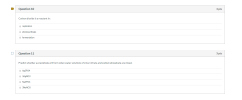 Question 10 3 pts Carbon dioxide is a reactant in: O replication photosynthesis fermentation Question 11 3 pts Predict whether a precipitate will form when water solutions of silver nitrate and sodium phosphate are mixed. Ag3PO4 3AgNO3 Na3PO4 3NaNO3 Question 12 3 pts Oxygen is a product in: aerobic cellular respiration fermentation photosynthesis Question 13 3 pts Which of the following molecules are classified as air pollutants and as emissions coming out of your car's tailpipe? CO2 and H2O vapor...
Help with 1,3 and 4 just answer please short answer Ex. 10 and 11 Questions 1....
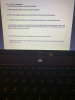 Help with 1,3 and 4 just answer please short answer
Ex. 10 and 11 Questions 1. Which bacterial species produce(s) amylase? 2. Which bacterial species do not produce amylase? 3. Which fermentation pathway does Escherichia coli use to ferment glucose? 4. Which fermentation pathway does Enterobacter aerogenes use to ferment glucose? 5. Enterobacter aerogenes inoculated into a glucose fermentation tube often gives a weak acid result (orange-yellow) with a very large bubble in the Durham tube. If it ferments glucose,...
Help with 1,3 and 4 just answer please short answer
Ex. 10 and 11 Questions 1. Which bacterial species produce(s) amylase? 2. Which bacterial species do not produce amylase? 3. Which fermentation pathway does Escherichia coli use to ferment glucose? 4. Which fermentation pathway does Enterobacter aerogenes use to ferment glucose? 5. Enterobacter aerogenes inoculated into a glucose fermentation tube often gives a weak acid result (orange-yellow) with a very large bubble in the Durham tube. If it ferments glucose,...
11. The solubility product constant for aluminum hydroxide (Al(OH)3) is 3.0 x 10”. Use the information...
 11. The solubility product constant for aluminum hydroxide (Al(OH)3) is 3.0 x 10”. Use the information to calculate the molar solubility of Aluminum hydroxide in: (a) pure water (6 points) 0.80 M KOH solution (4 points) 12. 20.0 mL of a 0.200 mol L solution of a metal ion M is mixed with 20.0 mL of a 0.300 mol I'' solution of a substance L. The following equilibrium is established: M (aq) + 2L (aq) + ML(aq) At equilibrium the...
transpo oprtn and logistics managment/ please use excel Problem 11. (10 marks) The accompanying data are the travel...
 transpo oprtn and logistics managment/ please use excel
Problem 11. (10 marks) The accompanying data are the travel times (min) on an arterial street collected by ten test vehicles. Vehicle 5 6 7 1 2 3 4 9 10 16 10 1 22 Travel Time (min) 10 14 9 10 12 11 Use Excel for Analysis a. Calculate the values of the sample mean, median, and mode b. From the relative locations of the above summary statistics, can you conjecture...
transpo oprtn and logistics managment/ please use excel
Problem 11. (10 marks) The accompanying data are the travel times (min) on an arterial street collected by ten test vehicles. Vehicle 5 6 7 1 2 3 4 9 10 16 10 1 22 Travel Time (min) 10 14 9 10 12 11 Use Excel for Analysis a. Calculate the values of the sample mean, median, and mode b. From the relative locations of the above summary statistics, can you conjecture...
Bio 121 I need to make (yeast fermentation) lab report. This is the lab experiment and...
 Bio 121
I need to make (yeast fermentation) lab
report.
This is the lab experiment and results:
This is a guide to making the lab report:
General Biology BIO121 Yeast Fermentation Lab Introduction Organisms stay alive by the utilization of energy through metabolism. The energy acquiring pathways in photosynthesis convert radiant energy from the sun into the chemical bond energy of carbohydrates. This photosynthetic process is limited to the producers or autotrophs, which include plants, photosynthetic bacteria and some protists....
Bio 121
I need to make (yeast fermentation) lab
report.
This is the lab experiment and results:
This is a guide to making the lab report:
General Biology BIO121 Yeast Fermentation Lab Introduction Organisms stay alive by the utilization of energy through metabolism. The energy acquiring pathways in photosynthesis convert radiant energy from the sun into the chemical bond energy of carbohydrates. This photosynthetic process is limited to the producers or autotrophs, which include plants, photosynthetic bacteria and some protists....
Problem 10 (3 points): Assume that you are using qPCR to determine the amount of DNA...
Problem 10 (3 points): Assume that you are using qPCR to determine the amount of DNA in a given sample. Your calibration sample, which contained an amount of 10-15 mol, required 12 PCR cycles to reach a specific level of PCR product. Your cell sample with an unknown DNA amount required only 9 PCR cycles to reach the same level. How many moles of DNA did the cell sample contain? Describe how you arrived at that conclusion.
In the figure, which number produces haploid gametes by mitosis? 1 2 3 4 In the...
 In the figure, which number produces haploid gametes by mitosis? 1 2 3 4 In the figure, which structure produces haploid spores by meiosis? 1 2 3 4 If four of the original colonists died before they produced offspring, the ratios of genotypes could be quite different in the subsequent generations. This would be an example of diploidy. gene flow, genetic drift. disruptive selection. stabilizing selection. Each of the following questions have a 3.points value: Please use the following information...
 EXERCISE 5B CELLULAR RESPIRATION Alcoholic Fermentation by Yeast OBJECTIVES the completion of this exercise the student should be able to Upon 1 distinguish between the dependent and independent variables in a controlled experiment. . formulate a basic hypothesis. measure the volume of carbon dioxide generated by anacrobic fermentation in baker's 3. yeast. 4. express data in tabular form. 5, relate data generated in an experiment to a hypothesis previously formulated 6. graph data, calculate the slope of a line, and...
 just the prelab worksheet, no data yet
Lab Six: Fermentation Learning Objectives: • Explain the biochemistry of fermentation, substrates and products, conditions, and purpose for cells • Describe alcoholic fermentation of yeast, naming reactants and products Perform a pre-designed experiment to measure the rate of yeast fermentation of glucose under two different conditions. Propose hypotheses and make predictions based on them. Design and perform a novel experiment to test additional substrates for yeast fermentation using findings of the pre-designed experiment....
just the prelab worksheet, no data yet
Lab Six: Fermentation Learning Objectives: • Explain the biochemistry of fermentation, substrates and products, conditions, and purpose for cells • Describe alcoholic fermentation of yeast, naming reactants and products Perform a pre-designed experiment to measure the rate of yeast fermentation of glucose under two different conditions. Propose hypotheses and make predictions based on them. Design and perform a novel experiment to test additional substrates for yeast fermentation using findings of the pre-designed experiment....
 pay
no attention to the numbers that it is labeled just do down the
list from top to bottom
Alternate Energy Molecules 27) Where do fatty acids enter the aerobic respiration cycle? 28) Where do proteins enter the aerobic respiration cycle? 29) Why can proteins enter the respiration pathway in several places? 30) What extra waste is produced from protein breakdown? Anaerobic Respiration 31) Who does anaerobic respiration? 32) Define obligate anaerobe: 33) How much ATP does anaerobic respiration produce?...
pay
no attention to the numbers that it is labeled just do down the
list from top to bottom
Alternate Energy Molecules 27) Where do fatty acids enter the aerobic respiration cycle? 28) Where do proteins enter the aerobic respiration cycle? 29) Why can proteins enter the respiration pathway in several places? 30) What extra waste is produced from protein breakdown? Anaerobic Respiration 31) Who does anaerobic respiration? 32) Define obligate anaerobe: 33) How much ATP does anaerobic respiration produce?...
 Question 10 3 pts Carbon dioxide is a reactant in: O replication photosynthesis fermentation Question 11 3 pts Predict whether a precipitate will form when water solutions of silver nitrate and sodium phosphate are mixed. Ag3PO4 3AgNO3 Na3PO4 3NaNO3 Question 12 3 pts Oxygen is a product in: aerobic cellular respiration fermentation photosynthesis Question 13 3 pts Which of the following molecules are classified as air pollutants and as emissions coming out of your car's tailpipe? CO2 and H2O vapor...
 Help with 1,3 and 4 just answer please short answer
Ex. 10 and 11 Questions 1. Which bacterial species produce(s) amylase? 2. Which bacterial species do not produce amylase? 3. Which fermentation pathway does Escherichia coli use to ferment glucose? 4. Which fermentation pathway does Enterobacter aerogenes use to ferment glucose? 5. Enterobacter aerogenes inoculated into a glucose fermentation tube often gives a weak acid result (orange-yellow) with a very large bubble in the Durham tube. If it ferments glucose,...
Help with 1,3 and 4 just answer please short answer
Ex. 10 and 11 Questions 1. Which bacterial species produce(s) amylase? 2. Which bacterial species do not produce amylase? 3. Which fermentation pathway does Escherichia coli use to ferment glucose? 4. Which fermentation pathway does Enterobacter aerogenes use to ferment glucose? 5. Enterobacter aerogenes inoculated into a glucose fermentation tube often gives a weak acid result (orange-yellow) with a very large bubble in the Durham tube. If it ferments glucose,...
 11. The solubility product constant for aluminum hydroxide (Al(OH)3) is 3.0 x 10”. Use the information to calculate the molar solubility of Aluminum hydroxide in: (a) pure water (6 points) 0.80 M KOH solution (4 points) 12. 20.0 mL of a 0.200 mol L solution of a metal ion M is mixed with 20.0 mL of a 0.300 mol I'' solution of a substance L. The following equilibrium is established: M (aq) + 2L (aq) + ML(aq) At equilibrium the...
 transpo oprtn and logistics managment/ please use excel
Problem 11. (10 marks) The accompanying data are the travel times (min) on an arterial street collected by ten test vehicles. Vehicle 5 6 7 1 2 3 4 9 10 16 10 1 22 Travel Time (min) 10 14 9 10 12 11 Use Excel for Analysis a. Calculate the values of the sample mean, median, and mode b. From the relative locations of the above summary statistics, can you conjecture...
transpo oprtn and logistics managment/ please use excel
Problem 11. (10 marks) The accompanying data are the travel times (min) on an arterial street collected by ten test vehicles. Vehicle 5 6 7 1 2 3 4 9 10 16 10 1 22 Travel Time (min) 10 14 9 10 12 11 Use Excel for Analysis a. Calculate the values of the sample mean, median, and mode b. From the relative locations of the above summary statistics, can you conjecture...
 Bio 121
I need to make (yeast fermentation) lab
report.
This is the lab experiment and results:
This is a guide to making the lab report:
General Biology BIO121 Yeast Fermentation Lab Introduction Organisms stay alive by the utilization of energy through metabolism. The energy acquiring pathways in photosynthesis convert radiant energy from the sun into the chemical bond energy of carbohydrates. This photosynthetic process is limited to the producers or autotrophs, which include plants, photosynthetic bacteria and some protists....
Bio 121
I need to make (yeast fermentation) lab
report.
This is the lab experiment and results:
This is a guide to making the lab report:
General Biology BIO121 Yeast Fermentation Lab Introduction Organisms stay alive by the utilization of energy through metabolism. The energy acquiring pathways in photosynthesis convert radiant energy from the sun into the chemical bond energy of carbohydrates. This photosynthetic process is limited to the producers or autotrophs, which include plants, photosynthetic bacteria and some protists....
 In the figure, which number produces haploid gametes by mitosis? 1 2 3 4 In the figure, which structure produces haploid spores by meiosis? 1 2 3 4 If four of the original colonists died before they produced offspring, the ratios of genotypes could be quite different in the subsequent generations. This would be an example of diploidy. gene flow, genetic drift. disruptive selection. stabilizing selection. Each of the following questions have a 3.points value: Please use the following information...
Most questions answered within 3 hours.
-
Where is the error in this code sequence?
String s1 = "Hello";
String s2 = "ello";...
asked 10 months ago -
Financial data for Joel de Paris, Inc., for last year
follow:
Joel de Paris, Inc.
Balance...
asked 10 months ago -
Consider this reaction:
Al2(SO4)3 (aq)+ BaCl3
(aq) Al2Cl6 (aq)- +
3BaSO4(s) . What is the...
asked 10 months ago -
Suppose that Savneet is considering increasing her
recent random sample from 20 car rentals to 40...
asked 10 months ago -
Trucks arrive at an unloading terminal at an average rate of 120
per hour.
Trucks arrive...
asked 10 months ago -
Why are methanol and ethanol completely soluble in water while
octanol is not very little soluble....
asked 10 months ago -
A facilities manager at a university reads in a research report
that the mean amount of...
asked 10 months ago -
When the CuSO4 is rehydrated by adding water to the anhydrous
compound, is this an endothermic...
asked 10 months ago -
A ray of sunlight is passing from diamond into crown glass; the
angle of incidence is...
asked 10 months ago -
A block of mass 0.249 kg is placed on top of a light, vertical
spring of...
asked 10 months ago -
how do the kidneys compensate in the presences of acidosis
a) trigger hyperventilate
b) reserve acid...
asked 10 months ago -
Question 501 pts
The rental rate of capital to the firm increases. Which of the
following...
asked 10 months ago