
Homework Answers
Add Answer to:
Number 5 final
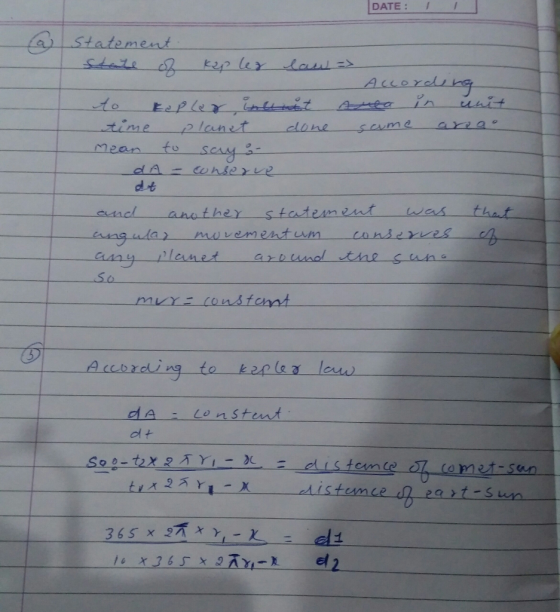
This problem is on gravitation. a) State the Kepler law? b) A comet...
For the purposes of this problem, use the following data: mass of Comet 67P is 1...
 For the purposes of this problem, use the following data: mass of Comet 67P is 1 times 10^13 kg; radius of Comet 67P is 2.30 km; mass of Philae = 100 kg; mass of Rosetta = 1000 kg; radius of Rosetta's orbit was 22.3 km (a) What is the acceleration due to gravity on the surface of the comet, where Philae is? m/s^2 (b) What is the escape speed at the surface of the comet? This is the speed above...
Newton's law of universal gravitation strictly applies to perfectly spherical bodies. Many celestial bodies, like the...
Newton's law of universal gravitation strictly applies to perfectly spherical bodies. Many celestial bodies, like the Sun and Earth, are not perfect spheres. This has a measureable effect on the trajectories of orbiting satellites. Restricting attention to equatorial orbits, the gravity law can be corrected in a simple way to account for the Sun's imperfect shape. →Fg=−GMmr2(1+3J2R22r2)^rF→g=−GMmr2(1+3J2R22r2)r^ where G=6.67×10⁻¹¹ N⋅m2/kg2G=6.67×10−11 N⋅m2/kg2 is the universal gravitation constant, M=1990000 kgM=1990000 kg is the mass of the Sun, mm is the mass of...
Question 4 of 5 > Check out the graphic of a comet orbiting the sun. Answer...
 Question 4 of 5 > Check out the graphic of a comet orbiting the sun. Answer the three questions below using three significant digits. Part A: At what point in the orbit is the comet moving the fastest? OOOO Part B: At what point in the orbit is the force of gravity between the sun and the comet the least? ОА OD Oc OB Part C: Let F and r correspond to the gravitational force acting on the comet at...
I need some help with these final problems please! 9. (a) Find the centripetal acceleration on...
 I need some help with these final problems please!
9. (a) Find the centripetal acceleration on a 2000 kg car travelling with a speed of 25 mph around a curve of 35 m. A banked curve makes an angle of 30° with the horizontal. Find the centripetal acceleration of this banked curve. (b) 10. (a) Find the force of attraction between the earth and the sun using the Newton's law of Universal Gravitation and the following: Mass of the earth...
I need some help with these final problems please!
9. (a) Find the centripetal acceleration on a 2000 kg car travelling with a speed of 25 mph around a curve of 35 m. A banked curve makes an angle of 30° with the horizontal. Find the centripetal acceleration of this banked curve. (b) 10. (a) Find the force of attraction between the earth and the sun using the Newton's law of Universal Gravitation and the following: Mass of the earth...
Please help me out with this assignment as soon as possible Thabk You Ch.5 -Circular Motion...
 Please help me out with this assignment as soon as
possible
Thabk You
Ch.5 -Circular Motion
6. According to Newton's Law of Gravitation, if the distance between two bodies is doubled, the attractive force between them becomes ( twice as large. Show reasoning: 0 half as large. four times as large. ( one quarter as large. 0 unchanged. fourt Kepler's third law can be simplified to T/r=1 or Tar if the orbit period T is expressed in earth years and...
Please help me out with this assignment as soon as
possible
Thabk You
Ch.5 -Circular Motion
6. According to Newton's Law of Gravitation, if the distance between two bodies is doubled, the attractive force between them becomes ( twice as large. Show reasoning: 0 half as large. four times as large. ( one quarter as large. 0 unchanged. fourt Kepler's third law can be simplified to T/r=1 or Tar if the orbit period T is expressed in earth years and...
The orbit of a 1.5 ✕ 1010 kg comet around the Sun is elliptical, with an aphelion distance of 33.0 AU and...
The orbit of a 1.5 ✕ 1010 kg comet around the Sun is elliptical, with an aphelion distance of 33.0 AU and perihelion distance of 0.850 AU. (Note: 1 AU = one astronomical unit = the average distance from the Sun to the Earth = 1.496 ✕ 1011 m.) (a)What is its orbital eccentricity? (b)What is its period? (Enter your answer in yr.) (c)At aphelion what is the potential energy (in J) of the comet—Sun system?
Problem 2: Haley's Comet (A Real Life Example): Important: for this problem, complete all numerical work...
 Problem 2: Haley's Comet (A Real Life Example): Important: for this problem, complete all numerical work to a precision of at least six significant digits. Specifically: use the following precise values for astronomical constants: • Mass of the Sun = 1.98855 x 1030 kg • 1 AU = 149,597,870,700 meters . G=6.67384 x 10⁻¹¹ N·m²/kg? Neptune Uranus Saturn Jupiter 05 2000 2005 2000----1995 2010 19921989 1988 1987 2024 1986 2061 2040 2060 2045 2050 2055 2056 2057 2058 2059 In...
Chapter 13, Problem 049 Suppose that a comet that was seen in 613 A.D. by Chinese...
 Chapter 13, Problem 049 Suppose that a comet that was seen in 613 A.D. by Chinese astronomers was spotted again in year 1966. Assume the time between observations is the period of the comet and take its eccentricity as 0.981. What are (a) the semimajor axis of the comet's orbit and (b) its greatest distance from the Sun? (a) Number Units Units (b) Number
Most geologists believe that the dinosaurs became extinct 65 million years ago when a large comet...
Most geologists believe that the dinosaurs became extinct 65 million years ago when a large comet or asteroid struck the earth, throwing up so much dust that the sun was blocked out for a period of many months. Suppose an asteroid with a diameter of 5.0 km and a mass of 2.5*10^14 kg hits the earth with an impact speed of 4.0*10^4 m/s. Part A: What is the earth's recoil speed after such a collision? Assume that the mass of...
Most geologists believe that the dinosaurs became extinct 65 million years ago when a large comet...
Most geologists believe that the dinosaurs became extinct 65 million years ago when a large comet or asteroid struck the earth, throwing up so much dust that the sun was blocked out for a period of many months. Suppose an asteroid with a diameter of 2.0 km and a mass of 1.1 ×10¹³ kg hits the earth (6.0×1024 kg) with an impact speed of 4.5 ×10⁴ m/s. a. What is the earth’s recoil speed after such a collision? (Use a...
 For the purposes of this problem, use the following data: mass of Comet 67P is 1 times 10^13 kg; radius of Comet 67P is 2.30 km; mass of Philae = 100 kg; mass of Rosetta = 1000 kg; radius of Rosetta's orbit was 22.3 km (a) What is the acceleration due to gravity on the surface of the comet, where Philae is? m/s^2 (b) What is the escape speed at the surface of the comet? This is the speed above...
 Question 4 of 5 > Check out the graphic of a comet orbiting the sun. Answer the three questions below using three significant digits. Part A: At what point in the orbit is the comet moving the fastest? OOOO Part B: At what point in the orbit is the force of gravity between the sun and the comet the least? ОА OD Oc OB Part C: Let F and r correspond to the gravitational force acting on the comet at...
 I need some help with these final problems please!
9. (a) Find the centripetal acceleration on a 2000 kg car travelling with a speed of 25 mph around a curve of 35 m. A banked curve makes an angle of 30° with the horizontal. Find the centripetal acceleration of this banked curve. (b) 10. (a) Find the force of attraction between the earth and the sun using the Newton's law of Universal Gravitation and the following: Mass of the earth...
I need some help with these final problems please!
9. (a) Find the centripetal acceleration on a 2000 kg car travelling with a speed of 25 mph around a curve of 35 m. A banked curve makes an angle of 30° with the horizontal. Find the centripetal acceleration of this banked curve. (b) 10. (a) Find the force of attraction between the earth and the sun using the Newton's law of Universal Gravitation and the following: Mass of the earth...
 Please help me out with this assignment as soon as
possible
Thabk You
Ch.5 -Circular Motion
6. According to Newton's Law of Gravitation, if the distance between two bodies is doubled, the attractive force between them becomes ( twice as large. Show reasoning: 0 half as large. four times as large. ( one quarter as large. 0 unchanged. fourt Kepler's third law can be simplified to T/r=1 or Tar if the orbit period T is expressed in earth years and...
Please help me out with this assignment as soon as
possible
Thabk You
Ch.5 -Circular Motion
6. According to Newton's Law of Gravitation, if the distance between two bodies is doubled, the attractive force between them becomes ( twice as large. Show reasoning: 0 half as large. four times as large. ( one quarter as large. 0 unchanged. fourt Kepler's third law can be simplified to T/r=1 or Tar if the orbit period T is expressed in earth years and...
 Problem 2: Haley's Comet (A Real Life Example): Important: for this problem, complete all numerical work to a precision of at least six significant digits. Specifically: use the following precise values for astronomical constants: • Mass of the Sun = 1.98855 x 1030 kg • 1 AU = 149,597,870,700 meters . G=6.67384 x 10⁻¹¹ N·m²/kg? Neptune Uranus Saturn Jupiter 05 2000 2005 2000----1995 2010 19921989 1988 1987 2024 1986 2061 2040 2060 2045 2050 2055 2056 2057 2058 2059 In...
 Chapter 13, Problem 049 Suppose that a comet that was seen in 613 A.D. by Chinese astronomers was spotted again in year 1966. Assume the time between observations is the period of the comet and take its eccentricity as 0.981. What are (a) the semimajor axis of the comet's orbit and (b) its greatest distance from the Sun? (a) Number Units Units (b) Number
Most questions answered within 3 hours.
-
Where is the error in this code sequence?
String s1 = "Hello";
String s2 = "ello";...
asked 11 months ago -
Financial data for Joel de Paris, Inc., for last year
follow:
Joel de Paris, Inc.
Balance...
asked 11 months ago -
Consider this reaction:
Al2(SO4)3 (aq)+ BaCl3
(aq) Al2Cl6 (aq)- +
3BaSO4(s) . What is the...
asked 11 months ago -
Suppose that Savneet is considering increasing her
recent random sample from 20 car rentals to 40...
asked 11 months ago -
Trucks arrive at an unloading terminal at an average rate of 120
per hour.
Trucks arrive...
asked 11 months ago -
Why are methanol and ethanol completely soluble in water while
octanol is not very little soluble....
asked 11 months ago -
A facilities manager at a university reads in a research report
that the mean amount of...
asked 11 months ago -
When the CuSO4 is rehydrated by adding water to the anhydrous
compound, is this an endothermic...
asked 11 months ago -
A ray of sunlight is passing from diamond into crown glass; the
angle of incidence is...
asked 11 months ago -
A block of mass 0.249 kg is placed on top of a light, vertical
spring of...
asked 11 months ago -
how do the kidneys compensate in the presences of acidosis
a) trigger hyperventilate
b) reserve acid...
asked 11 months ago -
Question 501 pts
The rental rate of capital to the firm increases. Which of the
following...
asked 11 months ago