Colorblindness and Hemophilia A are X-linked recessive conditions. A woman heterozygous for hemophila mutation and a...
Colorblindness and Hemophilia A are X-linked recessive conditions. A woman heterozygous for hemophila mutation and a colorblind man have a son who is haemophilic and has Klinefelter's syndrome (XXY). Which of the following nondisjunction events is the most compatible with the situation described? Please provide an explanation
a. meiosis I, mother
b. meiosis II, mother
c. meiosis I, father
d. meiosis II, father
e. a and b
Homework Answers
Ans. E (a and b)
A woman heterozygous for hemophila mutation and a colorblind man have a son is haemophilic and has Klinefelters syndrome (XXY).
haemophilia is a X-linked recessive disorder- these disorders are never passed from father to son.
in the X-linked recessive conditions A Hetrozygous mother acts as carriers and transmit this trait to half of their sons, and it is never passed from father to son.
so in the above case son is haemophilic means trait come from the mother.
in the process of cell cycle the normal separation of chromosomes and sister chromatids in meiosis I and Meiosis II recepctively is termed as disjunction.when this segregation is not normal then it is called as nondisjunction results production of gametes which have unusual number of chromosomes and is a common mechanism for the production of trisomy or monosomy. Nondisjunction is the process can occur either in meiosis I or meiosis II phases of cell cycle.
here is the example of the nondisjunction event of the one X-chromosome during meiosis I in the female leads to production of XXY Karyotype.
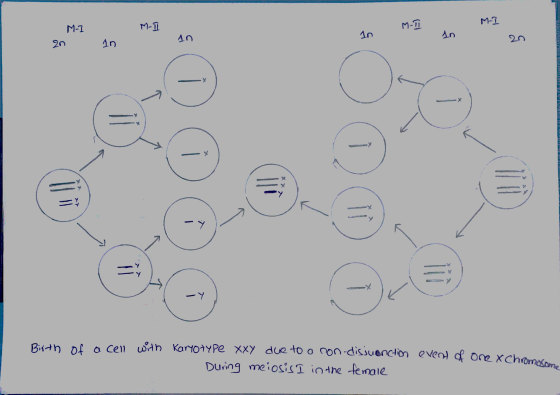
this kind of nondisjunction may occur in Meiosis II also.
Add Answer to:
Colorblindness and Hemophilia A are X-linked recessive
conditions. A woman heterozygous for hemophila mutation and a...
Two normal parents have a son with hemophilia (an X-linked recessive disorder) that also has Klinefelter...
Two normal parents have a son with hemophilia (an X-linked recessive disorder) that also has Klinefelter Syndrome. a. Write out the cross as described above illustrating the genotypes and phenotypes of the parents and child. b. Did the non-disjunction event occur in the mother, the father, or could have occurred in either of the two parents? c. Did the nondisjunction event occur during meiosis I, meiosis II, or could it have occurred in either division during meiosis.
Two normal parents have a daughter with hemophilia (an X-linked recessive disorder) that also has Turner...
Two normal parents have a daughter with hemophilia (an X-linked recessive disorder) that also has Turner Syndrome. a. Write out the cross as described above illustrating the genotypes and phenotypes of the parents and child. b. Did the non-disjunction event occur in the mother, the father, or could have occurred in either of the two parents? Did the nondisjunction event occur during meiosis I, meiosis II, or could it have occurred in either division during meiosis.
A woman with albinism (an X-linked recessive gene) has a child with a man who has...
A woman with albinism (an X-linked recessive gene) has a child with a man who has normal pigment. Their child has albinism with Klinefelter's syndrome (XXY). Where did the non-disjunction event occur? a.Could only have occurred in the mother b.Can't determine from the information given. c.Could only have occurred in the father d.Could have occurred in either the mother or the father
7. A colorblind woman and a man with normal vision have a son with Klineflter syndrome...
7. A colorblind woman and a man with normal vision have a son with Klineflter syndrome (XXY) who has normal vision. Determine the parent in whom nondisjuction occurs, and whether nondisjuction takes place in the first of second meiotic division. Colorblindness is an X-linked recessive trait. a. female meiosis I b. Either male meiosis I or II. c. male meiosis II d. female meiosis II e. male meiosis I
Color-blindness is an X-linked recessive condition. A man with normal vision and a woman who is...
Color-blindness is an X-linked recessive condition. A man with normal vision and a woman who is color-blind have a child with Turner Syndrome. This child has normal vision. Where did the non-disjunction occur? In meiosis I of the mother In meiosis II of the mother In meiosis I of the father In meiosis II of the father In either meiosis I or II of the mother.
A man with a pointed nose and a woman with a round nose have a son...
A man with a pointed nose and a woman with a round nose have a son with Klinefelter Syndrome (genotype XXY) with a pointed nose. Options for answers: Circle one for Father and for Mother: Nondisjunction Meiosis I Nondisjuction Meiosis II Neither Either I or II
3. In humans Red-Green colorblindness is due to an X-linked recessive allele. A woman was diagnosed...
 3. In humans Red-Green colorblindness is due to an X-linked recessive allele. A woman was diagnosed with colorblindness in her right eye, but nommal vision in her left eye. It is known that her father was colorblind and that her mother had normal vision. Explain how the phenomena of dosage compensation could explain this woman's condition.
Hemophilia B is an X-linked recessive trait that causes problems with blood-clotting. (2 pts) If a...
Hemophilia B is an X-linked recessive trait that causes problems with blood-clotting. (2 pts) If a normal man and a woman who is a carrier for hemophila decide to have children, what is the probability their first child will have hemophila? Please show your work using a Punnett Square. (3 pts) How would X inactivation in the woman described above (a carrier for hemophilia) affect her phenotype for hemophilia symptoms?
0.33334 points (Ext QUESTION 59 Red-green colorblindness is an X-linked recessive trait in humans. What is...
 0.33334 points (Ext QUESTION 59 Red-green colorblindness is an X-linked recessive trait in humans. What is the probability that a colorblind woman and a man with normal vision will have a colorblind son? 75 percent 50 percent 25 percent 0 percent
Hemophilia in humans is a recessive sex-linked trait. A man with hemophilia and a woman who...
Hemophilia in humans is a recessive sex-linked trait. A man with hemophilia and a woman who does not have hemophilia have a daughter who does not have hemophilia. She then marries a man who does not have hemophilia. What is the probability that their first child will be a daughter with hemophilia? A daughter without hemophilia? A son with hemophilia? A son without hemophilia? If the couple has four sons, what is the probability that all four will be born...
 3. In humans Red-Green colorblindness is due to an X-linked recessive allele. A woman was diagnosed with colorblindness in her right eye, but nommal vision in her left eye. It is known that her father was colorblind and that her mother had normal vision. Explain how the phenomena of dosage compensation could explain this woman's condition.
 0.33334 points (Ext QUESTION 59 Red-green colorblindness is an X-linked recessive trait in humans. What is the probability that a colorblind woman and a man with normal vision will have a colorblind son? 75 percent 50 percent 25 percent 0 percent
Most questions answered within 3 hours.
-
Where is the error in this code sequence?
String s1 = "Hello";
String s2 = "ello";...
asked 11 months ago -
Financial data for Joel de Paris, Inc., for last year
follow:
Joel de Paris, Inc.
Balance...
asked 11 months ago -
Consider this reaction:
Al2(SO4)3 (aq)+ BaCl3
(aq) Al2Cl6 (aq)- +
3BaSO4(s) . What is the...
asked 11 months ago -
Suppose that Savneet is considering increasing her
recent random sample from 20 car rentals to 40...
asked 11 months ago -
Trucks arrive at an unloading terminal at an average rate of 120
per hour.
Trucks arrive...
asked 11 months ago -
Why are methanol and ethanol completely soluble in water while
octanol is not very little soluble....
asked 11 months ago -
A facilities manager at a university reads in a research report
that the mean amount of...
asked 11 months ago -
When the CuSO4 is rehydrated by adding water to the anhydrous
compound, is this an endothermic...
asked 11 months ago -
A ray of sunlight is passing from diamond into crown glass; the
angle of incidence is...
asked 11 months ago -
A block of mass 0.249 kg is placed on top of a light, vertical
spring of...
asked 11 months ago -
how do the kidneys compensate in the presences of acidosis
a) trigger hyperventilate
b) reserve acid...
asked 11 months ago -
Question 501 pts
The rental rate of capital to the firm increases. Which of the
following...
asked 11 months ago