T.H. Morgan also performed the following set of breeding experiments involving another mutant strain with yellow...
Homework Answers
Answer-
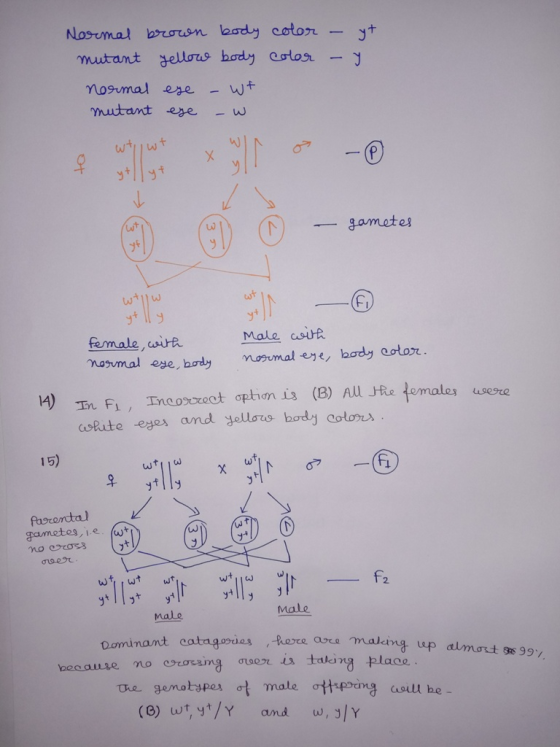
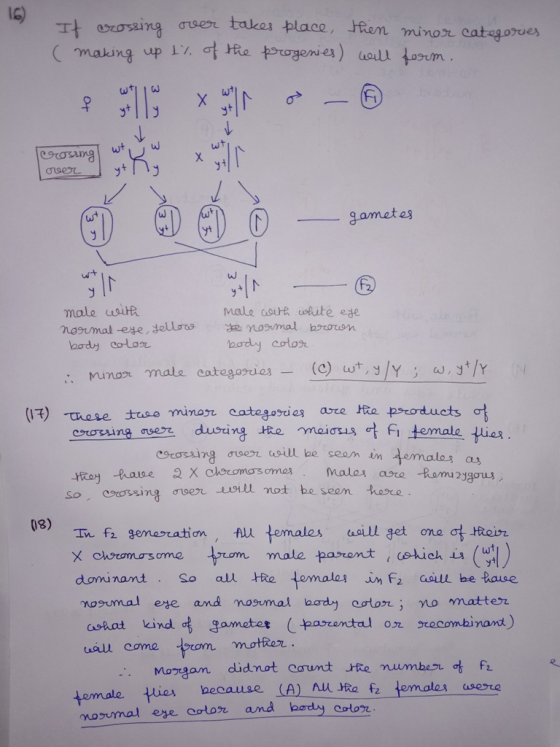
14) Incorrect option is B) All the females were white eyes and yellow body colors.
Explanation for all answers is provided below:
Add Answer to:
T.H. Morgan also performed the following set of breeding
experiments involving another mutant strain with yellow...
T.H. Morgan also performed the following set of breeding experiments involving another mutant strain with yellow...
T.H. Morgan also performed the following set of breeding experiments involving another mutant strain with yellow body colors, Xy, which is linked to X chromosome. The allele for the normal brown body color is indicated with Xy+. The interpretation of the breeding outcomes ended up discovering genetic linkage. P: female with normal eye and body color (w+,y+/w+,y+ x male with white eye and yellow body (w,y/Y) 16. He also saw two minor categories, making up 1%...
Normal eye color in flies is red. Mutant flies have brown eye color. Similarly, normal wing...
Normal eye color in flies is red. Mutant flies have brown eye color. Similarly, normal wing length is long. Mutant flies have short wings. A female true breeding fly with brown eyes and short wings is crossed with a true breeding male with red eyes and long wings. In the F1 the female flies are red eyed and long winged. The male flies are red eyed and short winged. F1 males are crossed to F1 females Both sexes of F2...
We crossed pure-bred female flies with yellow body and forked-shaped bristles with male flies extra bristles....
 We crossed pure-bred female flies with yellow body and
forked-shaped bristles with male flies extra bristles. The
subsequent F1 flies showed all normal phenotypes except that all of
the F1 males are yellow-body. We crossed again the normal F1
females with males homozygous for yellow body, extra bristles, and
forked bristles as a testcross. The number of each category of F2
progeny is shown below. The mutant allele for yellow body is y; the
mutant allele for extra bristles is...
We crossed pure-bred female flies with yellow body and
forked-shaped bristles with male flies extra bristles. The
subsequent F1 flies showed all normal phenotypes except that all of
the F1 males are yellow-body. We crossed again the normal F1
females with males homozygous for yellow body, extra bristles, and
forked bristles as a testcross. The number of each category of F2
progeny is shown below. The mutant allele for yellow body is y; the
mutant allele for extra bristles is...
In early 20th century, the inheritance pattern of two fly mutants (eye color, w+ or w;...
In early 20th century, the inheritance pattern of two fly mutants (eye color, w+ or w; body color, y+ or y) was used for discovering genetic linkage and crossing-over. Answer the following questions. P w+,y+/w+,y+ x w,y/Y F1 w+,y+/w,y x w+y+/Y F2 w+,y+/Y (Category 1) w,y/Y (Category 2) w+,y/Y (Category 3) w,y+/Y (Category 4) 6. Let’s assume you used the following breeding scheme at the P stage and repeated the entire experiments. Which is INCORRECT regarding...
Question 6: Imagine you a research student working in the lab of T.H. Morgan and are...
 Question 6: Imagine you a research student working in the lab of T.H. Morgan and are given the task of determining the recombination frequency of double mutants for eye color and wing type. You breed a female that is homozygous dominant for red eyes and normal wings with a male that has white eyes and vestigial wings. What phenotypes do you predict you will observe in the males of the F1 generation? a. All of the males will have white...
Experimental technique: Reciprocal crosses
 1)When Gregor Mendel conducted his genetic experiments with pea plants, he observed that a trait’s inheritance pattern was the same regardless of whether the trait was inherited from the maternal or paternal parent. Mendel made these observations by carrying out reciprocal crosses: For example, he first crossed a female plant homozygous for yellow seeds with a male plant homozygous for green seeds and then crossed a female plant homozygous for green seeds with a male plant homozygous for yellow seeds.Unlike...
5. In Drosophila, males from a true-breeding stock with raspberry-colored eyes were mated to females from...
 5. In Drosophila, males from a true-breeding stock with raspberry-colored eyes were mated to females from a true-breeding stock with sable-colored bodies. In the F1 generation, all the females had wild-type eye and body color, while all the males had wild-type eye color but sable-colored bodies. When F1 males and females were mated to each other, the F2 was composed of: 216 females with wild-type eyes and wild-type bodies 223 females with wild-type eyes and sable bodies 191 males with...
Question 4 (1 point) Continue Consider a mating between a single F2 male that is phenotypically...
 Question 4 (1 point) Continue Consider a mating between a single F2 male that is phenotypically wild-type (i.e., red eyes and tan body) and a single, phenotypically wild-type F2 female. What is the probability that ALL of the resulting F3 progeny will be true breeding and have red eyes and tan bodies? 1/6 01/12 1/256 1/36 1/8 1/64 1/18 1/32 Question 3 (1 point) Saved In flies (Drosophila), loss of function mutations in the X-linked white gene cause a recessive...
You begin working in a genetics lab that uses Drosophila and find that a previous student...
 You begin working in a genetics lab that uses Drosophila and
find that a previous student has left behind a bottle of flies that
have a yellow (instead of brown) body with no information about the
mutation that leads to the yellow body color. You first determine
that these flies are true breeding, and then set up some crosses.
Cross 1: You cross yellow females with true breeding wild type
males. In the F1s, all of the females have brown...
You begin working in a genetics lab that uses Drosophila and
find that a previous student has left behind a bottle of flies that
have a yellow (instead of brown) body with no information about the
mutation that leads to the yellow body color. You first determine
that these flies are true breeding, and then set up some crosses.
Cross 1: You cross yellow females with true breeding wild type
males. In the F1s, all of the females have brown...
1. You cross true breeding yellow crossveinless forked (y, cv, and fare autosomal genes) female flies...
 1. You cross true breeding yellow crossveinless forked (y, cv, and fare autosomal genes) female flies (y-y-cv-cv- f-f- XX) to wild type male flies (y+y+ cv+cV+ f+f+ XY). a. What are the genotype(s) of the F1 progeny? b. How many different combinations of those four traits are possible? c. Assuming simple Mendelian recombination, if we do a test cross with the female F1, what fraction of the F2s will have the phenotype: i. yellow crossveinless forked male? ii. wild type...
 We crossed pure-bred female flies with yellow body and
forked-shaped bristles with male flies extra bristles. The
subsequent F1 flies showed all normal phenotypes except that all of
the F1 males are yellow-body. We crossed again the normal F1
females with males homozygous for yellow body, extra bristles, and
forked bristles as a testcross. The number of each category of F2
progeny is shown below. The mutant allele for yellow body is y; the
mutant allele for extra bristles is...
We crossed pure-bred female flies with yellow body and
forked-shaped bristles with male flies extra bristles. The
subsequent F1 flies showed all normal phenotypes except that all of
the F1 males are yellow-body. We crossed again the normal F1
females with males homozygous for yellow body, extra bristles, and
forked bristles as a testcross. The number of each category of F2
progeny is shown below. The mutant allele for yellow body is y; the
mutant allele for extra bristles is...
 Question 6: Imagine you a research student working in the lab of T.H. Morgan and are given the task of determining the recombination frequency of double mutants for eye color and wing type. You breed a female that is homozygous dominant for red eyes and normal wings with a male that has white eyes and vestigial wings. What phenotypes do you predict you will observe in the males of the F1 generation? a. All of the males will have white...
 5. In Drosophila, males from a true-breeding stock with raspberry-colored eyes were mated to females from a true-breeding stock with sable-colored bodies. In the F1 generation, all the females had wild-type eye and body color, while all the males had wild-type eye color but sable-colored bodies. When F1 males and females were mated to each other, the F2 was composed of: 216 females with wild-type eyes and wild-type bodies 223 females with wild-type eyes and sable bodies 191 males with...
 Question 4 (1 point) Continue Consider a mating between a single F2 male that is phenotypically wild-type (i.e., red eyes and tan body) and a single, phenotypically wild-type F2 female. What is the probability that ALL of the resulting F3 progeny will be true breeding and have red eyes and tan bodies? 1/6 01/12 1/256 1/36 1/8 1/64 1/18 1/32 Question 3 (1 point) Saved In flies (Drosophila), loss of function mutations in the X-linked white gene cause a recessive...
 You begin working in a genetics lab that uses Drosophila and
find that a previous student has left behind a bottle of flies that
have a yellow (instead of brown) body with no information about the
mutation that leads to the yellow body color. You first determine
that these flies are true breeding, and then set up some crosses.
Cross 1: You cross yellow females with true breeding wild type
males. In the F1s, all of the females have brown...
You begin working in a genetics lab that uses Drosophila and
find that a previous student has left behind a bottle of flies that
have a yellow (instead of brown) body with no information about the
mutation that leads to the yellow body color. You first determine
that these flies are true breeding, and then set up some crosses.
Cross 1: You cross yellow females with true breeding wild type
males. In the F1s, all of the females have brown...
 1. You cross true breeding yellow crossveinless forked (y, cv, and fare autosomal genes) female flies (y-y-cv-cv- f-f- XX) to wild type male flies (y+y+ cv+cV+ f+f+ XY). a. What are the genotype(s) of the F1 progeny? b. How many different combinations of those four traits are possible? c. Assuming simple Mendelian recombination, if we do a test cross with the female F1, what fraction of the F2s will have the phenotype: i. yellow crossveinless forked male? ii. wild type...
Most questions answered within 3 hours.
-
Where is the error in this code sequence?
String s1 = "Hello";
String s2 = "ello";...
asked 10 months ago -
Financial data for Joel de Paris, Inc., for last year
follow:
Joel de Paris, Inc.
Balance...
asked 10 months ago -
Consider this reaction:
Al2(SO4)3 (aq)+ BaCl3
(aq) Al2Cl6 (aq)- +
3BaSO4(s) . What is the...
asked 10 months ago -
Suppose that Savneet is considering increasing her
recent random sample from 20 car rentals to 40...
asked 10 months ago -
Trucks arrive at an unloading terminal at an average rate of 120
per hour.
Trucks arrive...
asked 10 months ago -
Why are methanol and ethanol completely soluble in water while
octanol is not very little soluble....
asked 10 months ago -
A facilities manager at a university reads in a research report
that the mean amount of...
asked 10 months ago -
When the CuSO4 is rehydrated by adding water to the anhydrous
compound, is this an endothermic...
asked 10 months ago -
A ray of sunlight is passing from diamond into crown glass; the
angle of incidence is...
asked 10 months ago -
A block of mass 0.249 kg is placed on top of a light, vertical
spring of...
asked 10 months ago -
how do the kidneys compensate in the presences of acidosis
a) trigger hyperventilate
b) reserve acid...
asked 10 months ago -
Question 501 pts
The rental rate of capital to the firm increases. Which of the
following...
asked 10 months ago