1. A $5,000 bond, redeemable at 105 on Sep. 1, 2014, has semiannual coupons at j2...
1. A $5,000 bond, redeemable at 105 on Sep. 1, 2014, has semiannual coupons at j2 = 2r. It is purchased for $5,203.69 on March 1, 1993, to yield j2 = 12.5%. Find r.
2. A bond with $80 annual coupons is purchased at a discount to yield j2 = 7.5%. The write-up for the first year is $22. What was the purchase price?
Homework Answers
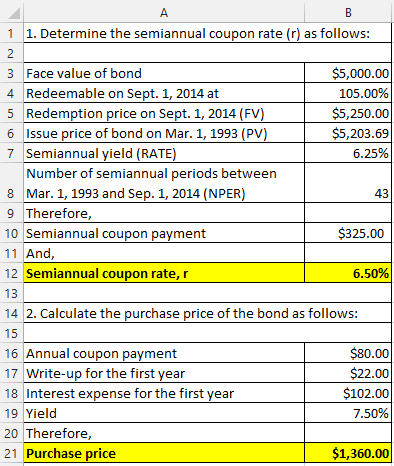
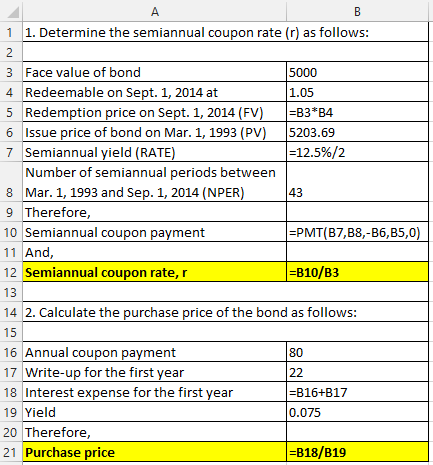
The figures shown above have been calculated in MS Excel in the following manner:
Add Answer to:
1. A $5,000 bond, redeemable at 105 on Sep. 1, 2014, has
semiannual coupons at j2...
A $5,000 bond, redeemable at 105 on Sep. 1, 2014, has semiannual coupons at j2 =...
A $5,000 bond, redeemable at 105 on Sep. 1, 2014, has semiannual coupons at j2 = 2r. It is purchased for $5,203.69 on March 1, 1993, to yield j2 = 12.5%. Find r.
A $1,000 seven-year 4% bond with semiannual coupons is redeemable for $1,052. It was originally purchased at issue for...
 A $1,000 seven-year 4% bond with semiannual coupons is redeemable for $1,052. It was originally purchased at issue for $960. It is sold after 45 months for $999. Find the accrued interest by the practical method and again by the theoretical method using the new yield to maturity. (Round your answers to the nearest cent.) accrued interest by the practical method $ accrued interest by the theoretical method
A $1,000 seven-year 4% bond with semiannual coupons is redeemable for $1,052....
A $1,000 seven-year 4% bond with semiannual coupons is redeemable for $1,052. It was originally purchased at issue for $960. It is sold after 45 months for $999. Find the accrued interest by the practical method and again by the theoretical method using the new yield to maturity. (Round your answers to the nearest cent.) accrued interest by the practical method $ accrued interest by the theoretical method
A $1,000 seven-year 4% bond with semiannual coupons is redeemable for $1,052....
(2) A $1,000 seven-year 6% bond with semiannual coupons is redeemable for $1,065. It was originally...
 (2) A $1,000 seven-year 6% bond with semiannual coupons is redeemable for $1,065. It was originally purchased at issue for $970. It is sold after 45 months for $995. Find the accrued interest by the practical method and again by the theoretical method using the new yield to maturity.
A $5,000 15% ten-year bond has semiannual coupons and is sold to yield 5.1% convertible semiannually. The discount on t...
 A $5,000 15% ten-year bond has semiannual coupons and is sold to yield 5.1% convertible semiannually. The discount on the bond is $81.15 Find the redemption amount. (Round your answer to the nearest cent.)
A $5,000 15% ten-year bond has semiannual coupons and is sold to yield 5.1% convertible semiannually. The discount on the bond is $81.15 Find the redemption amount. (Round your answer to the nearest cent.)
A $5,000 15% ten-year bond has semiannual coupons and is sold to yield 5.1% convertible semiannually. The discount on the bond is $81.15 Find the redemption amount. (Round your answer to the nearest cent.)
A $ 100 000, 8% bond redeemable at par with quarterly coupons is purchased to yield...
 A $ 100 000, 8% bond redeemable at par with quarterly coupons is purchased to yield 6.5% compounded quarterly. Find the premium or discount and the purchase price if the bond is purchased (a) fifteen years before maturity; (b) five years before maturity.
Sara purchases a 3-year bond with a par value of $100, 4% annual coupons, and redeemable...
 Sara purchases a 3-year bond with a par value of $100, 4% annual coupons, and redeemable at $104. The annual effective yield rate is 6% a) Find the bond purchase price P- b) The bond is sold at a A. premium B. discount c) Fill in the the bond amortization schedule Amount for Period Coupon Interest Earned Accumulation o Book Value Discount 0 Total Note that ΣΡ, C-P-The Amount of Premium. The "principal repaid" is called the "amount for accumulation...
$20,000 bond has annual coupons and is redeemable at the end of fourteen years for $21,900. It has a base amount equal...
 $20,000 bond has annual coupons and is redeemable at the end of fourteen years for $21,900. It has a base amount equal to $18,480 when purchased to yield 2%. Find its base amount if it were purchased to yield 5%. (Round your answer to the nearest cent.)
$20,000 bond has annual coupons and is redeemable at the end of fourteen years for $21,900. It has a base amount equal to $18,480 when purchased to yield 2%. Find its base amount...
$20,000 bond has annual coupons and is redeemable at the end of fourteen years for $21,900. It has a base amount equal to $18,480 when purchased to yield 2%. Find its base amount if it were purchased to yield 5%. (Round your answer to the nearest cent.)
$20,000 bond has annual coupons and is redeemable at the end of fourteen years for $21,900. It has a base amount equal to $18,480 when purchased to yield 2%. Find its base amount...
a) Suppose a five-year, $1,000 bond with semiannual coupons has a price of $957.35 and yield...
a) Suppose a five-year, $1,000 bond with semiannual coupons has a price of $957.35 and yield to maturity of 6%. What is the bond’s coupon rate? b) Hacker Software has 6.2 percent coupon bonds on the market with nine years to maturity. The bonds make semiannual payments and currently sell for 105 percent of par. What is the yield to maturity on this bond? (Write down the expression for YTM and then use a financial calculator or a spreadsheet program...
7. (5+10 points) A $1000 bond redeemable at $1050 on December 1, 2016, pays interest at...
 7. (5+10 points) A $1000 bond redeemable at $1050 on December 1, 2016, pays interest at j2 = 6.5%. The bond is bought on June 1, 2014 to yield j2 = 5.5% to maturity. (a) Determine the purchase price of the bond. (b) Construct the complete bond schedule.
A $1,000 par value 10-year bond with annual coupons is redeemable at $1,055, and has a...
 A $1,000 par value 10-year bond with annual coupons is redeemable at $1,055, and has a purchase price of $986 at a yield rate of 4% per annum. The coupons are non-level and increase by $2 per year. (a) Find the amount of the first coupon payment. Round your answer to the nearest 0.01. (b) Using a spreadsheet software, construct a bond amortization schedule for all the years. You may use your own spreadsheet template. (c) Suppose that the issue...
 A $1,000 seven-year 4% bond with semiannual coupons is redeemable for $1,052. It was originally purchased at issue for $960. It is sold after 45 months for $999. Find the accrued interest by the practical method and again by the theoretical method using the new yield to maturity. (Round your answers to the nearest cent.) accrued interest by the practical method $ accrued interest by the theoretical method
A $1,000 seven-year 4% bond with semiannual coupons is redeemable for $1,052....
A $1,000 seven-year 4% bond with semiannual coupons is redeemable for $1,052. It was originally purchased at issue for $960. It is sold after 45 months for $999. Find the accrued interest by the practical method and again by the theoretical method using the new yield to maturity. (Round your answers to the nearest cent.) accrued interest by the practical method $ accrued interest by the theoretical method
A $1,000 seven-year 4% bond with semiannual coupons is redeemable for $1,052....
 (2) A $1,000 seven-year 6% bond with semiannual coupons is redeemable for $1,065. It was originally purchased at issue for $970. It is sold after 45 months for $995. Find the accrued interest by the practical method and again by the theoretical method using the new yield to maturity.
 A $5,000 15% ten-year bond has semiannual coupons and is sold to yield 5.1% convertible semiannually. The discount on the bond is $81.15 Find the redemption amount. (Round your answer to the nearest cent.)
A $5,000 15% ten-year bond has semiannual coupons and is sold to yield 5.1% convertible semiannually. The discount on the bond is $81.15 Find the redemption amount. (Round your answer to the nearest cent.)
A $5,000 15% ten-year bond has semiannual coupons and is sold to yield 5.1% convertible semiannually. The discount on the bond is $81.15 Find the redemption amount. (Round your answer to the nearest cent.)
 A $ 100 000, 8% bond redeemable at par with quarterly coupons is purchased to yield 6.5% compounded quarterly. Find the premium or discount and the purchase price if the bond is purchased (a) fifteen years before maturity; (b) five years before maturity.
 Sara purchases a 3-year bond with a par value of $100, 4% annual coupons, and redeemable at $104. The annual effective yield rate is 6% a) Find the bond purchase price P- b) The bond is sold at a A. premium B. discount c) Fill in the the bond amortization schedule Amount for Period Coupon Interest Earned Accumulation o Book Value Discount 0 Total Note that ΣΡ, C-P-The Amount of Premium. The "principal repaid" is called the "amount for accumulation...
 $20,000 bond has annual coupons and is redeemable at the end of fourteen years for $21,900. It has a base amount equal to $18,480 when purchased to yield 2%. Find its base amount if it were purchased to yield 5%. (Round your answer to the nearest cent.)
$20,000 bond has annual coupons and is redeemable at the end of fourteen years for $21,900. It has a base amount equal to $18,480 when purchased to yield 2%. Find its base amount...
$20,000 bond has annual coupons and is redeemable at the end of fourteen years for $21,900. It has a base amount equal to $18,480 when purchased to yield 2%. Find its base amount if it were purchased to yield 5%. (Round your answer to the nearest cent.)
$20,000 bond has annual coupons and is redeemable at the end of fourteen years for $21,900. It has a base amount equal to $18,480 when purchased to yield 2%. Find its base amount...
 7. (5+10 points) A $1000 bond redeemable at $1050 on December 1, 2016, pays interest at j2 = 6.5%. The bond is bought on June 1, 2014 to yield j2 = 5.5% to maturity. (a) Determine the purchase price of the bond. (b) Construct the complete bond schedule.
 A $1,000 par value 10-year bond with annual coupons is redeemable at $1,055, and has a purchase price of $986 at a yield rate of 4% per annum. The coupons are non-level and increase by $2 per year. (a) Find the amount of the first coupon payment. Round your answer to the nearest 0.01. (b) Using a spreadsheet software, construct a bond amortization schedule for all the years. You may use your own spreadsheet template. (c) Suppose that the issue...
Most questions answered within 3 hours.
-
Where is the error in this code sequence?
String s1 = "Hello";
String s2 = "ello";...
asked 11 months ago -
Financial data for Joel de Paris, Inc., for last year
follow:
Joel de Paris, Inc.
Balance...
asked 11 months ago -
Consider this reaction:
Al2(SO4)3 (aq)+ BaCl3
(aq) Al2Cl6 (aq)- +
3BaSO4(s) . What is the...
asked 11 months ago -
Suppose that Savneet is considering increasing her
recent random sample from 20 car rentals to 40...
asked 11 months ago -
Trucks arrive at an unloading terminal at an average rate of 120
per hour.
Trucks arrive...
asked 11 months ago -
Why are methanol and ethanol completely soluble in water while
octanol is not very little soluble....
asked 11 months ago -
A facilities manager at a university reads in a research report
that the mean amount of...
asked 11 months ago -
When the CuSO4 is rehydrated by adding water to the anhydrous
compound, is this an endothermic...
asked 11 months ago -
A ray of sunlight is passing from diamond into crown glass; the
angle of incidence is...
asked 11 months ago -
A block of mass 0.249 kg is placed on top of a light, vertical
spring of...
asked 11 months ago -
how do the kidneys compensate in the presences of acidosis
a) trigger hyperventilate
b) reserve acid...
asked 11 months ago -
Question 501 pts
The rental rate of capital to the firm increases. Which of the
following...
asked 11 months ago