
Homework Answers
Add Answer to:
hi
this is for exam please finsih it and i will guve yoy the best
rating...
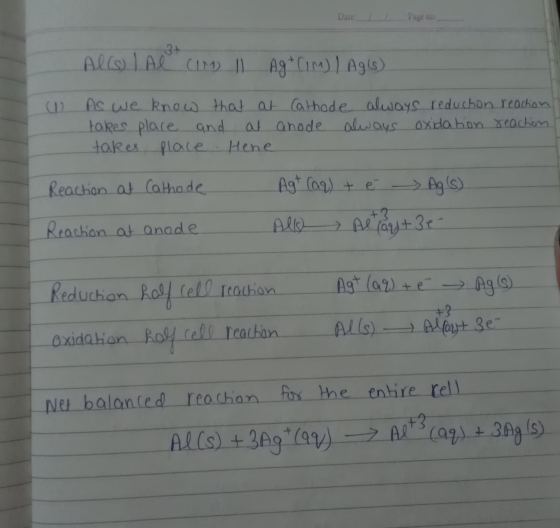
A voltaic cell is based on the reduction of Ag^+(aq) to Ag(s) and the oxidation of...
 A voltaic cell is based on the reduction of Ag^+(aq) to Ag(s) and the oxidation of Sn(s) to Sn^2+(aq). (a) Write half-reactions for the cell's anode and cathode. Include the phases of all species in the chemical equation. Anode Cathode (b) Write a balanced cell reaction. Include the phases of all species in the chemical equation.
with Al I. Consider the following depiction of a voltaic cell with 1.0 M solutions of...
 with Al I. Consider the following depiction of a voltaic cell with 1.0 M solutions of AINO,) and AgNO, along and Ag electrodes to construct a voltaic cell. The salt bridge contains a saturated solution of KCI. Complete the picture associated with this problem by accomplishing the following: a) Write the symbols of the elements and ions in the appropriate areas for both solutions and both electrodes b) Identify the anode and cathode. ) Indicate the direction of electron flow...
Ag For the following galvanic cell shown below. PC122 cm 1. Write the line notation that...
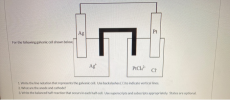 Ag For the following galvanic cell shown below. PC122 cm 1. Write the line notation that represents the galvanic cell. Use backslashes (/) to indicate vertical lines. 2. What are the anode and cathode? 3. Write the balanced half-reaction that occurs in each half-cell. Use superscripts and subscripts appropriately. States are optional
Enter electrons as e Use smallest possible integer coefficients for ALL reactions If a box is not...
 Enter electrons as e Use smallest possible integer coefficients for ALL reactions If a box is not needed, leave it blank. A voltaic electrochemical cell is constructed in which the anode is a Ag lAgh f-cell compartme nts are connected by a salt bridge. Write the anode reaction. Write the cathode reaction. Write the net cell reaction. In the external circuit, electrons migrate the Br2 Br electrode the Ag lAg electrode. In the salt bridge, anions migrate the Br,lBr compartmentthe...
all parts please cell A voltaic cell employs the following redox reaction: Cu(s) + 2 Ag+...
 all parts please
cell A voltaic cell employs the following redox reaction: Cu(s) + 2 Ag+ (aq) Cu 2+ (aq) + 2 Ag(s) The E° for the reaction is +0.46 V. The initial (nonstandard) conditions are: (Ag +) = 2.0 M; [Cu 2+] = 0.025 M Part a. Write the half-reaction that occurs at the anode. Part b. Write the half-reaction that occurs at the cathode. Part c. How many electrons are transferred in this reaction? Part d. What is...
all parts please
cell A voltaic cell employs the following redox reaction: Cu(s) + 2 Ag+ (aq) Cu 2+ (aq) + 2 Ag(s) The E° for the reaction is +0.46 V. The initial (nonstandard) conditions are: (Ag +) = 2.0 M; [Cu 2+] = 0.025 M Part a. Write the half-reaction that occurs at the anode. Part b. Write the half-reaction that occurs at the cathode. Part c. How many electrons are transferred in this reaction? Part d. What is...
Voltaic cells chemistry please help with A-C, H and I. 3. A voltaic cell is built...
 Voltaic cells chemistry
please help with A-C, H and I.
3. A voltaic cell is built from two half-cells using the reduction reactions given below: Sn 2(aq) → Sn(s); Eredn = -0.14 V Cr20;2(aq) → Cr+ (aq) Eredin = 1.33 V a) Write the balanced cathode half reaction in acidic medium: (show work step by step and box your answer) b) Write the balanced anode half reaction and box your answer: c) Write the balanced overall cell reaction and box...
Voltaic cells chemistry
please help with A-C, H and I.
3. A voltaic cell is built from two half-cells using the reduction reactions given below: Sn 2(aq) → Sn(s); Eredn = -0.14 V Cr20;2(aq) → Cr+ (aq) Eredin = 1.33 V a) Write the balanced cathode half reaction in acidic medium: (show work step by step and box your answer) b) Write the balanced anode half reaction and box your answer: c) Write the balanced overall cell reaction and box...
The following problems are based upon the following voltaic cell (concentration of aqueous solutions are 1...
 The following problems are based upon the following voltaic cell (concentration of aqueous solutions are 1 M): (Show all work for full credit.) Cr(s) c (aq) IlCut (aq) Cu (s) (3) I. From the voltaic cell written above, which half cell will be the anode, and which will be the cathode? Why? (3) 2. Write a balanced equation describing the redox reaction in this cell. (Molecular or Net lonic equation is correct) (2) 3. How many electrons are transferred in...
Pb^2+ +2e- __> Pb e=-0.13V Ag+ +1e-__> Ag e=+0.80V Pb(s)| Pb2+ (1M) || Ag+ (1M) |...
Pb^2+ +2e- __> Pb e=-0.13V Ag+ +1e-__> Ag e=+0.80V Pb(s)| Pb2+ (1M) || Ag+ (1M) | Ag(s) Determine which of the following statements about the cell shown are True or False. The silver half-cell is the cathode. True False The mass of the silver electrode is decreasing. True False Anions move to the silver half-cell. True False Electrons are spontaneously produced in the lead half-cell. True False The cell, as represented by the line notation, is a voltaic cell. True False The standard cell potential,...
Need help with question 1. A-F Name: ELECTROCHEMISTRY WORKSHEET 1. Answer the questions below regarding the...
 Need help with question 1. A-F
Name: ELECTROCHEMISTRY WORKSHEET 1. Answer the questions below regarding the voltaic cell drawn. NO Cathode NO, BI Anode NO3- NO3 NO, NO, a. Write both half reactions: Cathode Half Reaction: Anode Half Reaction: b. In which direction will the electrons flow? c. Which electrode will be positively charged? d. In which direction will the NO3 ions flow in the salt bridge? e. Which electrode decreases in mass during the reaction? f. Write the shorthand...
Need help with question 1. A-F
Name: ELECTROCHEMISTRY WORKSHEET 1. Answer the questions below regarding the voltaic cell drawn. NO Cathode NO, BI Anode NO3- NO3 NO, NO, a. Write both half reactions: Cathode Half Reaction: Anode Half Reaction: b. In which direction will the electrons flow? c. Which electrode will be positively charged? d. In which direction will the NO3 ions flow in the salt bridge? e. Which electrode decreases in mass during the reaction? f. Write the shorthand...
The following problems are based upon the following voltaic cell (concentration of aqueous solutions are 1...
 The following problems are based upon the following voltaic cell (concentration of aqueous solutions are 1 M): (Show all work for full credit.) Fe (s) Fe" (aq) | |Cu (aq) | Cu (s) (3) 1. The reduction potential for the iron half reaction is -0.040 v. Use your textbook to determine the reduction potential for the copper half reaction, and record that here. )2. From the voltaic cell written above, which half cell will be the anode, and which will...
 A voltaic cell is based on the reduction of Ag^+(aq) to Ag(s) and the oxidation of Sn(s) to Sn^2+(aq). (a) Write half-reactions for the cell's anode and cathode. Include the phases of all species in the chemical equation. Anode Cathode (b) Write a balanced cell reaction. Include the phases of all species in the chemical equation.
 with Al I. Consider the following depiction of a voltaic cell with 1.0 M solutions of AINO,) and AgNO, along and Ag electrodes to construct a voltaic cell. The salt bridge contains a saturated solution of KCI. Complete the picture associated with this problem by accomplishing the following: a) Write the symbols of the elements and ions in the appropriate areas for both solutions and both electrodes b) Identify the anode and cathode. ) Indicate the direction of electron flow...
 Ag For the following galvanic cell shown below. PC122 cm 1. Write the line notation that represents the galvanic cell. Use backslashes (/) to indicate vertical lines. 2. What are the anode and cathode? 3. Write the balanced half-reaction that occurs in each half-cell. Use superscripts and subscripts appropriately. States are optional
 Enter electrons as e Use smallest possible integer coefficients for ALL reactions If a box is not needed, leave it blank. A voltaic electrochemical cell is constructed in which the anode is a Ag lAgh f-cell compartme nts are connected by a salt bridge. Write the anode reaction. Write the cathode reaction. Write the net cell reaction. In the external circuit, electrons migrate the Br2 Br electrode the Ag lAg electrode. In the salt bridge, anions migrate the Br,lBr compartmentthe...
 all parts please
cell A voltaic cell employs the following redox reaction: Cu(s) + 2 Ag+ (aq) Cu 2+ (aq) + 2 Ag(s) The E° for the reaction is +0.46 V. The initial (nonstandard) conditions are: (Ag +) = 2.0 M; [Cu 2+] = 0.025 M Part a. Write the half-reaction that occurs at the anode. Part b. Write the half-reaction that occurs at the cathode. Part c. How many electrons are transferred in this reaction? Part d. What is...
all parts please
cell A voltaic cell employs the following redox reaction: Cu(s) + 2 Ag+ (aq) Cu 2+ (aq) + 2 Ag(s) The E° for the reaction is +0.46 V. The initial (nonstandard) conditions are: (Ag +) = 2.0 M; [Cu 2+] = 0.025 M Part a. Write the half-reaction that occurs at the anode. Part b. Write the half-reaction that occurs at the cathode. Part c. How many electrons are transferred in this reaction? Part d. What is...
 Voltaic cells chemistry
please help with A-C, H and I.
3. A voltaic cell is built from two half-cells using the reduction reactions given below: Sn 2(aq) → Sn(s); Eredn = -0.14 V Cr20;2(aq) → Cr+ (aq) Eredin = 1.33 V a) Write the balanced cathode half reaction in acidic medium: (show work step by step and box your answer) b) Write the balanced anode half reaction and box your answer: c) Write the balanced overall cell reaction and box...
Voltaic cells chemistry
please help with A-C, H and I.
3. A voltaic cell is built from two half-cells using the reduction reactions given below: Sn 2(aq) → Sn(s); Eredn = -0.14 V Cr20;2(aq) → Cr+ (aq) Eredin = 1.33 V a) Write the balanced cathode half reaction in acidic medium: (show work step by step and box your answer) b) Write the balanced anode half reaction and box your answer: c) Write the balanced overall cell reaction and box...
 The following problems are based upon the following voltaic cell (concentration of aqueous solutions are 1 M): (Show all work for full credit.) Cr(s) c (aq) IlCut (aq) Cu (s) (3) I. From the voltaic cell written above, which half cell will be the anode, and which will be the cathode? Why? (3) 2. Write a balanced equation describing the redox reaction in this cell. (Molecular or Net lonic equation is correct) (2) 3. How many electrons are transferred in...
 Need help with question 1. A-F
Name: ELECTROCHEMISTRY WORKSHEET 1. Answer the questions below regarding the voltaic cell drawn. NO Cathode NO, BI Anode NO3- NO3 NO, NO, a. Write both half reactions: Cathode Half Reaction: Anode Half Reaction: b. In which direction will the electrons flow? c. Which electrode will be positively charged? d. In which direction will the NO3 ions flow in the salt bridge? e. Which electrode decreases in mass during the reaction? f. Write the shorthand...
Need help with question 1. A-F
Name: ELECTROCHEMISTRY WORKSHEET 1. Answer the questions below regarding the voltaic cell drawn. NO Cathode NO, BI Anode NO3- NO3 NO, NO, a. Write both half reactions: Cathode Half Reaction: Anode Half Reaction: b. In which direction will the electrons flow? c. Which electrode will be positively charged? d. In which direction will the NO3 ions flow in the salt bridge? e. Which electrode decreases in mass during the reaction? f. Write the shorthand...
 The following problems are based upon the following voltaic cell (concentration of aqueous solutions are 1 M): (Show all work for full credit.) Fe (s) Fe" (aq) | |Cu (aq) | Cu (s) (3) 1. The reduction potential for the iron half reaction is -0.040 v. Use your textbook to determine the reduction potential for the copper half reaction, and record that here. )2. From the voltaic cell written above, which half cell will be the anode, and which will...
Most questions answered within 3 hours.
-
Where is the error in this code sequence?
String s1 = "Hello";
String s2 = "ello";...
asked 11 months ago -
Financial data for Joel de Paris, Inc., for last year
follow:
Joel de Paris, Inc.
Balance...
asked 11 months ago -
Consider this reaction:
Al2(SO4)3 (aq)+ BaCl3
(aq) Al2Cl6 (aq)- +
3BaSO4(s) . What is the...
asked 11 months ago -
Suppose that Savneet is considering increasing her
recent random sample from 20 car rentals to 40...
asked 11 months ago -
Trucks arrive at an unloading terminal at an average rate of 120
per hour.
Trucks arrive...
asked 11 months ago -
Why are methanol and ethanol completely soluble in water while
octanol is not very little soluble....
asked 11 months ago -
A facilities manager at a university reads in a research report
that the mean amount of...
asked 11 months ago -
When the CuSO4 is rehydrated by adding water to the anhydrous
compound, is this an endothermic...
asked 11 months ago -
A ray of sunlight is passing from diamond into crown glass; the
angle of incidence is...
asked 11 months ago -
A block of mass 0.249 kg is placed on top of a light, vertical
spring of...
asked 11 months ago -
how do the kidneys compensate in the presences of acidosis
a) trigger hyperventilate
b) reserve acid...
asked 11 months ago -
Question 501 pts
The rental rate of capital to the firm increases. Which of the
following...
asked 11 months ago