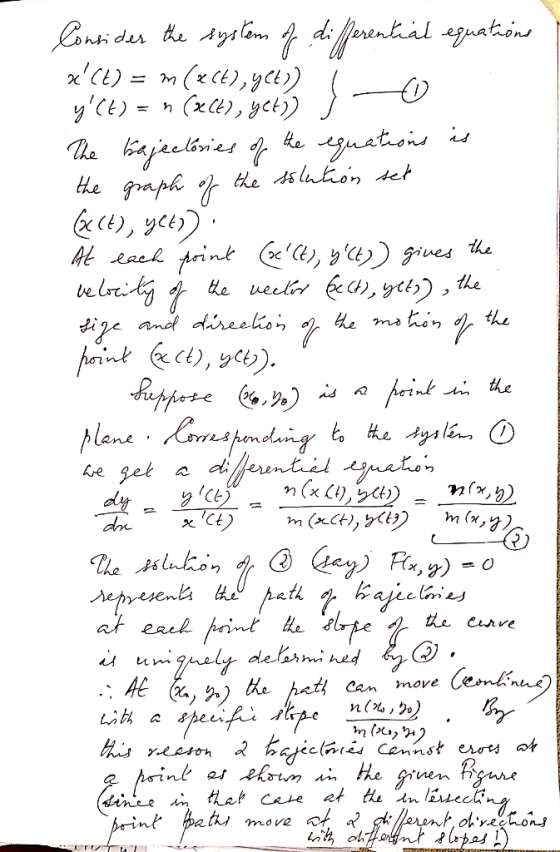
![Can two trajectories of a system x t] m[x[t]. y[t]] yt]n[xt], ylt] ever cross each other like this? Why or why not?](http://img.homeworklib.com/questions/dfbff7c0-c6b1-11ea-aa94-2dabba0789f0.png?x-oss-process=image/resize,w_560)
Homework Answers
Add Answer to:
Can two trajectories of a system x t] m[x[t]. y[t]] y't]n[xt], ylt] ever cross each other...
and C2 in the xy-planedefined by the parametric equations Consider trajectories on two curves C1:x=t?, y=t?...
 and C2 in the xy-planedefined by the parametric equations Consider trajectories on two curves C1:x=t?, y=t? - <t<«. C2: x = 3t, y=t?, - <t<mo. These two trajectories are known to *intersect* at exactly two points. The origin (0,0) is one of them. And there is another one, which we'll call P. Find Pand select the choice below which gives the slope of the tangent line to the first curve at the point P. Note that only ONE of the...
Consider the system of coupled ODES: x' = x - y, y = x + xy...
 Consider the system of coupled ODES: x' = x - y, y = x + xy - 6y (+) (a) Find the critical points (C+, Y*) € R2 of this system. [3 marks] Hint: One critical point is (0,0) and there are two more critical points. (b) For each critical point, find the approximate linear ODE system that is valid in a small neighbourhood of it. [6 marks] (c) Find the eigenvalues of each of the linear systems found in...
Given two functions, M(x, y) and N(x,y), suppose that ON/ that an/az-amay is M-N a function...
 Given two functions, M(x, y) and N(x,y), suppose that ON/ that an/az-amay is M-N a function of x +y. That is, let f(t) be a function such that ON _ OM dc du f(x+y) = M-N Assume that you can solve the differential equation Mdx + Ndy = 0 by multiplying by an integrating factor u that makes it exact and that it can also be written as a function of x + y, u = g(x + y) for...
Consider the Spring-Mass-Damper system: 17 →xt) linn M A Falt) Ffl v) Consider the following system...
 Consider the Spring-Mass-Damper system: 17 →xt) linn M A Falt) Ffl v) Consider the following system parameter values: Case 1: m= 7 kg; b = 1 Nsec/m; Fa = 3N; k = 2 N/m; x(0) = 4 m;x_dot(0)=0 m/s Case2:m=30kg;b=1Nsec/m; Fa=3N; k=2N/m;x(0)=2m;x_dot(0)=0m/s Use MATLAB in order to do the following: 1. Solve the system equations numerically (using the ODE45 function). 2. For the two cases, plot the Position x(t) of the mass, on the same graph (include proper titles, axis...
Consider the nonlinear system: - x + (x – 1) y y + 4x° (1 –...
 Consider the nonlinear system: - x + (x – 1) y y + 4x° (1 – x). (a) Show that the system has a unique fixed point at the origin (0, 0). (b) Use a linear approximation to determine the stability of the fixed point. (c) Apply the Liapunov direct method to determine the stability of the fixed point. Is your conclusion different form that of Part (a)? Why? (d) Can the system have closed orbits (trajectories)? Explain.
4. Consider two functions x(h),y (h), Vh> 0 and cross-covariance function 7xy(h), Vh e Z (a)...
 4. Consider two functions x(h),y (h), Vh> 0 and cross-covariance function 7xy(h), Vh e Z (a) (7 points) Find the Best Linear Predictor (BLP) of Y given Xt, and its Mean Square Prediction Error (MSPE), expressed in terms of x(h). (h), xy (h) jointly stationary time series (X, Y), with individual auto-covariance (b) (13 points) Find the BLP of Y given Xt, X-1,Y-1, and its MSPE, expressed in terms of 7x(h)(h), x.y (h). (Note: you don't need to solve the...
5. Consider the nonlinear two dimensional Lotka-Volterra (predator-prey) system z'(t) = z(t)[2-2(t)-2y(t)l, y'(t) = y(t)12-y(t)--2(t)] (a)...
 5. Consider the nonlinear two dimensional Lotka-Volterra (predator-prey) system z'(t) = z(t)[2-2(t)-2y(t)l, y'(t) = y(t)12-y(t)--2(t)] (a) Find all critical points of this system, and at each determine whether or not the system is locally stable or unstable. (b) We proved in class, using the Bendixson-Dulac theorem, that this system has no periodic solution with trajectory in the first quadrant of the plane. Assuming this, use the Poincare-Bendixson theorem to prove that all trajectories (z(t),y(t)) of the system (2) with initial...
2) Let the cross-correlation function of two processes X(t) and Y(t) be where A, B, and ω are con...
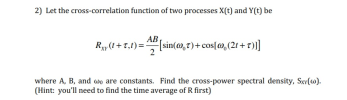 2) Let the cross-correlation function of two processes X(t) and Y(t) be where A, B, and ω are constants. Find the cross-power spectral density, SXY(ω). (Hint: you'll need to find the time average of R first)
2) Let the cross-correlation function of two processes X(t) and Y(t) be where A, B, and ω are constants. Find the cross-power spectral density, SXY(ω). (Hint: you'll need to find the time average of R first)
2) Let the cross-correlation function of two processes X(t) and Y(t) be where A, B, and ω are constants. Find the cross-power spectral density, SXY(ω). (Hint: you'll need to find the time average of R first)
2) Just as an nth order equation can be transformed to a system of n first...
 2) Just as an nth order equation can be transformed to a system of n first order equations, a system of m n" order equations can be transformed into a system of mn first order equations. Transform the system of two second order equations into a system of first order equations. Again, your variables are x,, X2, X3..... x" + 3x' + 4x – 2y=0, y" + 2y' – 3x + y =é cost, where x = x(t), y =...
1. Auto- and Cross-Correlation. For each of the following, compute the cross correlation T/2 Rry(,) = E[drpd, + n-linx...
 1. Auto- and Cross-Correlation. For each of the following, compute the cross correlation T/2 Rry(,) = E[drpd, + n-linx t-Tax(ry(, + rdr . Hint: Use trigonometric identities (see HW 1), 27T such as sin a sin b-2 [cos(a-b)-cos(a + b)] . Also use the fact that j cos(ont-б unless co-0 x(t) = sin(2n/r), y(t)-sin(2nft) (here x and y are the same, so Rry-Rrr is the a. autocorrelation of x). x(t) = sin(2nft), y(t) = sin(2nf(t-to)) c. x(t)-n(), y()2x(t) +n2(t) where...
 and C2 in the xy-planedefined by the parametric equations Consider trajectories on two curves C1:x=t?, y=t? - <t<«. C2: x = 3t, y=t?, - <t<mo. These two trajectories are known to *intersect* at exactly two points. The origin (0,0) is one of them. And there is another one, which we'll call P. Find Pand select the choice below which gives the slope of the tangent line to the first curve at the point P. Note that only ONE of the...
 Consider the system of coupled ODES: x' = x - y, y = x + xy - 6y (+) (a) Find the critical points (C+, Y*) € R2 of this system. [3 marks] Hint: One critical point is (0,0) and there are two more critical points. (b) For each critical point, find the approximate linear ODE system that is valid in a small neighbourhood of it. [6 marks] (c) Find the eigenvalues of each of the linear systems found in...
 Given two functions, M(x, y) and N(x,y), suppose that ON/ that an/az-amay is M-N a function of x +y. That is, let f(t) be a function such that ON _ OM dc du f(x+y) = M-N Assume that you can solve the differential equation Mdx + Ndy = 0 by multiplying by an integrating factor u that makes it exact and that it can also be written as a function of x + y, u = g(x + y) for...
 Consider the Spring-Mass-Damper system: 17 →xt) linn M A Falt) Ffl v) Consider the following system parameter values: Case 1: m= 7 kg; b = 1 Nsec/m; Fa = 3N; k = 2 N/m; x(0) = 4 m;x_dot(0)=0 m/s Case2:m=30kg;b=1Nsec/m; Fa=3N; k=2N/m;x(0)=2m;x_dot(0)=0m/s Use MATLAB in order to do the following: 1. Solve the system equations numerically (using the ODE45 function). 2. For the two cases, plot the Position x(t) of the mass, on the same graph (include proper titles, axis...
 Consider the nonlinear system: - x + (x – 1) y y + 4x° (1 – x). (a) Show that the system has a unique fixed point at the origin (0, 0). (b) Use a linear approximation to determine the stability of the fixed point. (c) Apply the Liapunov direct method to determine the stability of the fixed point. Is your conclusion different form that of Part (a)? Why? (d) Can the system have closed orbits (trajectories)? Explain.
 4. Consider two functions x(h),y (h), Vh> 0 and cross-covariance function 7xy(h), Vh e Z (a) (7 points) Find the Best Linear Predictor (BLP) of Y given Xt, and its Mean Square Prediction Error (MSPE), expressed in terms of x(h). (h), xy (h) jointly stationary time series (X, Y), with individual auto-covariance (b) (13 points) Find the BLP of Y given Xt, X-1,Y-1, and its MSPE, expressed in terms of 7x(h)(h), x.y (h). (Note: you don't need to solve the...
 5. Consider the nonlinear two dimensional Lotka-Volterra (predator-prey) system z'(t) = z(t)[2-2(t)-2y(t)l, y'(t) = y(t)12-y(t)--2(t)] (a) Find all critical points of this system, and at each determine whether or not the system is locally stable or unstable. (b) We proved in class, using the Bendixson-Dulac theorem, that this system has no periodic solution with trajectory in the first quadrant of the plane. Assuming this, use the Poincare-Bendixson theorem to prove that all trajectories (z(t),y(t)) of the system (2) with initial...
 2) Let the cross-correlation function of two processes X(t) and Y(t) be where A, B, and ω are constants. Find the cross-power spectral density, SXY(ω). (Hint: you'll need to find the time average of R first)
2) Let the cross-correlation function of two processes X(t) and Y(t) be where A, B, and ω are constants. Find the cross-power spectral density, SXY(ω). (Hint: you'll need to find the time average of R first)
2) Let the cross-correlation function of two processes X(t) and Y(t) be where A, B, and ω are constants. Find the cross-power spectral density, SXY(ω). (Hint: you'll need to find the time average of R first)
 2) Just as an nth order equation can be transformed to a system of n first order equations, a system of m n" order equations can be transformed into a system of mn first order equations. Transform the system of two second order equations into a system of first order equations. Again, your variables are x,, X2, X3..... x" + 3x' + 4x – 2y=0, y" + 2y' – 3x + y =é cost, where x = x(t), y =...
 1. Auto- and Cross-Correlation. For each of the following, compute the cross correlation T/2 Rry(,) = E[drpd, + n-linx t-Tax(ry(, + rdr . Hint: Use trigonometric identities (see HW 1), 27T such as sin a sin b-2 [cos(a-b)-cos(a + b)] . Also use the fact that j cos(ont-б unless co-0 x(t) = sin(2n/r), y(t)-sin(2nft) (here x and y are the same, so Rry-Rrr is the a. autocorrelation of x). x(t) = sin(2nft), y(t) = sin(2nf(t-to)) c. x(t)-n(), y()2x(t) +n2(t) where...
Most questions answered within 3 hours.
-
Where is the error in this code sequence?
String s1 = "Hello";
String s2 = "ello";...
asked 11 months ago -
Financial data for Joel de Paris, Inc., for last year
follow:
Joel de Paris, Inc.
Balance...
asked 11 months ago -
Consider this reaction:
Al2(SO4)3 (aq)+ BaCl3
(aq) Al2Cl6 (aq)- +
3BaSO4(s) . What is the...
asked 11 months ago -
Suppose that Savneet is considering increasing her
recent random sample from 20 car rentals to 40...
asked 11 months ago -
Trucks arrive at an unloading terminal at an average rate of 120
per hour.
Trucks arrive...
asked 11 months ago -
Why are methanol and ethanol completely soluble in water while
octanol is not very little soluble....
asked 11 months ago -
A facilities manager at a university reads in a research report
that the mean amount of...
asked 11 months ago -
When the CuSO4 is rehydrated by adding water to the anhydrous
compound, is this an endothermic...
asked 11 months ago -
A ray of sunlight is passing from diamond into crown glass; the
angle of incidence is...
asked 11 months ago -
A block of mass 0.249 kg is placed on top of a light, vertical
spring of...
asked 11 months ago -
how do the kidneys compensate in the presences of acidosis
a) trigger hyperventilate
b) reserve acid...
asked 11 months ago -
Question 501 pts
The rental rate of capital to the firm increases. Which of the
following...
asked 11 months ago