Derive equations 1 and 2, thank you! 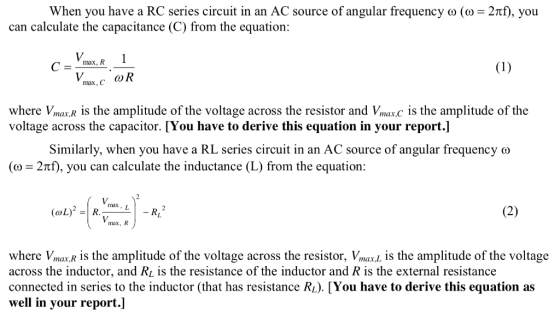
Homework Answers
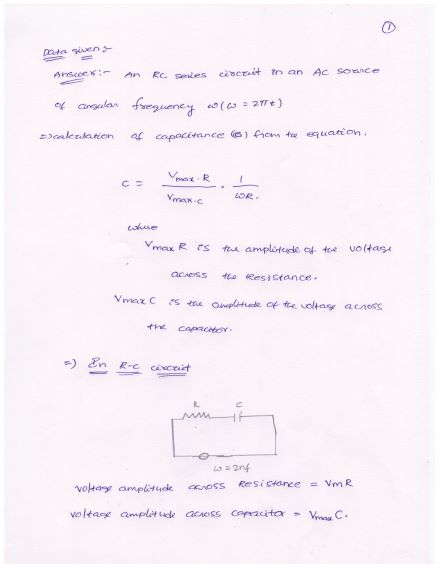
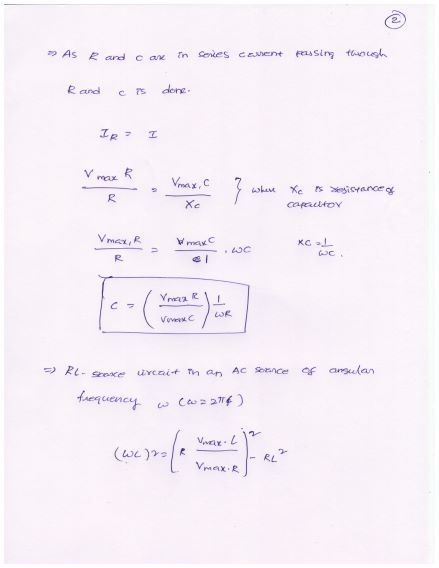
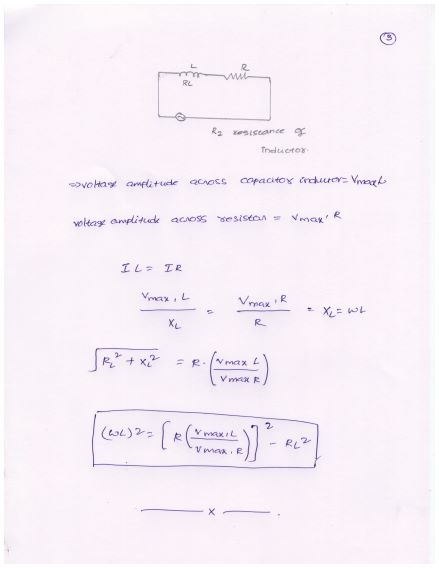
Add Answer to:
Derive equations 1 and 2, thank you!
When you have a RC series circuit in an...
You have a resistor of resistance 250 Ω , an inductor of inductance 0.370 H ,...
You have a resistor of resistance 250 Ω , an inductor of inductance 0.370 H , a capacitor of capacitance 5.90 μF and a voltage source that has a voltage amplitude of 26.0 V and an angular frequency of 280 rad/s . The resistor, inductor, capacitor, and voltage source are connected to form an L-R-C series circuit. Part F What is the voltage amplitude across the inductor? Part G What is the voltage amplitudes across the capacitor? Part H Explain...
In a series R-L-C circuit, L = 0.215 H , C = 82.5 μF and the...
In a series R-L-C circuit, L = 0.215 H , C = 82.5 μF and the voltage amplitude of the source is 260 V . 1)What is the resonance angular frequency of the circuit? 2)When the source operates at the resonance angular frequency, the current amplitude in the circuit is 0.595 A . What is the resistance R of the resistor? 3)At the resonance frequency, what are the peak voltages across the inductor, the capacitor, and the resistor?
A circuit has an ac voltage source and a resistor and capacitor connected in series. There is no inductor.
A circuit has an ac voltage source and a resistor and capacitor connected in series. There is no inductor. The ac voltage source has voltage amplitude 0.900 kV and angular frequency w = 20.0 rad/s. The voltage amplitude across the capacitor is 0.500 kV. The resistor has resistance R= 0.300 kΩ. Part A What is the voltage amplitude across the resistor? Part B What is the capacitance C of the capacitor? Part C Does the source voltage lag or lead the current? Part D What is the average...
Part A: What is the impedance of the circuit? Part B: What is the current amplitude?...
 Part A: What is the impedance of the circuit?
Part B: What is the current amplitude?
Part C: What is the phase angle of the source voltage with
respect to the current?
Part D: Does the source voltage lag or lead the current?
Part E: What is the voltage amplitude across the resistor?
Part F: What is the voltage amplitude across the inductor?
Part G: What is the voltage amplitudes across the capacitor?
Constants You have a resistor of resistance...
Part A: What is the impedance of the circuit?
Part B: What is the current amplitude?
Part C: What is the phase angle of the source voltage with
respect to the current?
Part D: Does the source voltage lag or lead the current?
Part E: What is the voltage amplitude across the resistor?
Part F: What is the voltage amplitude across the inductor?
Part G: What is the voltage amplitudes across the capacitor?
Constants You have a resistor of resistance...
In a series R-L-C circuit, L = 0.190 H , C = 84.5 μF and the...
In a series R-L-C circuit, L = 0.190 H , C = 84.5 μF and the voltage amplitude of the source is 290 V . Part A What is the resonance angular frequency of the circuit? ω0 = rad/s SubmitMy AnswersGive Up Part B When the source operates at the resonance angular frequency, the current amplitude in the circuit is 0.610 A . What is the resistance R of the resistor? R = Ω SubmitMy AnswersGive Up Part C At...
An ac series circuit containing a capacitor, inductor, and resistance is found to have a current...
An ac series circuit containing a capacitor, inductor, and resistance is found to have a current of amplitude 0.300 A for a source voltage of amplitude 10.0 V at an angular frequency of 200.0 rad/s. The total resistance in the circuit is 18.0 Ω. What is the power factor for the circuit?
1. Compute the impedance of a series R-L-C circuit at angular frequencies of ω1= 1000 rad/s...
1. Compute the impedance of a series R-L-C circuit at angular frequencies of ω1= 1000 rad/s , ω2= 710 rad/s and ω3= 455 rad/s . Take R = 170 Ω , L = 0.935 H and C = 2.40 μF . What is the phase angle of the source voltage with respect to the current when ω = 1000 rad/s? 2. A series R–L–C circuit of R = 150 Ω , L = 0.915 H and C = 2.05 μF...
a. An AC source of amplitude 10 Vmax and 500 Hz frequency is connected in series...
a. An AC source of amplitude 10 Vmax and 500 Hz frequency is connected in series with a 3 Kohm resistor and a 15 micro Farad capacitor. Draw the circuit. Determine the total current and the voltage drops across the resistor and the capacitor, respectively. b. An AC source of amplitude 10 Vmax and 5000 Hz frequency is connected in series with a 2 Kohm resistor and a 10 mH (milli Henry) inductor. Draw the circuit. Determine the total current...
A series L-R-C circuit is driven with AC voltage of amplitude Vin and frequency ω. Define...
 A series L-R-C circuit is driven with AC voltage of
amplitude Vin and frequency ω. Define Vout to be the amplitude of
the voltage across the capacitor. The resistance of the resistor is
R, the capacitance of the capacitor is C, and the inductance of the
inductor is L.(Figure 1)
What is the ratio VoutVin?
Express your answer in terms of either R, ω, L, and C or R, XL
=ωL, and XC =1ωC.
Vin c+ Vout
A series L-R-C circuit is driven with AC voltage of
amplitude Vin and frequency ω. Define Vout to be the amplitude of
the voltage across the capacitor. The resistance of the resistor is
R, the capacitance of the capacitor is C, and the inductance of the
inductor is L.(Figure 1)
What is the ratio VoutVin?
Express your answer in terms of either R, ω, L, and C or R, XL
=ωL, and XC =1ωC.
Vin c+ Vout
You have a 240-Ω resistor and a 0.360-H inductor. Suppose you take the resistor and inductor...
You have a 240-Ω resistor and a 0.360-H inductor. Suppose you take the resistor and inductor and make a series circuit with a voltage source that has a voltage amplitude of 32.0 V and an angular frequency of 270 rad/s . What is the impedance of the circuit? What is the current amplitude? What is the voltage amplitude across the resistor? What is the voltage amplitudes across the inductor? What is the phase angle ϕ of the source voltage with...
 Part A: What is the impedance of the circuit?
Part B: What is the current amplitude?
Part C: What is the phase angle of the source voltage with
respect to the current?
Part D: Does the source voltage lag or lead the current?
Part E: What is the voltage amplitude across the resistor?
Part F: What is the voltage amplitude across the inductor?
Part G: What is the voltage amplitudes across the capacitor?
Constants You have a resistor of resistance...
Part A: What is the impedance of the circuit?
Part B: What is the current amplitude?
Part C: What is the phase angle of the source voltage with
respect to the current?
Part D: Does the source voltage lag or lead the current?
Part E: What is the voltage amplitude across the resistor?
Part F: What is the voltage amplitude across the inductor?
Part G: What is the voltage amplitudes across the capacitor?
Constants You have a resistor of resistance...
 A series L-R-C circuit is driven with AC voltage of
amplitude Vin and frequency ω. Define Vout to be the amplitude of
the voltage across the capacitor. The resistance of the resistor is
R, the capacitance of the capacitor is C, and the inductance of the
inductor is L.(Figure 1)
What is the ratio VoutVin?
Express your answer in terms of either R, ω, L, and C or R, XL
=ωL, and XC =1ωC.
Vin c+ Vout
A series L-R-C circuit is driven with AC voltage of
amplitude Vin and frequency ω. Define Vout to be the amplitude of
the voltage across the capacitor. The resistance of the resistor is
R, the capacitance of the capacitor is C, and the inductance of the
inductor is L.(Figure 1)
What is the ratio VoutVin?
Express your answer in terms of either R, ω, L, and C or R, XL
=ωL, and XC =1ωC.
Vin c+ Vout
Most questions answered within 3 hours.
-
Where is the error in this code sequence?
String s1 = "Hello";
String s2 = "ello";...
asked 10 months ago -
Financial data for Joel de Paris, Inc., for last year
follow:
Joel de Paris, Inc.
Balance...
asked 10 months ago -
Consider this reaction:
Al2(SO4)3 (aq)+ BaCl3
(aq) Al2Cl6 (aq)- +
3BaSO4(s) . What is the...
asked 10 months ago -
Suppose that Savneet is considering increasing her
recent random sample from 20 car rentals to 40...
asked 10 months ago -
Trucks arrive at an unloading terminal at an average rate of 120
per hour.
Trucks arrive...
asked 10 months ago -
Why are methanol and ethanol completely soluble in water while
octanol is not very little soluble....
asked 10 months ago -
A facilities manager at a university reads in a research report
that the mean amount of...
asked 10 months ago -
When the CuSO4 is rehydrated by adding water to the anhydrous
compound, is this an endothermic...
asked 10 months ago -
A ray of sunlight is passing from diamond into crown glass; the
angle of incidence is...
asked 10 months ago -
A block of mass 0.249 kg is placed on top of a light, vertical
spring of...
asked 10 months ago -
how do the kidneys compensate in the presences of acidosis
a) trigger hyperventilate
b) reserve acid...
asked 10 months ago -
Question 501 pts
The rental rate of capital to the firm increases. Which of the
following...
asked 10 months ago