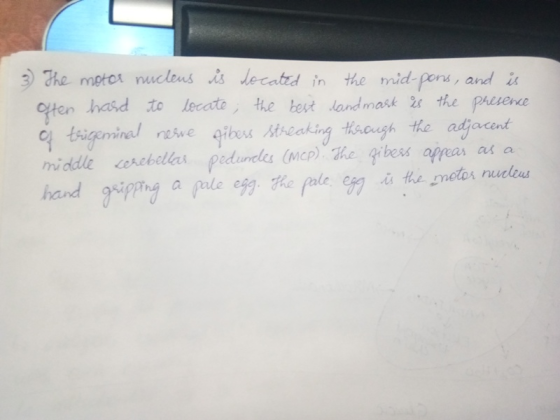
3. Be able to identify motor control nuclei in myelin-stained sections from the spinal cord and...
3. Be able to identify motor control nuclei in myelin-stained sections from the spinal cord and brainstem.
4. Describe the three major functional divisions of the cerebellum, and their general functions. What part of the cerebellar cortex is represented in each? Which deep cerebellar (or brainstem) nuclei does each division use, and which descending systems does each impinge upon?
5. Describe the intrinsic circuitry of the basal ganglia (cerebral cortex to basal ganglia to thalamus to frontal cortex), including the direct and indirect paths. How is this circuit disordered in a hypokinetic disorder, such as Parkinson’s disease, and in a hyperkinetic disorder, such as Huntington’s disease or hemiballism?
Homework Answers
3)
4)
- Functional classification: Vestibulocerebellum also called as Archicerebellum
- Anatomical parts: Flocculonodular lobe (adjacent to vermis)
- Role: It regulates the balance and eye movements. It receives vestibular input from both the semicircular canals and from the vestibular nuclei, and sends fibres back to the medial and lateral vestibular nuclei. It also receives visual input from the superior colliculi and from the visual cortex (the latter via the pontine nuclei, forming a cortico-ponto-cerebellar pathway). Lesions of the vestibulocerebellum cause disturbances of balance and gait. It has a small region, the biventer lobule.
- Functional classification: Spinocerebellum also called as Paleocerebellum
- Anatomical parts: Vermis and intermediate parts of the hemispheres ("paravermis")
- Role: It regulates the body and limb movements. It receives proprioception input from the dorsal columns of the spinal cord(including the spinocerebellar tract) and the trigeminal nerve, as well as from visual and auditory systems. It sends fibres to deep cerebellar nuclei (including the fastigial nucleus) which in turn project to both the cerebral cortex (via midbrain and thalamus) and the brain stem (via reticular formation in the pons, and vestibular nuclei in the medula), thus providing modulation of descending motor systems. It has sensory maps as it receives data on the position of various body parts in space: the vermis receives nerves from the trunk and proximal portions of limbs, while the intermediate parts of the hemispheres receive nerves from the distal portions of limbs. The spinocerebellum is able to elaborate proprioceptive input in order to anticipate the future position of a body part during the course of a movement, in a "feed forward" manner.
- Functional classification: Cerebrocerebellum also called as Neocerebellum, Pontocerebellum
- Anatomical parts: Lateral parts of the hemispheres
- Role: It is involved in planning movement and evaluating sensory information for action. It receives input exclusively from the cerebral cortex (the parietal lobe) through the pontine nuclei (in the pons, forming cortico-ponto-cerebellar pathways) and dentate nucleus (in the cerebellum), and sends fibres mainly to the ventrolateral thalamus (in turn connected to motor areas of the premotor cortex and primary motor area of the cerebral cortex) and to the red nucleus (in turn connected to the inferior olivary nucleus, which links back to the cerebellar hemispheres). It is involved in planning movement that is about to occur[4] and has purely cognitive functions as well.
5) 
Intrinsic circuit anatomy of the motor circuit. The cortical motor areas give rise to a specific motor subcircuit. Red arrows indicate inhibitory (?-aminobutyric acid [GABA]–ergic) connections; green arrows, excitatory (glutamatergic) connections. CM indicates centromedian nucleus of thalamus; CMAr, rostral portion of cingulate motor area; CMAd, dorsal portion of cingulate motor area; CMAv, ventral portion of cingulate motor area; GPe, external segment of the globus pallidus; GPi, internal segment of the globus pallidus; M1, primary motor cortex; Pf, parafascicular nucleus of the thalamus; PMd, dorsal premotor cortex; PMv, ventral premotor cortex; PPN, pedunculopontine nucleus; SMA, supplementary motor area; SNc, substantia nigra pars compacta; SNr, substantia nigra pars reticulata; STN, subthalamic nucleus; VApc, ventral anterior nucleus of thalamus pars parvocellularis; VLm, ventrolateral nucleus of thalamus pars medialis; VLo, ventrolateral nucleus of thalamus pars oralis; VLcr, ventrolateral nucleus of thalamus rostral pars caudalis; c, caudal; cl, caudolateral; and d, dorsal.
Indirect and Direct pathways:
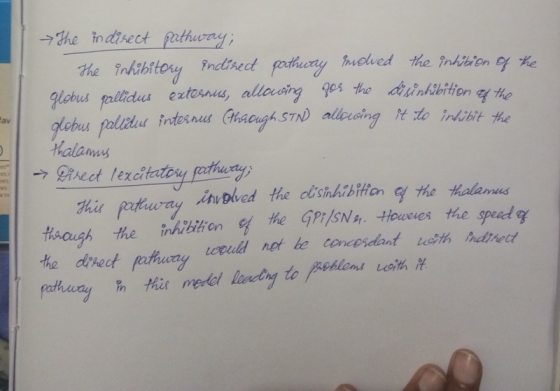
- Hypokinetic disorders - reduced motor function. This is generally attributed to higher than normal basal ganglia output causing inhibition of thalamocortical motor neurons.
- example: Parkinsonism- symptoms: muscle rigidity, tremors and slow cardinal motor movements. Parkinson's disease are attributed to a reduction in dopaminergic activity in the basal ganglia motor areas, particularly the putamen, due to gradually reduced innervation from SNc. Other motor deficits and common non-motor features of Parkinson's such as autonomic dysfunction, cognitive impairment, and gait/balance difficulties, are thought to result from widespread progressive pathological changes commencing in the lower brain stem and ascending to the midbrain, amygdala, thalamus and ultimately the cerebral cortex.
-
Hyperkinetic disorders: movement disorders - increased uncontrollable motor function. They are caused by reduced basal ganglia output, which causes increased thalamocortical function which lead to the inability to stop unwanted movement.
-
examples:
-
Huntington’s disease: is a hereditary disease that causes defects in behavior, cognition, and uncontrolled rapid, jerky movements. Huntington’s disease stems from a defect that consists of an expanded CAG repeat in a gene located on chromosome 4p. Evidence shows that the basal ganglias in patients with Huntington’s Disease show a decrease in activity of the mitochondrial pathway, complex II-III. Deficiencies cause basal ganglia degeneration.This degeneration of striatal neurons projecting to GPe leads to disinhibition of the indirect pathway, increased inhibition of STN, and therefore, reduced output of the basal ganglia.The neuronal degeneration eventually causes death within 10 to 20 years.
-
Hemiballismus - (hyperkinetic movement disorder) symptoms: uncontrolled movement on one side of the body. Causes: damage to the subthalamic nucleus (STN). Since the internal segment of the globus pallidus (GPi) is the link in the circuit between the STN and thalamic projection, destruction of localized brain cells in the GPi via a pallidotony has proven to serve as a useful treatment for Hemiballismus.
Add Answer to:
3. Be able to identify motor control nuclei in myelin-stained
sections from the spinal cord and...
Most questions answered within 3 hours.
-
Where is the error in this code sequence?
String s1 = "Hello";
String s2 = "ello";...
asked 10 months ago -
Financial data for Joel de Paris, Inc., for last year
follow:
Joel de Paris, Inc.
Balance...
asked 10 months ago -
Consider this reaction:
Al2(SO4)3 (aq)+ BaCl3
(aq) Al2Cl6 (aq)- +
3BaSO4(s) . What is the...
asked 10 months ago -
Suppose that Savneet is considering increasing her
recent random sample from 20 car rentals to 40...
asked 10 months ago -
Trucks arrive at an unloading terminal at an average rate of 120
per hour.
Trucks arrive...
asked 10 months ago -
Why are methanol and ethanol completely soluble in water while
octanol is not very little soluble....
asked 10 months ago -
A facilities manager at a university reads in a research report
that the mean amount of...
asked 10 months ago -
When the CuSO4 is rehydrated by adding water to the anhydrous
compound, is this an endothermic...
asked 10 months ago -
A ray of sunlight is passing from diamond into crown glass; the
angle of incidence is...
asked 10 months ago -
A block of mass 0.249 kg is placed on top of a light, vertical
spring of...
asked 10 months ago -
how do the kidneys compensate in the presences of acidosis
a) trigger hyperventilate
b) reserve acid...
asked 10 months ago -
Question 501 pts
The rental rate of capital to the firm increases. Which of the
following...
asked 10 months ago